
The additions surfaced on AMD’s product pages on August 9, with VideoCardz, Notebookcheck, and Tbreak each identifying the same defining omission: neither processor has a listed XDNA NPU or a stated AI-performance rating. AMD has not issued a launch announcement, named a laptop partner, provided availability dates, or disclosed pricing. At this stage, the database listings establish the SKUs and their specifications; they do not establish when consumers will be able to buy a machine using them.
The reporting correctly identifies the Ryzen 7 449 and Ryzen 5 439 as Gorgon Point designs, the same family behind AMD’s Ryzen AI 400 mobile chips. But the most consequential detail is more mundane than the headlines suggest: AMD is segmenting the same basic CPU-and-GPU platform into a non-AI Ryzen 400 tier, creating a potential lower-cost option that retains current Windows 11 compatibility while dropping the hardware requirement for Microsoft’s Copilot+ category.
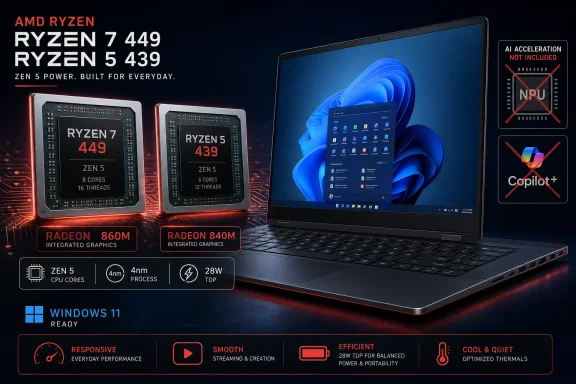 The confirmed specifications: Gorgon Point without a listed NPU
AMD’s own pages list the Ryzen 7 449 as an eight-core, 16-thread processor with four Zen 5 cores and four compact Zen 5c cores. Its performance cores can boost to 5.0 GHz, its Zen 5c cluster reaches 3.4 GHz, and it includes 16MB of L3 cache. Integrated Radeon 860M graphics provide eight RDNA 3.5 compute units at up to 2.8 GHz.
The Ryzen 5 439 uses a six-core, 12-thread configuration: three Zen 5 cores and three Zen 5c cores. It reaches up to 4.6 GHz on its Zen 5 cores and 3.3 GHz on the Zen 5c cluster, with 8MB of L3 cache. Its Radeon 840M graphics have four RDNA 3.5 compute units and the same 2.8 GHz maximum graphics frequency.
Both chips have a 28W default TDP, configurable from 15W to 54W, use TSMC’s 4nm process, and are soldered FP8 parts. AMD lists DDR5-5600 support for each. The Ryzen 7 449 supports LPDDR5X-8000, while the Ryzen 5 439 tops out at LPDDR5X-7500. They also retain USB4, PCIe 4.0, AVX-512 support, and Windows 11 support.
Those details make clear that these are not recycled older Ryzen designs wearing a newer number. They are current-generation Gorgon Point processors with the same Zen 5/Zen 5c split and RDNA 3.5 graphics technology found in AMD’s Ryzen AI 400 lineup.
What they lack is the specification block AMD normally uses to state NPU architecture, NPU TOPS, and total AI TOPS. On the Ryzen AI 400 parts, that information is central to the product pitch. On the Ryzen 7 449 and Ryzen 5 439, it is absent.
“Binned NPU” is plausible, but AMD has not confirmed it
Notebookcheck and Tbreak characterize the two processors as chips with binned-off NPUs, while VideoCardz says AMD has not explained whether the NPU is physically disabled or otherwise unavailable. The second formulation is the one the public record supports.
AMD’s pages confirm only that the Ryzen 7 449 and Ryzen 5 439 have no listed NPU capability. They do not say that an XDNA 2 block is present but fused off, defective, firmware-disabled, or omitted from the underlying silicon. All three outlets are working from the same newly published AMD specification pages, rather than a statement from AMD explaining the manufacturing or product-segmentation decision.
That distinction matters to buyers and IT departments because “no NPU specification” tells them what software capabilities they can count on; a theory about disabled silicon does not. If an OEM later publishes a system built around one of these chips, its Windows hardware identifiers and driver stack will settle whether an NPU device is exposed to the operating system. Until then, treating binned as confirmed is premature.
There is precedent for AMD shipping closely related products with key accelerator blocks disabled or absent. But precedent is not proof for these specific SKUs. AMD’s silence leaves an unusually basic product question unanswered: are these salvage parts, deliberate lower-tier configurations, or simply new branding for a different implementation of Gorgon Point?
The real Windows limitation is Copilot+, not Windows 11
Microsoft’s published Copilot+ PC requirements call for an NPU capable of more than 40 TOPS, alongside at least 16GB of RAM, 256GB of storage, and Windows 11 version 24H2 or later. The Ryzen 7 449 and Ryzen 5 439 cannot meet that requirement as currently documented because AMD lists no NPU at all.
That excludes the processors from the hardware class used for Windows experiences such as Recall, Click to Do, several Windows Studio Effects functions, local Live Captions translation, and other features Microsoft reserves for Copilot+ PCs. The distinction is important: a laptop based on either processor can still run Windows 11 normally, use Microsoft Copilot services, and run AI applications that rely on a CPU, GPU, or cloud service. It simply will not receive features tied to the Copilot+ NPU requirement.
Tbreak’s estimate that the parts offer roughly 8 to 16 total TOPS from the rest of the platform should not be used as a qualification figure. Microsoft’s threshold is explicitly an NPU threshold, not a combined CPU-and-GPU score. A GPU can run many local AI workloads, but it cannot substitute for the hardware category Windows uses to enable Copilot+ experiences.
For fleet buyers, this makes procurement simpler. A system advertised with a Ryzen 7 449 or Ryzen 5 439 should be evaluated as a conventional Windows 11 PC with modern integrated graphics—not as a discounted Ryzen AI system that happens to miss the Copilot+ badge. If a business has standardized on NPU-backed Windows features, these processors are the wrong baseline unless the OEM’s final device documentation says otherwise.
AMD has cut more than the AI label
The Ryzen 7 449 most closely resembles the Ryzen AI 7 PRO 450 in basic CPU configuration: both use four Zen 5 plus four Zen 5c cores and Radeon 860M graphics. But the new Ryzen 7 loses 100MHz from its top CPU boost clock, 200MHz from its Zen 5c maximum, and 300MHz from the maximum GPU clock. The Ryzen AI 7 PRO 450 carries an XDNA 2 NPU rated at up to 50 TOPS; AMD’s platform-level figure for that chip is up to 66 TOPS.
The Ryzen 5 439 is a sharper cut beside the Ryzen AI 5 PRO 440. Both use the same three-Zen-5 plus three-Zen-5c CPU layout and Radeon 840M graphics, but the Ryzen 5 439 drops from 4.8 GHz to 4.6 GHz on the main cores, from 3.5 GHz to 3.3 GHz on the Zen 5c cores, from 2.9 GHz to 2.8 GHz on graphics, and from 16MB to 8MB of L3 cache. Again, the Ryzen AI PRO counterpart includes a 50-TOPS XDNA 2 NPU that the 439 does not list.
So the expected savings, if they materialize in retail systems, will not come solely from AMD deleting AI acceleration. These are lower-clocked configurations, and the Ryzen 5 439 has half the L3 cache of its nearest Ryzen AI PRO comparison. Buyers should not assume a Ryzen 5 439 laptop will deliver essentially Ryzen AI 5 PRO 440 performance at a lower price until independent benchmark data exists.
No benchmark results for the two new processors have been published, and neither AMD nor an OEM has supplied power-limit configurations. Since laptop makers can set these chips anywhere from 15W to 54W, chassis cooling and firmware policy will have at least as much influence on sustained performance as the small differences in AMD’s headline clocks.
AMD’s product database exposes a naming problem
AMD places both chips in the “Ryzen 400 Series,” leaving off the word “AI” used across the broader Gorgon Point mobile family. The company’s own product pages also list the form factor as “Laptops, Desktops,” despite FP8 being the mobile-package designation and no desktop platforms having been announced.
Notebookcheck further spotted a product-finder page that grouped the new parts under Ryzen 400 while retaining a “Ryzen 6000 Series Processors” header. That appears to be a website labeling error, not evidence of a mysterious new Ryzen 6000 generation. It does, however, show that AMD’s public materials were not polished before the SKUs appeared.
The practical risk is familiar: consumers will see a “Ryzen 7” label, eight cores, Radeon 860M graphics, and a 2026-series number, then assume the machine has the AI hardware found in a Ryzen AI 7 450 or Ryzen AI 7 PRO 450 system. It does not, based on AMD’s published specifications. OEMs will need to make that distinction visible in product listings rather than relying on shoppers to decode AMD’s increasingly crowded mobile nomenclature.
AMD’s next move should be a formal product brief that identifies the intended OEM tier, confirms whether the NPU is physically unavailable or merely disabled, and states the expected availability of the first systems. Until that happens, the Ryzen 7 449 and Ryzen 5 439 are best understood as non-Copilot+ Gorgon Point parts: modern Windows 11 laptop processors whose value proposition will depend entirely on how much less their first systems cost than NPU-equipped Ryzen AI alternatives.
References
- Primary source: tbreak.com
Published: August 10, 2026 at 9:12 AM UTC
Loading…
tbreak.com - Independent coverage: videocardz.com
Published: August 9, 2026 at 6:31 PM UTC
Loading…
videocardz.com - Independent coverage: Notebookcheck
Published: August 9, 2026 at 3:40 PM UTC
Loading…
www.notebookcheck.net - Related coverage: amd.com
Loading…
www.amd.com - Related coverage: ultrabookreview.com
Loading…
www.ultrabookreview.com - Related coverage: amd.com
Loading…
www.amd.com - Related coverage: docs.amd.com
Loading…
docs.amd.com - Related coverage: notebookcheck.com
Loading…
www.notebookcheck.com - Related coverage: en.wikichip.org
Loading…
en.wikichip.org - Related coverage: ir.amd.com
AMD Gives Consumers and Businesses More AI PC Options with Expanded Ryzen™ AI 400 Series Portfolio :: Advanced Micro Devices, Inc. (AMD)
News Summary AMD expands its Ryzen AI portfolio with new Ryzen AI 400 Series and Ryzen AI PRO 400 Series desktop processors, the world’s first…...ir.amd.com - Related coverage: tomshardware.com
AMD's Ryzen AI 400 series includes the first Copilot+ desktop CPU — Team Red refreshes Zen 5 APUs and Strix Halo | Tom's Hardware
Still Zen 5, still Ryzen AI – Gorgon Point is a clock speed bumpwww.tomshardware.com - Related coverage: computerbase.de
Loading…
www.computerbase.de - Related coverage: ir.amd.com
Loading…
ir.amd.com - Related coverage: tomsguide.com
AMD Ryzen AI 400 Series might finally make charging anxiety a thing of the past — 1.7x higher unplugged performance and big multitasking upgrades | Tom's Guide
AMD is back and the rumors are true — Ryzen AI 400 Series chips (codenamed “Gorgon Point”) have just been made official at CES 2026. Here’s everything you need to know about the new silicon from Team Red.www.tomsguide.com - Related coverage: tomshardware.com
Loading…
www.tomshardware.com - Related coverage: learn.microsoft.com
Copilot + pc? - Microsoft Q&A
Hi, I bought a Huawei Matebook 14 2024 ultra 7 3 months ago, I think ally eh specs meet the criteria of the copilot+ pc, so should it be equipped with features of copilot+ pc or not? Thank you! Learnmore_smartlearn.microsoft.com - Related coverage: support.microsoft.com
Learn more about Copilot+ PCs and Windows 11 PCs from Surface | Microsoft Support
Learn more about Copilot + PCs with powerful neural processing units and AI experiences like Recall and Cocreator, as well as Windows 11 PCs from Surface.support.microsoft.com - Related coverage: learn.microsoft.com
Loading…
learn.microsoft.com