
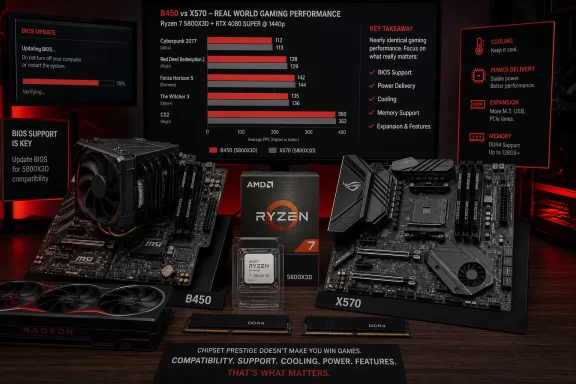
The important finding is real: chipset prestige is largely irrelevant to frame rates with this particular processor. TechSpot’s AM4 scaling work found little practical performance separation between tested B350, B450, X370 and X570 boards when the Ryzen 7 5800X3D was paired with equivalent memory and a high-end GPU. In one Photoshop test, the X570 boards were only about 1% ahead. Its newer 10th Anniversary Edition review also confirms that the chip remains a potent upgrade over older AM4 CPUs.
But the broader claim published by Shane the Gamer needs tightening. The motherboard may not change the 5800X3D’s benchmark result very much, yet the specific board model, its BIOS support, its power delivery, storage connectivity and expansion requirements can still decide whether this is a sensible upgrade.
AMD brought the 5800X3D back to retail on June 25, 2026, at a suggested price of $349, bundling the processor with a Carbice Ice Pad thermal interface material. The boxed part is 100-100000651POF. It is still an eight-core, 16-thread Zen 3 processor with a 3.4GHz base clock, boost speeds up to 4.5GHz, 96MB of L3 cache and a 105W TDP. For an existing AM4 owner coming from a Ryzen 5 3600, Ryzen 7 3700X, or even a Ryzen 5 5600X, those specifications can translate into a substantial improvement in CPU-limited games and, often more importantly, 1% low frame rates.
The board underneath it is usually not where that improvement is won or lost.
 The chipset result is believable, but it is not new
A Ryzen 7 5800X3D does most of its gaming work on the CPU package. Its defining feature is the extra 3D V-Cache, which reduces the frequency with which a game has to reach out to comparatively slower system memory. Changing from B450 to X570 does not give the processor more cores, higher official boost clocks, more cache, or a wider DDR4 memory interface.
That is why TechSpot’s older test results remain useful context for the re-release. Its testing compared multiple generations of AM4 boards using the same Ryzen 7 5800X3D, DDR4-3200 memory, and Radeon RX 6900 XT graphics. In normal CPU and game tests, the tested boards generally clustered tightly. There were occasional outliers, including a Gigabyte X370 board that lagged in one Factorio result, but the result was not a broad chipset-generation advantage for X570.
This is also why the B550-versus-X570 comparison cited in the submitted report is less revealing than it sounds. Those two chipsets were already aimed at the same Zen 3-era processors. For an owner running one graphics card, a reasonable memory configuration, and one or two drives, buying an X570 board merely to install a 5800X3D is unlikely to create a visible gaming return.
The useful conclusion is narrower and more practical: do not replace a functioning AM4 motherboard solely to chase higher 5800X3D frame rates. Put that money toward the processor, a capable cooler if one is needed, storage, or a graphics upgrade.
AMD’s official support list starts at A520, B450 and X470
There is an important difference between tested compatibility and officially listed compatibility. AMD’s current product page lists X570, X470, B550, B450 and A520 as supporting chipsets for the Ryzen 7 5800X3D. It does not list 300-series boards, despite TechSpot showing that several B350 and X370 models could run the chip with later firmware.
That distinction matters for anyone holding a first-generation AM4 board. A manufacturer may have released a BIOS that supports the 5800X3D; it may also have provided only a beta BIOS, limited support to particular revisions, or omitted the CPU altogether. A working result on an MSI B350 Tomahawk or Asus X370 board does not establish support for an arbitrary 2017 board from a different vendor.
Before ordering the Anniversary Edition, AM4 owners should treat the motherboard vendor’s CPU-support page as the final authority. The board name printed on the PCB matters, but so does the exact hardware revision. A BIOS intended for one revision can be incompatible with another that shares nearly the same retail name.
The basic procedure is straightforward, but it should be done before removing the existing CPU:
- Confirm that the motherboard’s CPU-support list explicitly names the Ryzen 7 5800X3D or the 100-100000651POF Anniversary Edition SKU.
- Install the required BIOS while the old, working processor is still fitted, unless the board has a verified CPU-less flashback feature.
- Reset unstable memory or CPU overclocks before the swap, then load default firmware settings after installation and re-enable only stable memory profiles.
- Check cooler mounting pressure and thermal behavior after the first boot, because the supplied Carbice pad is thermal interface material, not a replacement for a CPU cooler.
The 5800X3D has a 90°C maximum operating temperature and does not include a stock thermal solution. AMD recommends liquid cooling for optimal performance, though a good air cooler is commonly sufficient in a case with competent airflow. What should not be assumed is that an old cooler, a dried thermal paste application, and a neglected case will all remain adequate simply because the motherboard is.
X570 still has a purpose — just not as a frame-rate upgrade
The original report’s strongest point is that a budget B450 board can keep pace in CPU performance. Its weakest implication is that motherboard choice no longer matters at all.
X570 offers more chipset-provided PCIe 4.0 connectivity than older AM4 chipsets. AMD’s own specifications show the 5800X3D supplies PCIe 4.0 from the CPU, while platform-level expansion varies by chipset. X570 also brings more flexible high-speed I/O for users with multiple NVMe drives, fast external storage, capture hardware, additional expansion cards, or a need for more bandwidth behind the chipset.
Those are system-design differences, not CPU benchmark differences. A gamer with a single graphics card and one NVMe SSD may never notice them. A workstation that needs several PCIe 4.0 drives, 10GbE networking, a capture card and plentiful USB may care a great deal.
The same caution applies to B450 power delivery. A solid B450 board such as an MSI Tomahawk-class model is a different proposition from the cheapest 2019 microATX board with minimal heatsinking. The 5800X3D is not an extreme 16-core workstation processor, but it is still a 105W part. A board that technically boots it may deliver poorer sustained behavior in a warm case or have little margin for a heavy all-core workload.
For gaming-only use, this often remains a secondary concern. For video rendering, compiling large codebases, or long-running compute work, it is worth checking independent board reviews and monitoring clocks and temperatures rather than assuming the chipset label tells the whole story.
The re-release is less identical than the specification sheet suggests
AMD is selling the Anniversary Edition with the same published core count, cache capacity, clock speeds and TDP as the 2022 processor. That supports treating existing 5800X3D game benchmarks as relevant to prospective buyers.
However, describing it as merely old silicon in commemorative packaging leaves out a significant manufacturing detail. Tom’s Hardware reported in June that AMD had to re-qualify and re-engineer the stacked-cache assembly because the original TSMC bonding process was no longer available. AMD’s David McAfee said the company had to migrate the design to a newer stacking process, build samples and validate reliability before returning the part to production.
That does not mean buyers should expect a performance uplift over the original 5800X3D. AMD has not announced changed clocks or a revised cache configuration, and reviewers have treated the processor as performance-equivalent. It does mean the anniversary model is a renewed production effort, rather than a warehouse clearance exercise.
It also explains why $349 is not the effortless bargain the headline suggests. TechSpot notes that the original 5800X3D occasionally sold for under $300 before it disappeared, while Tom’s Hardware puts the re-release in direct competition with newer CPUs. The price is justified most easily when it replaces only a CPU. It is much harder to defend when the buyer must also purchase a motherboard, DDR4 kit, cooler and storage.
The real target is the AM4 owner who missed the first run
TechSpot’s 13-game average found the 5800X3D roughly 53% to 61% faster than a Ryzen 7 3800X or Ryzen 5 5500, depending on test settings, and 31% to 34% faster than a Ryzen 5 5600X. The exact gain will depend on the game, graphics card, resolution and quality settings, but those figures explain why AMD revived a four-year-old processor.
For a user already holding a compatible B450, B550, X470, X570 or A520 board and usable DDR4 memory, the Anniversary Edition can preserve an otherwise serviceable Windows 11 gaming PC for another upgrade cycle. The board does not need an X570 badge to make that work.
For a new build, the logic changes. The Ryzen 5 7600X3D costs less, performs better in many current comparisons, and opens the AM5 upgrade path. DDR5 pricing has distorted the calculation, as Tom’s Hardware and TechSpot both note, but it has not made a $349 Zen 3 CPU automatically superior to a modern platform purchase.
The 5800X3D Anniversary Edition is best understood as a targeted rescue part: buy it to extend a known-good AM4 machine after checking the BIOS and cooling, not as an excuse to assemble a fresh AM4 system around an old chipset.