
The important qualification behind the anniversary branding is easy to miss: AMD says the part retains the familiar eight Zen 3 cores, 16 threads, 3.4 GHz base clock, 4.5 GHz maximum boost clock, 105 W TDP, PCIe 4.0 support, and 96 MB of L3 cache. Yet this is not literally old stock with a commemorative box. Reporting by Tom’s Hardware, based on comments from AMD’s David McAfee, says the original first-generation TSMC bonding process used to stack the cache die was no longer available. AMD had to re-engineer the package around a newer stacking process before it could make more chips.
That distinction explains two seemingly conflicting facts: the 10th Anniversary Edition performs like the original 5800X3D, while AMD could not simply restart the 2022 production line. TechSpot compared original and anniversary samples and found only normal chip-to-chip variation, including temperature differences of roughly 1–2°C. For buyers, this is the practical outcome that counts: treat it as a 5800X3D with renewed availability, not as a faster revision.
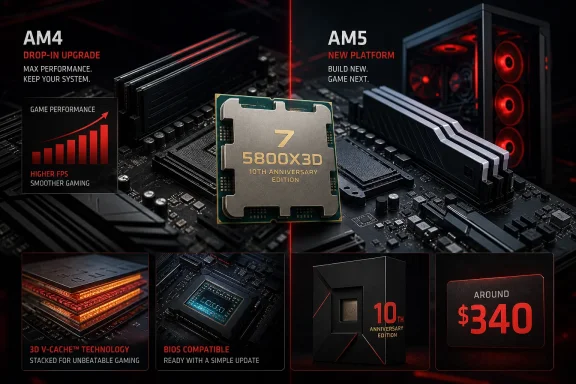 The AM4 upgrade calculation is unusually simple
For a gamer on a Ryzen 5 3600, Ryzen 7 3700X, Ryzen 7 3800X, or even a Ryzen 5 5600X system, the 5800X3D remains the final serious CPU upgrade for AM4. It preserves the existing motherboard, DDR4 kit, Windows installation, cooler mounting hardware, and—assuming the board vendor provides a suitable firmware update—most of the rest of the system. That removes the hidden costs and reconfiguration work behind an AM5 migration.
Independent testing supports the upgrade case. TechSpot’s 13-game average placed the anniversary processor broadly level with the Ryzen 5 9600X and only 4–5% behind Intel’s Core Ultra 5 250K Plus in its tested gaming workload. More relevant to owners of older AM4 hardware, it reported a 53–61% average uplift over the Ryzen 7 3800X and Ryzen 5 5500, plus a 31–34% lead over the Ryzen 5 5600X.
Those averages conceal why X3D chips earned their reputation. Some games respond dramatically to the 96 MB L3 cache, which reduces trips out to comparatively slow main memory. TechSpot measured the 5800X3D 93% ahead of the Ryzen 7 3800X in Assetto Corsa Competizione, 103% ahead in Baldur’s Gate 3, and 72% ahead in ARC Raiders under its CPU-limited settings. These results are not a promise of similar gains in every game, but they show why a four-year-old Zen 3 design can still compete with substantially newer midrange CPUs.
The cash comparison is even clearer. A $349 processor installed in an existing AM4 PC is a $349 upgrade. A move to AM5 means a new CPU, motherboard, and DDR5 memory, and possibly a Windows reactivation or a clean installation depending on how the system is licensed and maintained. For users trying to extend a stable Windows 11 gaming PC for another generation, the 5800X3D buys high-end frame pacing without turning the job into a platform rebuild.
It is a poor foundation for a new PC
The same processor becomes much harder to recommend once a buyer must also purchase an AM4 board and DDR4 memory. AM4’s long run is a virtue for owners, but a constraint for newcomers: the 5800X3D is the platform’s endpoint. There is no later Zen generation to install after it, no DDR5 support, and no PCIe 5.0 support.
AMD itself made the contrast unusually explicit at Computex in May. Alongside the 5800X3D relaunch, it announced the Ryzen 7 7700X3D for AM5 and extended AM5 support through 2029. The company is selling the old socket as a way to extend an existing machine; it is making the newer socket the place for future upgrades. Buyers should take AMD at its word on both points.
Tom’s Hardware reaches the same practical conclusion in its re-review: the 5800X3D is the best gaming upgrade for people who already possess AM4 and DDR4, but it is expensive compared with modern alternatives when building from scratch. Its testing also found that the old Zen 3 chip falls well behind newer options in productivity work, where newer architectures and higher core-count Intel parts can offer much stronger throughput.
There is a further complication in the current market. DDR5 pricing has risen sharply, helping make an AM4 drop-in upgrade attractive again, but a temporary memory-price problem should not be mistaken for a platform roadmap. A new builder can save money today with AM4, then find that the next meaningful CPU upgrade requires replacing the board and RAM anyway. An existing AM4 owner avoids that purchase today because those components are already sunk costs.
“Compatible AM4” requires a BIOS check
TechPowerUp correctly frames the 5800X3D as a broad AM4 upgrade, but “drops into any Socket AM4 motherboard with a BIOS update” needs one operational asterisk: support is determined by the motherboard maker’s CPU support list, its required BIOS version, and sometimes the specific board revision. Socket fit alone is not a compatibility guarantee.
There is solid evidence that older boards can make the jump. ASRock, for example, lists Ryzen 7 5800X3D support for selected X370, B350, and A320 models after a BIOS update. ASUS issued firmware based on AMD AGESA 1.2.0.6b for its supported boards when the original 5800X3D launched. But users should not generalize that into universal support across every 300-series board from every manufacturer.
Before ordering, check the exact motherboard model and PCB revision against the vendor’s CPU support page, then note the minimum BIOS version. Update the firmware while the old, known-good CPU is still installed unless the board has a validated USB BIOS Flashback feature. Reset memory overclocks after the update, load optimized defaults, and confirm that Resizable BAR, TPM settings, boot order, BitLocker recovery information, and Windows 11 Secure Boot configuration remain in the expected state.
The 5800X3D also does not include a bundled air cooler. AMD’s Carbice Ice Pad is a thermal-interface material, not a cooling solution. The existing cooler must be adequate for a 105 W processor with a cache die stacked over the compute die, a configuration that limits heat transfer compared with a conventional chip. A competent dual-tower air cooler or a properly functioning liquid cooler is the sensible baseline.
The Carbice pad is an accessory, not a reason to buy
Every retail 10th Anniversary Edition includes Carbice’s Ice Pad, a dry carbon-nanotube thermal interface intended to replace thermal paste. AMD presents it as a cleaner, longer-lasting option, and the inclusion is the package’s one conspicuous difference from the ordinary retail processor.
That does not establish a universal thermal advantage over quality paste. The available independent evidence is stronger on the processor’s comparable behavior than on an across-the-board win for the pad. TechSpot found the anniversary chip thermally indistinguishable from the original within normal sample variation, but that is not the same as a head-to-head verdict that the supplied pad beats conventional paste on every cooler and mounting pressure.
Users should follow the pad’s installation guidance precisely and avoid treating early temperature anecdotes as proof of a defective processor. The 5800X3D has always been a relatively warm-running chip under all-core work because of its stacked-cache layout. If temperatures are unexpectedly high, first verify cooler contact, mounting pressure, fan and pump curves, case airflow, BIOS settings, and whether the protective layers on the thermal pad were removed. The pad is a welcome extra, but it should not be the deciding factor in a $349 CPU purchase.
The price is the story, but availability decides the outcome
AMD’s suggested price is $349, while current retail listings around $339.95 show that the street price can fall slightly below that figure. The supplied TechPowerUp review’s $340 figure is therefore credible as a retail observation, but prospective buyers should not confuse it with AMD’s official launch price. Availability has also been inconsistent: Tom’s Hardware reported brief stock shortages and resale attempts far above MSRP shortly after the June launch.
Do not pay a collector premium for anniversary packaging. This is a limited re-release of a proven gaming CPU, but the underlying proposition collapses if a retailer or reseller pushes it into $450 territory. At that point, the buyer should price a complete AM5 package rather than nostalgia-shop for the final AM4 flagship.
For an AM4 owner with a supported board, DDR4 already installed, a capable cooler, and a CPU bottleneck in modern games, the Ryzen 7 5800X3D 10th Anniversary Edition remains a direct, defensible purchase at approximately $340–$349. For everyone else, it is a well-preserved exit ramp from an old platform—not a compelling entrance to one.