
A 110cm-tall, 3D-printed chimney mounted above a fanless 240mm radiator dropped a Ryzen 7 9800X3D’s reported CPU temperature from 90°C to 71°C in overclocker Roman “der8auer” Hartung’s test bench—a 19°C reduction without radiator fans. The result is real enough to be visible in the accompanying airflow demonstration, but it is a proof of natural-draft cooling on an open bench, not a new way to cool a desktop PC inside a conventional case.
Der8auer’s video, independently summarized by Tom’s Hardware, uses modular printed duct sections above the radiator to exploit the stack, or chimney, effect. Hotter air within a vertical duct becomes less dense than the surrounding air, creating a pressure differential that pulls cooler room air upward through the radiator and vents the warmed air at the top. A fog-machine demonstration showed air entering below the radiator and travelling up the final tower even without mechanical airflow.
The experiment’s biggest finding is less exotic than the hardware makes it appear: at enough height, passive convection can create useful airflow through a restrictive PC radiator. Its biggest limitation is equally clear. The final duct stands roughly 43 inches above the radiator alone, before accounting for the bench, tubing, motherboard, and clearance around the exhaust.
The progression reported by Tom’s Hardware is important. A short 10cm duct reduced temperatures by only about 0.5°C. Extending the assembly to 30cm lowered the coolant temperature further over roughly 30 minutes of stabilization. The dramatic result arrived only when der8auer added an 80cm section to reach a total chimney height of 110cm.
That scale is the point of the experiment. Stack-driven airflow depends on both the temperature difference and the height between intake and exhaust. Natural-ventilation guidance from the World Health Organization and Canada’s National Research Council describes the same principle in buildings: warmer, lighter air rises, and the available pressure difference grows with stack height and temperature differential.
A 110cm plastic duct is therefore doing the job normally handled by a pair of 120mm fans: establishing a pressure difference across the radiator so room air crosses its fins rather than lingering around them. PC fans simply do it in a few centimeters, at a controlled speed, and in a form factor that fits behind a front panel or under a top filter.
Der8auer’s fog test makes the airflow visible, but it should not be mistaken for a standardized airflow or thermal-performance measurement. The public reporting documents the chimney height, the 90°C-to-71°C CPU reading, and the fanless 240mm loop; it does not establish a full comparison matrix of ambient temperature, exact coolant flow, sustained package power, fan curves, radiator fin density, noise, or performance against a conventional fan-equipped radiator under otherwise identical conditions.
That absence does not invalidate the result. It defines it correctly: an effective demonstration of passive draft in one test bench, rather than evidence that a tall duct is a practical replacement for fans across desktop systems.
That layout change was specifically designed to improve thermal access for the CPU cores and enabled AMD to restore overclocking support on the 9800X3D. Gamers Nexus, which examined the package changes at launch, reported that the cache’s relocation beneath the core complex creates a more direct path toward the heat spreader and removes prior insulating elements used in the older stack.
So the chimney test does not demonstrate that the 9800X3D’s V-Cache acts as a thermal blanket. It demonstrates that a 120W-class processor can hit high reported temperatures when its water-cooling loop has a 240mm radiator with no active airflow, then benefit enormously once the radiator is given a strong enough passive exhaust path.
AMD itself rates the Ryzen 7 9800X3D at a 120W default TDP, specifies a 95°C maximum operating temperature, and recommends liquid cooling for optimal performance. A reported 90°C CPU temperature in a fanless radiator configuration is therefore a stress point near the processor’s thermal ceiling, not evidence of a defect in the chip or its cache packaging.
There is another reason to be cautious when comparing single temperature figures. Gamers Nexus found that AMD had changed internal sensor placement across these architectures and warned that direct thermal comparisons with the previous 7800X3D using software sensor readings alone can be misleading. That does not undermine der8auer’s before-and-after reading within the same experiment, but it does make broader claims about X3D thermals much harder to support.
The rising duct prevented much of the warmed air from pooling around the radiator and encouraged replacement air to enter from below. Put another way, it improved the radiator’s heat exchange by forcing a more useful path for room air. The CPU temperature fell because the coolant temperature and radiator operating conditions improved.
This distinction matters for anyone considering a smaller version. A short shroud or top-mounted exhaust duct may reduce recirculation in a case, particularly in cramped small-form-factor builds or cabinetry with poor clearance. But it will not replicate the pressure differential created by a one-meter chimney. The test’s first 10cm section provided a useful reality check: the benefit was measurable, yet tiny.
It also explains why adding normal fans would almost certainly overwhelm the effect. A 120mm radiator fan can develop static pressure and move air through fins far more reliably than a passive thermal draft, including when the room is warm or the system’s heat load changes quickly. Der8auer’s experiment is compelling precisely because it achieves useful cooling without those fans—not because it reveals a superior approach for an ordinary gaming rig.
There are more subtle issues. Plastic duct sections may be suitable for a controlled experiment, but a permanent build needs secure mounting, resistance to warping near warm exhaust air, protection against accidental impacts, and a plan for dust. A tall vertical column also introduces leverage on the radiator mounting point; that is manageable on a bench but unwelcome atop a PC case or external radiator frame.
The method remains sensitive to the environment. Stack effect gets stronger with a larger temperature difference between the air in the duct and the room. A cooler radiator, a hot room, blocked exhaust, or airflow from an HVAC vent can all change the draft. Mechanical fans are used in PCs because they offer predictable airflow despite those variables.
There is a viable niche here, though it is much narrower than “fanless gaming PC.” A custom external radiator installation with a dedicated vertical exhaust route—perhaps integrated into furniture or a workshop test station—could use the same physics to reduce fan speed and noise. That would demand proper thermal testing, a safe structure, and likely some active airflow for peak loads. Der8auer has shown the mechanism can work; he has not released a consumer-ready cooling design, printed-part files, pricing, or a compatibility plan for cases.
A fanless radiator is a deliberately difficult starting point. A pair of functioning fans, a less restrictive case exhaust path, or a larger radiator will nearly always deliver the practical part of this experiment in a fraction of the volume. Users seeking lower noise should start by tuning fan curves and eliminating hot-air recirculation, then consider a larger heat exchanger or slower, larger fans.
The 110cm chimney’s achievement is that it turns a 240mm radiator into a genuinely draft-driven passive cooler at around a 100W-class CPU load. Its consequence for desktop builders is simpler: airflow path and heat-exchanger conditions can matter as much as the cooler’s headline size—but the sensible answer remains a well-placed fan, not a ceiling-height plastic tower.
The experiment’s biggest finding is less exotic than the hardware makes it appear: at enough height, passive convection can create useful airflow through a restrictive PC radiator. Its biggest limitation is equally clear. The final duct stands roughly 43 inches above the radiator alone, before accounting for the bench, tubing, motherboard, and clearance around the exhaust.
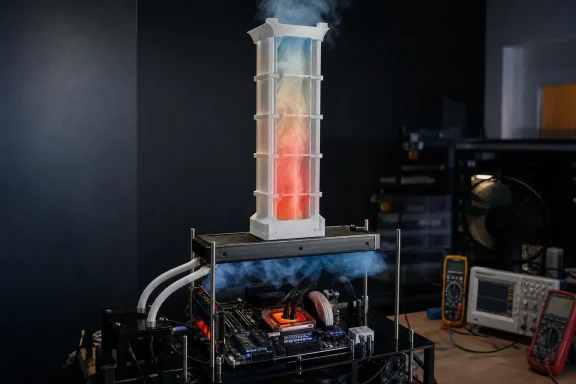 The temperature drop arrived only after the chimney became absurdly tall
The progression reported by Tom’s Hardware is important. A short 10cm duct reduced temperatures by only about 0.5°C. Extending the assembly to 30cm lowered the coolant temperature further over roughly 30 minutes of stabilization. The dramatic result arrived only when der8auer added an 80cm section to reach a total chimney height of 110cm.That scale is the point of the experiment. Stack-driven airflow depends on both the temperature difference and the height between intake and exhaust. Natural-ventilation guidance from the World Health Organization and Canada’s National Research Council describes the same principle in buildings: warmer, lighter air rises, and the available pressure difference grows with stack height and temperature differential.
A 110cm plastic duct is therefore doing the job normally handled by a pair of 120mm fans: establishing a pressure difference across the radiator so room air crosses its fins rather than lingering around them. PC fans simply do it in a few centimeters, at a controlled speed, and in a form factor that fits behind a front panel or under a top filter.
Der8auer’s fog test makes the airflow visible, but it should not be mistaken for a standardized airflow or thermal-performance measurement. The public reporting documents the chimney height, the 90°C-to-71°C CPU reading, and the fanless 240mm loop; it does not establish a full comparison matrix of ambient temperature, exact coolant flow, sustained package power, fan curves, radiator fin density, noise, or performance against a conventional fan-equipped radiator under otherwise identical conditions.
That absence does not invalidate the result. It defines it correctly: an effective demonstration of passive draft in one test bench, rather than evidence that a tall duct is a practical replacement for fans across desktop systems.
The 9800X3D’s 3D V-Cache is not the “thermal blanket” it used to be
One popular explanation attached to this story needs correcting. Earlier AMD X3D processors placed the added V-Cache layer above the core complex die, which complicated the path from the active CPU cores to the integrated heat spreader. The Ryzen 7 9800X3D uses AMD’s second-generation 3D V-Cache packaging, where the cache sits beneath the Zen 5 core complex instead.That layout change was specifically designed to improve thermal access for the CPU cores and enabled AMD to restore overclocking support on the 9800X3D. Gamers Nexus, which examined the package changes at launch, reported that the cache’s relocation beneath the core complex creates a more direct path toward the heat spreader and removes prior insulating elements used in the older stack.
So the chimney test does not demonstrate that the 9800X3D’s V-Cache acts as a thermal blanket. It demonstrates that a 120W-class processor can hit high reported temperatures when its water-cooling loop has a 240mm radiator with no active airflow, then benefit enormously once the radiator is given a strong enough passive exhaust path.
AMD itself rates the Ryzen 7 9800X3D at a 120W default TDP, specifies a 95°C maximum operating temperature, and recommends liquid cooling for optimal performance. A reported 90°C CPU temperature in a fanless radiator configuration is therefore a stress point near the processor’s thermal ceiling, not evidence of a defect in the chip or its cache packaging.
There is another reason to be cautious when comparing single temperature figures. Gamers Nexus found that AMD had changed internal sensor placement across these architectures and warned that direct thermal comparisons with the previous 7800X3D using software sensor readings alone can be misleading. That does not undermine der8auer’s before-and-after reading within the same experiment, but it does make broader claims about X3D thermals much harder to support.
The radiator, not the CPU cooler block, is where this experiment succeeds
The water block on the CPU was not transformed by plastic ducting. The experiment changed how the loop rejected heat into the room. With no fans attached to the 240mm radiator, heat moved from the CPU into coolant and then into a radiator whose surrounding air was initially moving mostly through weak local convection.The rising duct prevented much of the warmed air from pooling around the radiator and encouraged replacement air to enter from below. Put another way, it improved the radiator’s heat exchange by forcing a more useful path for room air. The CPU temperature fell because the coolant temperature and radiator operating conditions improved.
This distinction matters for anyone considering a smaller version. A short shroud or top-mounted exhaust duct may reduce recirculation in a case, particularly in cramped small-form-factor builds or cabinetry with poor clearance. But it will not replicate the pressure differential created by a one-meter chimney. The test’s first 10cm section provided a useful reality check: the benefit was measurable, yet tiny.
It also explains why adding normal fans would almost certainly overwhelm the effect. A 120mm radiator fan can develop static pressure and move air through fins far more reliably than a passive thermal draft, including when the room is warm or the system’s heat load changes quickly. Der8auer’s experiment is compelling precisely because it achieves useful cooling without those fans—not because it reveals a superior approach for an ordinary gaming rig.
A conventional chassis cannot house this design, and that is not the only constraint
The obvious practical barrier is height. A 110cm chimney would tower over nearly every tower case, test bench, desk enclosure, or rack shelf. It would also require an open, unobstructed path at the top, where it releases heat into the room.There are more subtle issues. Plastic duct sections may be suitable for a controlled experiment, but a permanent build needs secure mounting, resistance to warping near warm exhaust air, protection against accidental impacts, and a plan for dust. A tall vertical column also introduces leverage on the radiator mounting point; that is manageable on a bench but unwelcome atop a PC case or external radiator frame.
The method remains sensitive to the environment. Stack effect gets stronger with a larger temperature difference between the air in the duct and the room. A cooler radiator, a hot room, blocked exhaust, or airflow from an HVAC vent can all change the draft. Mechanical fans are used in PCs because they offer predictable airflow despite those variables.
There is a viable niche here, though it is much narrower than “fanless gaming PC.” A custom external radiator installation with a dedicated vertical exhaust route—perhaps integrated into furniture or a workshop test station—could use the same physics to reduce fan speed and noise. That would demand proper thermal testing, a safe structure, and likely some active airflow for peak loads. Der8auer has shown the mechanism can work; he has not released a consumer-ready cooling design, printed-part files, pricing, or a compatibility plan for cases.
What 9800X3D owners should take from the experiment
For Ryzen 7 9800X3D owners, the useful lesson is to diagnose airflow before buying exotic cooling hardware. AMD’s 95°C Tjmax means occasional high readings under demanding all-core workloads do not automatically indicate an unsafe processor. But a system that remains at the thermal limit while using a properly mounted, actively cooled liquid loop deserves routine troubleshooting: verify pump operation, radiator fan orientation and curves, cooler mounting pressure, thermal paste application, case intake and exhaust balance, dust buildup, and motherboard power settings.A fanless radiator is a deliberately difficult starting point. A pair of functioning fans, a less restrictive case exhaust path, or a larger radiator will nearly always deliver the practical part of this experiment in a fraction of the volume. Users seeking lower noise should start by tuning fan curves and eliminating hot-air recirculation, then consider a larger heat exchanger or slower, larger fans.
The 110cm chimney’s achievement is that it turns a 240mm radiator into a genuinely draft-driven passive cooler at around a 100W-class CPU load. Its consequence for desktop builders is simpler: airflow path and heat-exchanger conditions can matter as much as the cooler’s headline size—but the sensible answer remains a well-placed fan, not a ceiling-height plastic tower.
References
- Primary source: Wccftech
Published: 2026-08-01T19:22:14+00:00
Loading…
wccftech.com - Related coverage: tomshardware.com
Loading…
www.tomshardware.com - Related coverage: tomshardware.com
Loading…
www.tomshardware.com - Related coverage: pcgamesn.com
Loading…
www.pcgamesn.com - Related coverage: hwupgrade.it
Loading…
www.hwupgrade.it - Related coverage: dgl.ru
Loading…
www.dgl.ru - Related coverage: arstechnica.com
Loading…
arstechnica.com - Related coverage: hd-tecnologia.com
Loading…
www.hd-tecnologia.com - Related coverage: elchapuzasinformatico.com
Loading…
elchapuzasinformatico.com - Related coverage: gamersnexus.net
Loading…
gamersnexus.net - Related coverage: 3dnews.ru
Loading…
3dnews.ru - Related coverage: pugetsystems.com
Loading…
www.pugetsystems.com - Related coverage: amd.com
AMD Ryzen™ 7 9800X3D Desktop Processor
Harness the ultimate gaming edge with AMD Ryzen™ 7 9800X3D Processor. Enjoy faster gaming with 2nd gen AMD 3D V-Cache™ technology for low latency.www.amd.com - Related coverage: ir.amd.com
Loading…
ir.amd.com