
A PassMark result labeled “AMD Ryzen 9 3950H Edition” is almost certainly not evidence of a newly discovered Ryzen 9 mobile chip. The entry, first reported by VideoCardz on August 3, instead carries the core count, cache layout, clock behavior, and integrated graphics profile of AMD’s 2020 Ryzen 5 4500U — a six-core Renoir laptop APU that was sold as a 15 W part.
AMD has not announced a Ryzen 9 3950H Edition, and the name does not appear in its public Ryzen mobile product catalog or in the company’s Ryzen 4000-series launch material. More importantly, the reported hardware characteristics make the “Ryzen 9” label implausible before the benchmark score is even considered. AMD’s own Ryzen 4000 specifications list the Ryzen 5 4500U as a 6-core, 6-thread processor with a 2.3 GHz base clock, six Radeon graphics compute units, 3 MB of L2 cache, and 8 MB of L3 cache.
Those are the same numbers VideoCardz says appeared under the mysterious PassMark name: six cores, six threads, 3 MB of L2, 8 MB of L3, integrated Radeon graphics, and a measured base clock of roughly 2.37 GHz. This is not a loose resemblance to an older platform. It is a near-complete match to one specific known SKU.
The practical conclusion for Windows users and buyers is straightforward: do not treat “Ryzen 9 3950H Edition” as a valid CPU model when evaluating a used laptop, mini PC, or refurbished system. Until a real device, firmware dump, AMD statement, or a second independent benchmark establishes otherwise, the name is best understood as an altered processor-brand string attached to older Renoir hardware.
AMD introduced the Ryzen 5 4500U in January 2020 as part of the Ryzen 4000 U-series. It was positioned well below the company’s H-series performance parts, with a configurable 15 W power target designed for thin laptops. Unlike the Ryzen 5 4600U and Ryzen 7 4800U, it did not enable simultaneous multithreading, which is why its six physical cores also appear as six threads in Windows and benchmark utilities.
That six-core, six-thread configuration is the giveaway. AMD’s actual Ryzen 4000 H-series hierarchy was headed by the eight-core, 16-thread Ryzen 7 4800H, while the six-core Ryzen 5 4600H offered 12 threads. A supposed Ryzen 9-branded H-class processor reporting only six threads would require AMD to have created a product dramatically below its own mainstream H-series configuration while assigning it a premium tier name. There is no supporting product record for that.
The cache totals narrow the answer further. The reported 3 MB L2 and 8 MB L3 arrangement is precisely what AMD documented for the 4500U. Lenovo’s technical specification for the IdeaPad 5 15ARE05, one of the many systems built around that chip, independently lists the same six cores, six threads, 2.3 GHz base frequency, 3 MB L2 cache, and 8 MB L3 cache.
The integrated graphics description points in the same direction. The Ryzen 5 4500U includes six Radeon compute units, with a maximum graphics clock of 1.5 GHz. A reported G3D Mark score around 2,142 is consistent with an older integrated Radeon implementation, not with a contemporary premium mobile Ryzen design. PassMark’s entry may be unusual because of its name, but the underlying platform looks very ordinary.
That puts the mysterious result around 18% below the 4500U’s current multithread average and nearly 28% below its single-thread average. Those gaps do not disprove the 4500U identification; mobile benchmark results are sensitive to cooling, firmware power limits, memory configuration, background activity, Windows power settings, and the version of the test software. They do, however, undermine any idea that the entry represents an undisclosed performance-tier processor.
A single PassMark submission is weak evidence by design. PassMark itself marks CPU entries with five or fewer submissions as having a high margin of error, because one bad, throttled, misconfigured, or anomalous machine can distort the apparent result. Its public documentation also makes clear that submitted baselines come from users as well as internal testing.
The result therefore establishes only that a machine reported this name to PassMark and completed the test. It does not establish a commercial product, an AMD launch, a new OEM platform, or even a permanent firmware identity.
The system details reported by VideoCardz — 32 GB of DDR4-2666 memory, a 512 GB SOOONER drive, and no populated motherboard field — add little provenance. They suggest a low-cost system assembled around generic components, but do not identify a manufacturer, model, BIOS supplier, country of sale, or whether the machine was new, refurbished, or modified after shipment. The missing device identifier is a material limitation, because it prevents the benchmark from being tied to an actual product listing or OEM firmware image.
Independent analysis by Chips and Cheese demonstrated why that distinction matters. On AMD processors, the brand string can be stored in six writable model-specific registers, providing up to 48 characters for the name returned through CPUID. The processor name is ordinarily set during boot, but it is not a cryptographic certificate of the SKU inside the machine.
That makes a custom “Ryzen 9 3950H Edition” label technically possible without turning the processor into a Ryzen 9-class part. Windows System Information, Task Manager, Device Manager, CPU-Z, benchmark tools, inventory agents, and many deployment scripts may display that string because they ask the processor or firmware for its reported identity. They can still correctly observe the physical cache topology, instruction support, frequency behavior, and active logical processor count while presenting a misleading marketing label.
There is an important nuance here. A changed name string alone does not prove fraud. Engineering samples, custom OEM firmware, board-vendor experiments, repair-shop modifications, and firmware errors can all produce unexpected identification text. But none of those explanations creates an AMD-recognized Ryzen 9 3950H Edition product.
The evidence supports a more prosaic finding: someone — whether an OEM, reseller, firmware integrator, or system owner — likely made a Ryzen 5 4500U-class Renoir APU report a more impressive name. The exact actor cannot be determined from the PassMark record.
For an administrator validating a suspicious AMD machine, the useful checks are the ones that are harder to make internally consistent by accident:
No second outlet has independently reported a shipping product, OEM announcement, or AMD confirmation behind the PassMark entry. Until that changes, the database listing belongs in the category of anomalous benchmark metadata — useful for showing how easily a CPU label can travel through Windows tools, but not evidence that AMD quietly revived Renoir under a new Ryzen 9 badge.
Those are the same numbers VideoCardz says appeared under the mysterious PassMark name: six cores, six threads, 3 MB of L2, 8 MB of L3, integrated Radeon graphics, and a measured base clock of roughly 2.37 GHz. This is not a loose resemblance to an older platform. It is a near-complete match to one specific known SKU.
The practical conclusion for Windows users and buyers is straightforward: do not treat “Ryzen 9 3950H Edition” as a valid CPU model when evaluating a used laptop, mini PC, or refurbished system. Until a real device, firmware dump, AMD statement, or a second independent benchmark establishes otherwise, the name is best understood as an altered processor-brand string attached to older Renoir hardware.
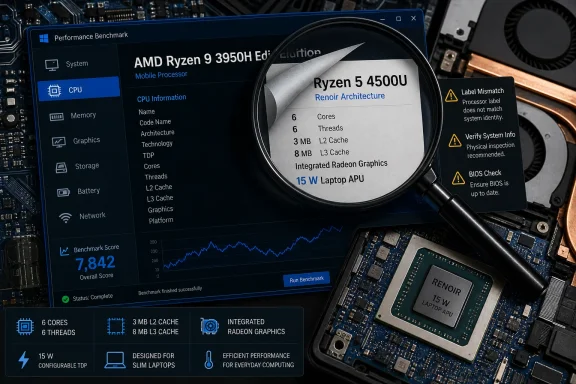 The Ryzen 5 4500U match is unusually exact
AMD introduced the Ryzen 5 4500U in January 2020 as part of the Ryzen 4000 U-series. It was positioned well below the company’s H-series performance parts, with a configurable 15 W power target designed for thin laptops. Unlike the Ryzen 5 4600U and Ryzen 7 4800U, it did not enable simultaneous multithreading, which is why its six physical cores also appear as six threads in Windows and benchmark utilities.That six-core, six-thread configuration is the giveaway. AMD’s actual Ryzen 4000 H-series hierarchy was headed by the eight-core, 16-thread Ryzen 7 4800H, while the six-core Ryzen 5 4600H offered 12 threads. A supposed Ryzen 9-branded H-class processor reporting only six threads would require AMD to have created a product dramatically below its own mainstream H-series configuration while assigning it a premium tier name. There is no supporting product record for that.
The cache totals narrow the answer further. The reported 3 MB L2 and 8 MB L3 arrangement is precisely what AMD documented for the 4500U. Lenovo’s technical specification for the IdeaPad 5 15ARE05, one of the many systems built around that chip, independently lists the same six cores, six threads, 2.3 GHz base frequency, 3 MB L2 cache, and 8 MB L3 cache.
The integrated graphics description points in the same direction. The Ryzen 5 4500U includes six Radeon compute units, with a maximum graphics clock of 1.5 GHz. A reported G3D Mark score around 2,142 is consistent with an older integrated Radeon implementation, not with a contemporary premium mobile Ryzen design. PassMark’s entry may be unusual because of its name, but the underlying platform looks very ordinary.
The scores do not make a case for a secret high-end part
According to VideoCardz, the single PassMark submission posted a CPU Mark of about 8,700 and a single-thread score of roughly 1,730. Those results are lower than PassMark’s current aggregate figures for the established Ryzen 5 4500U, which average 10,643 in multithreaded testing and 2,398 in single-thread testing from 2,980 submissions.That puts the mysterious result around 18% below the 4500U’s current multithread average and nearly 28% below its single-thread average. Those gaps do not disprove the 4500U identification; mobile benchmark results are sensitive to cooling, firmware power limits, memory configuration, background activity, Windows power settings, and the version of the test software. They do, however, undermine any idea that the entry represents an undisclosed performance-tier processor.
A single PassMark submission is weak evidence by design. PassMark itself marks CPU entries with five or fewer submissions as having a high margin of error, because one bad, throttled, misconfigured, or anomalous machine can distort the apparent result. Its public documentation also makes clear that submitted baselines come from users as well as internal testing.
The result therefore establishes only that a machine reported this name to PassMark and completed the test. It does not establish a commercial product, an AMD launch, a new OEM platform, or even a permanent firmware identity.
The system details reported by VideoCardz — 32 GB of DDR4-2666 memory, a 512 GB SOOONER drive, and no populated motherboard field — add little provenance. They suggest a low-cost system assembled around generic components, but do not identify a manufacturer, model, BIOS supplier, country of sale, or whether the machine was new, refurbished, or modified after shipment. The missing device identifier is a material limitation, because it prevents the benchmark from being tied to an actual product listing or OEM firmware image.
AMD’s processor name can be changed independently of the silicon
The key technical point is that the processor’s marketing name is not the same thing as its underlying hardware identity. On AMD systems, software commonly retrieves the CPU brand string through extended CPUID leaves. AMD’s CPUID documentation describes the brand identifier as information used by BIOS to generate the processor name string.Independent analysis by Chips and Cheese demonstrated why that distinction matters. On AMD processors, the brand string can be stored in six writable model-specific registers, providing up to 48 characters for the name returned through CPUID. The processor name is ordinarily set during boot, but it is not a cryptographic certificate of the SKU inside the machine.
That makes a custom “Ryzen 9 3950H Edition” label technically possible without turning the processor into a Ryzen 9-class part. Windows System Information, Task Manager, Device Manager, CPU-Z, benchmark tools, inventory agents, and many deployment scripts may display that string because they ask the processor or firmware for its reported identity. They can still correctly observe the physical cache topology, instruction support, frequency behavior, and active logical processor count while presenting a misleading marketing label.
There is an important nuance here. A changed name string alone does not prove fraud. Engineering samples, custom OEM firmware, board-vendor experiments, repair-shop modifications, and firmware errors can all produce unexpected identification text. But none of those explanations creates an AMD-recognized Ryzen 9 3950H Edition product.
The evidence supports a more prosaic finding: someone — whether an OEM, reseller, firmware integrator, or system owner — likely made a Ryzen 5 4500U-class Renoir APU report a more impressive name. The exact actor cannot be determined from the PassMark record.
Why this matters for Windows inventory and second-hand hardware
This is a reminder that a Windows-visible CPU name should not be the only field used to identify hardware. That applies especially to unmanaged mini PCs, repurposed laptops, imported systems, and refurbished devices, where firmware provenance can be difficult to establish.For an administrator validating a suspicious AMD machine, the useful checks are the ones that are harder to make internally consistent by accident:
- Compare core and thread counts in Task Manager, PowerShell, and a low-level utility such as HWiNFO or CPU-Z.
- Check the CPU family, model, stepping, cache topology, and supported instruction sets rather than relying on the product-name field alone.
- Record the BIOS vendor, BIOS version, motherboard identifier, SMBIOS system manufacturer, and Windows device model.
- Compare the reported configuration with AMD’s published specifications and the OEM’s hardware-maintenance documentation.
- Treat a premium Ryzen tier label that conflicts with the thread count and cache layout as an inventory exception, not as a new product discovery.
No second outlet has independently reported a shipping product, OEM announcement, or AMD confirmation behind the PassMark entry. Until that changes, the database listing belongs in the category of anomalous benchmark metadata — useful for showing how easily a CPU label can travel through Windows tools, but not evidence that AMD quietly revived Renoir under a new Ryzen 9 badge.
References
- Primary source: videocardz.com
Published: 2026-08-03T09:11:24+00:00
Loading…
videocardz.com - Related coverage: amd.com
Loading…
www.amd.com - Related coverage: learn.microsoft.com
Loading…
learn.microsoft.com - Related coverage: techcommunity.microsoft.com
Loading…
techcommunity.microsoft.com - Related coverage: passmark.com
Loading…
passmark.com - Related coverage: passmark.com
Loading…
www.passmark.com - Related coverage: techspot.com
Loading…
www.techspot.com - Related coverage: forums.passmark.com
Loading…
forums.passmark.com - Related coverage: forums.passmark.com
Loading…
forums.passmark.com - Related coverage: old.amw.gdynia.pl
Loading…
www.old.amw.gdynia.pl - Related coverage: amd.com
Loading…
www.amd.com