
There is also a material error in the supplied report that players should correct before searching storefronts or planning purchases. The expansion is called Cost of Hope, not “Hope of Despair.” GSC Game World announced Cost of Hope for August 20 in July, and Xbox Wire has described it as the first major story expansion, taking players into Iron Forest and the Chornobyl Nuclear Power Plant. The free update and paid DLC share a release date, but they are separate products.
Windows Central first detailed the new trailer and feature list, while GSC’s Update 2.0 announcement confirms that “Back to the Zone” is free for existing owners. That makes August 20 a much more consequential date for people who already own the PC version than a conventional DLC launch: even players skipping Cost of Hope will receive a major engine and systems update.
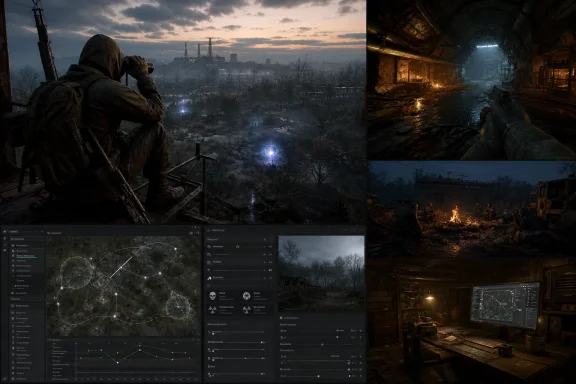 The Unreal Engine upgrade is the part to watch
GSC had previously said that S.T.A.L.K.E.R. 2 would move from Unreal Engine 5.1 to a newer build; reporting from Pure Xbox, XboxAchievements, and Digital Citizen identifies the target as Unreal Engine 5.5.4. GSC’s latest Update 2.0 post calls this a “significant engine upgrade,” though it stops short of publishing performance targets, revised system requirements, download sizes, or a platform-by-platform list of graphics changes.
That omission matters. An engine revision can enable lower-level fixes to streaming, lighting, memory handling, foliage rendering, and CPU scheduling, but its mere presence does not guarantee a particular frame-rate gain on a given PC. Players should resist treating the update trailer’s improved lighting and foliage as evidence that stuttering, shader-compilation hitching, CPU bottlenecks, or every stability complaint has been solved.
GSC says the game’s environmental lighting, including shadows and reflections, has been significantly changed; it also cites more realistic indoor and underground lighting, reworked landscapes and foliage, and fixes for hundreds of levitating objects. Those are visible and welcome cleanup items in a game whose atmosphere depends on an oppressive, coherent world. Yet the studio has not published benchmark comparisons for the August 20 build, nor has it said whether existing graphics settings will be reset after the migration.
For PC users, the practical advice is straightforward: allow time for a substantial Steam, GOG, Epic Games Store, or Microsoft Store download; capture current graphics and controller settings; and back up saves before installing. The lack of a published patch size or save-compatibility statement means there is no basis to promise a painless in-place upgrade for an existing campaign.
A-Life is receiving concrete behavior changes, not a blank-check relaunch
The Update 2.0 headline feature is a further revision to A-Life, the simulation system intended to make the Zone feel active beyond encounters directly in front of the player. GSC says NPCs and mutants will have more behavior patterns and places to interact: campfires, bus stops, and other points of interest can become contested; stalkers can loot corpses across the Zone even when the player does not witness it; and the update addresses enemies shooting or throwing objects through walls, overpopulated locations, and other systemic faults.
Those are more specific commitments than the vague promise of “improved AI” often attached to large game patches. They concern the lived-in quality of an open world: whether a fight feels like something that developed in the Zone, rather than an encounter staged as the player approaches.
But the announcement does not promise every behavior players associate with the original S.T.A.L.K.E.R. games, nor does it quantify simulation distance, NPC persistence, spawn rules, or the frequency of off-screen conflicts. Community discussion has focused heavily on the online/offline boundary for A-Life entities, yet GSC has provided no new public number for that range. Any claim that Update 2.0 “fixes A-Life completely” would outrun the evidence available before launch.
That distinction is especially important for returning players who stopped at release because the Zone did not behave as they expected. GSC has named several targeted corrections and new ambient activities. It has not supplied the kind of technical detail needed to establish how reliably those systems will behave across a long save, a crowded late-game region, or a heavily modded PC installation.
Custom Rules, fog, and binoculars change how players approach fights
The gameplay additions are more substantial than a cosmetic refresh. Update 2.0 adds a Custom Rules difficulty option, allowing players to alter individual aspects of the challenge instead of accepting a single preset. GSC frames this around combinations such as demanding combat with a less punishing economy, or a different balance between anomaly hazards and resource management.
That matters for S.T.A.L.K.E.R. 2 because its survival systems, damage model, carry limits, repair costs, and exploration pressure can appeal to different players for different reasons. A fully customizable difficulty setup gives GSC a way to preserve harsh baseline modes while making the campaign less punishing for someone primarily interested in the story or world. The studio has not yet published the exact sliders and ranges, so players should wait to see whether key frustrations can actually be adjusted independently.
Three types of binoculars will offer a new scouting layer, each with distinct functions, and GSC says they can be found in the Zone or purchased from certain traders. The patch also brings the Arev assault rifle, GP3A and SKP designated marksman rifles, and Fora-230 submachine gun, plus a unique variant of one weapon. A new 3x optic for Western-bloc weapons, a red-dot sight for Eastern weapons, and broader offset aiming are planned as well.
Fog is more than a screen effect in GSC’s description. The developer says visibility and hearing will be reduced for both players and enemies, potentially making stealth, ambushes, escapes, and close-range navigation more consequential. If it works as described, fog will be one of the few visual upgrades that directly changes the rules of an encounter rather than merely improving its presentation.
The Zone Kit upgrade may be the longer-term PC payoff
The official Zone Kit is receiving narrative scripting, audio, and localization tools designed to let creators build and package a complete story mod. That is a meaningful expansion of the toolkit’s scope. Level editing and asset work can create places to visit, but scripting, voiced content, and localization support are what turn a collection of assets into a self-contained quest or campaign.
GSC’s announcement says mod authors will be able to save a mod’s data, but it does not explain how existing mods will migrate to the new engine version or whether pre-2.0 projects need manual work. That is the major unresolved PC question heading into launch.
Historically, large Unreal Engine updates can require mod maintainers to rebuild packages, revise dependencies, or wait for toolchain updates. That is an inference from the nature of engine-version changes, not a compatibility warning issued by GSC. Still, anyone using extensive mod lists should assume that Update 2.0 could disrupt them until each author confirms support. Copying the game’s configuration and save folders is prudent; blindly updating a carefully customized install on day one is not.
The expanded Zone Kit also gives GSC an answer to a longer-running problem: a game with a powerful setting needs tools that enable the community to make new stories rather than only rebalance weapons or modify visuals. The value of those tools will depend on documentation, publication workflow, and how quickly creators can adapt after the engine shift. None of those implementation details has yet been laid out.
August 20 is effectively a relaunch test for the base game
Cost of Hope will have its own story, regions, and faction conflict between Duty and Freedom, according to GSC and Xbox Wire. Update 2.0 is the more immediate test of whether the base game now gives hesitant owners a credible reason to return. The combination is deliberate: a DLC can bring in paying customers, while a free overhaul gives existing players a reason to reinstall and gives modders a more capable foundation.
The update’s release-day condition will matter more than its feature count. GSC has announced visual revisions, bug corrections, more grounded A-Life behavior, new combat tools, customizable difficulty, and substantially broadened modding capability. It has not yet provided full patch notes, a supported-save statement, hardware-performance data, or a migration guide for existing mods.
For PC players, the safest plan is to preserve saves and mods, update the base game first, then assess performance and community compatibility reports before starting Cost of Hope or rebuilding a mod list. On August 20, the Zone is getting more than extra content; it is getting a technical and systemic revision whose success will be measured by how reliably those promised changes hold up outside the trailer.
