

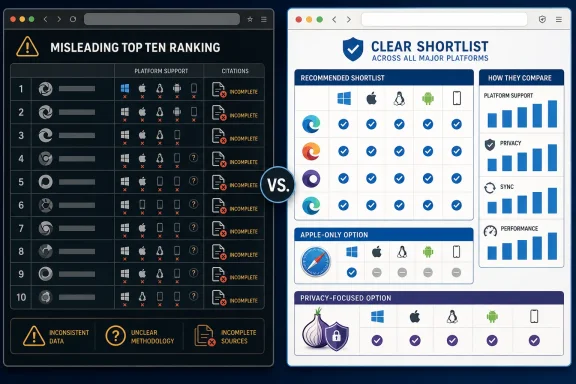
Safari is ranked second despite Apple having ended Safari for Windows in 2010; Apple’s own support documentation identifies Safari 5.1.7 as the final Windows release and says it is obsolete. Tor Browser has no official iOS version, according to the Tor Project. Epic Privacy Browser’s own privacy policy says its Chromium builds are for Windows, macOS, and Android, contradicting the roundup’s assertion that Epic is also available for iOS.
Those omissions turn a useful starting list of browsers into a misleading recommendation for people who need to move between Windows PCs, Macs, Linux machines, Android phones, and iPhones. A Windows user reading “multi-platform” reasonably expects they can keep the same browser, profile, sync model, and security posture across their devices. That is not what several of these recommendations deliver.
The ranking mixes browser categories that cannot be judged by one score
The NubiaPage list puts Chrome, Safari, Edge, Firefox, Brave, Opera, Vivaldi, Tor Browser, Arc, and Epic into one ordered table, then uses speed, privacy, platform availability, satisfaction, and distinctive features as if those dimensions can be reduced to a single universal ranking.
They cannot. Tor Browser is designed to resist tracking and network surveillance through the Tor network, and that architecture necessarily imposes latency and site-compatibility tradeoffs. Safari is deeply integrated with Apple hardware and operating systems, but does not serve Windows or Linux users. Arc’s desktop browser and its mobile Arc Search product are related, but the company’s mobile and desktop experiences are not equivalent substitutes for a browser with full feature parity on every operating system.
A browser for enterprise Windows deployment, a browser for private everyday browsing, and a browser for high-risk anonymity are different tools. Ranking Tor eighth because it is slow is about as useful as ranking a hardware security key below a password manager because it cannot autofill forms.
The practical question is not which browser is “best in the world.” It is which browser supports the endpoints an organization or user actually has, receives timely security updates on them, synchronizes the data they intend to sync, and provides the controls they need.
Magic Lasso tested four browsers, not ten
NubiaPage’s strongest-looking numerical claims come from Magic Lasso’s 2026 browser comparison, but the source’s actual scope is much narrower than the article suggests. Magic Lasso tested Safari 26.2, Chrome 143, Firefox 146, and Edge 143 on one MacBook Air configuration running macOS Tahoe 26.2. The comparison was last updated in January 2026.
Magic Lasso did rank Safari and Chrome jointly first overall, with a total score of 10 each; Edge third with 12; and Firefox fourth with 16. Those are rank totals, where lower is better, rather than product scores out of ten. NubiaPage reproduces those numbers but presents the work beside rankings for Brave, Opera, Vivaldi, Tor, Arc, and Epic — browsers Magic Lasso did not test in that comparison.
The published Magic Lasso performance numbers also do not match the roundup’s Windows figures. Its macOS JetStream 2.2 averages were 436.8 for Safari, 419.2 for Chrome, 413.3 for Edge, and 270.9 for Firefox. That does not prove the NubiaPage numbers are wrong; browser benchmarks vary substantially by processor, operating system, browser build, background workload, and test version. It does establish that the Magic Lasso comparison cannot substantiate the article’s claimed Windows JetStream 2 scores for a ten-browser field.
The article attributes those Windows scores to HighSpeedInternet.com, including a Chrome score of 761 and Firefox score of 541, but does not provide a test date, browser version, test system, test configuration, or a direct report readers can inspect. WindowsForum could not independently verify that stated 2026 test from the detail supplied in the roundup.
For IT professionals, this is more than a citation problem. A benchmark taken on an M2 MacBook Air does not predict the experience on a Windows 11 ARM notebook, an Intel VDI session, an older managed laptop with endpoint protection, or a Linux workstation. A browser’s behavior under Group Policy, memory pressure, VPN inspection, legacy authentication, and required extensions often matters more than a synthetic JavaScript score.
“Customer ratings” and privacy test results are being overstated
CloudSEK does publish a 2026 secure-browser guide that gives Brave a 4.8 out of 5 rating, Firefox and Vivaldi 4.7, Tor 4.6, and Epic 4.4. But CloudSEK labels the cited source for those figures as App Store and Capterra, not a proprietary CloudSEK customer-satisfaction dataset. That distinction was lost in the NubiaPage article, which says the numbers represent “aggregated user reviews compiled by CloudSEK.”
CloudSEK’s guide also creates a second platform discrepancy. Its table lists Epic Privacy Browser on iOS, while Epic’s own privacy policy describes Epic as built for Windows, Mac, and Android. Where a third-party comparison conflicts with the product maker’s platform documentation, the safer conclusion is that iOS availability is unconfirmed — not that the browser belongs in a cross-platform shortlist for iPhone users.
The Electronic Frontier Foundation’s Cover Your Tracks is similarly being used beyond its intended role. EFF provides a live diagnostic tool that examines how a particular browser configuration responds to selected tracker and fingerprinting tests. It does not publish a static 2026 overall leaderboard declaring Brave the winner over every browser in a universal privacy test.
EFF does identify Brave and Tor Browser as browsers built with fingerprinting resistance in mind, but it also explains that privacy results depend on the configuration and on whether a browser blends into a crowd or randomizes identifying characteristics. Extensions, content blockers, private mode, account sign-in, VPNs, device settings, and the sites a person visits all change the result.
The practical takeaway is that “private browser” is not a category you can validate with a star rating. Brave’s Shields provide meaningful default tracking protections. Firefox provides Total Cookie Protection and strong customization options. Tor Browser provides a distinct anonymity model and should be left close to its defaults. Those are defensible descriptions. Declaring one winner through a mixture of app-store scores and a browser fingerprint test is not.
A real multi-platform shortlist is shorter than ten
If multi-platform means current support for Windows, macOS, Linux, Android, and iOS, the defensible mainstream shortlist is considerably smaller than NubiaPage’s list implies.
| Browser | Windows | macOS | Linux | Android | iOS | What that means in practice |
|---|---|---|---|---|---|---|
| Google Chrome | Yes | Yes | Yes | Yes | Yes | The broadest Google-account and enterprise-management fit. |
| Microsoft Edge | Yes | Yes | Yes | Yes | Yes | A strong Windows choice with Chromium extension compatibility and Microsoft management integration. |
| Mozilla Firefox | Yes | Yes | Yes | Yes | Yes | The primary non-Chromium desktop option with an established privacy and customization story. |
| Brave | Yes | Yes | Yes | Yes | Yes | A practical cross-platform option for users who want tracker and ad blocking enabled by default. |
| Opera | Yes | Yes | Yes | Yes | Yes | Broad device coverage, though feature consistency differs among Opera products and releases. |
| Vivaldi | Yes | Yes | Yes | Yes | Yes | The power-user choice for interface customization, tab management, and encrypted sync. |
Safari belongs in a separate Apple-only recommendation. It remains a strong option for people whose devices are Macs, iPhones, iPads, and Apple Watches, particularly where battery life and Apple integration matter. It does not belong in a ranking marketed to Windows and Linux users as multi-platform.
Tor Browser should be a separate security recommendation. It officially supports Windows, macOS, Linux, and Android, while the Tor Project recommends Onion Browser rather than an official Tor Browser release for iOS. Its use case is anonymity and censorship circumvention, not ordinary browser synchronization or raw benchmark performance.
Epic belongs in a more limited Windows, macOS, and Android privacy-browser category unless the vendor documents an active iOS release. Arc is available on Windows and macOS, while Arc Search is available on iOS and Android, but the product split and lack of Linux support mean it is not a clean five-platform deployment answer.
What Windows users should take from the correction
For a Windows 11 user who wants a browser that follows them to Linux, Android, and iPhone, Edge, Chrome, Firefox, Brave, Opera, and Vivaldi are the candidates worth comparing. The choice then comes down to management, extensions, privacy defaults, sync, and compatibility with the services already in use.
Edge remains the lowest-friction option in Windows-centric environments because it is preinstalled, Chromium-compatible, available on every major desktop and mobile platform, and integrates with Microsoft’s management stack. Chrome offers equally broad platform coverage and remains the market-share leader: StatCounter recorded Chrome at 69.65% worldwide share in June 2026, ahead of Safari at 15.31%, Edge at 5.21%, and Firefox at 3.33%. That dominance makes Chrome a compatibility baseline, though it is not a privacy recommendation by default.
Firefox, Brave, and Vivaldi are the better places to start when privacy defaults or user control are a priority. Safari is the right answer for an Apple-only household. Tor Browser is the right answer when the threat model calls for Tor Browser.
The consequence for readers is straightforward: do not use the NubiaPage ordering as a purchasing, deployment, or migration decision. Its best-supported finding is limited to a January 2026 macOS comparison of Safari, Chrome, Edge, and Firefox. Its broader top ten is a collection of recognizable browsers, not a verified global ranking of ten genuinely multi-platform products.