
Mark Ellis Reviews’ early verdict on Samsung’s Galaxy Z Fold8 is unusually emphatic: the $1,899 foldable’s new “passport phone” shape may be the company’s most compelling attempt yet to make a tablet-sized display practical as an everyday phone.
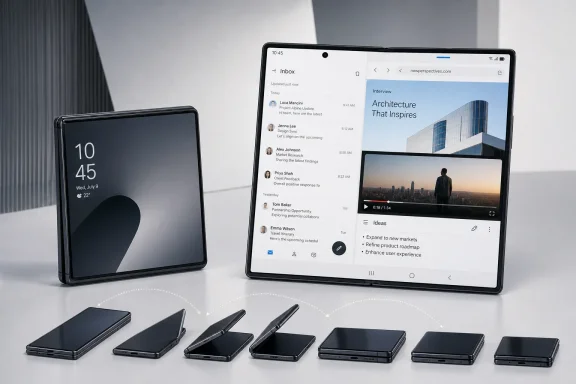
Samsung introduced the Z Fold8 alongside the conventional Z Fold8 Ultra at its July 22 Unpacked event in London. The distinction matters: the Ultra carries forward the familiar large-book foldable formula, while the 201g Z Fold8 uses a much shorter, wider 5.5-inch cover display and a 7.6-inch internal panel. General availability is scheduled for August 7.
According to Samsung, the Z Fold8 is designed around “immersion,” while the Z Fold8 Ultra is aimed at maximum productivity. That positioning is visible in the hardware: the Fold8 Ultra has larger 6.5-inch and 8-inch displays, a 200MP main camera, and a 3x optical telephoto lens.
The smaller Fold8 instead pairs two 50MP rear cameras — main and ultra-wide — with up to 10x digital zoom. Ellis identifies that missing telephoto camera as the biggest functional compromise, particularly when the phone costs $1,899 in the US or £1,699 in the UK.
For users accustomed to carrying a Galaxy Z Fold as a mobile workstation, the Ultra remains the more obvious upgrade. But the Fold8’s unusually broad cover screen could be the more interesting design shift, especially for people who find tall, narrow phone displays awkward for typing, messaging, and reading.
That use case will be familiar to Windows users who rely on Outlook, Teams, Microsoft 365, browser-based admin consoles, and remote-work tools. A foldable cannot replace a Windows laptop for serious administration, but a properly scaled pane-based interface can make quick triage and communication less painful away from the desk.
There is still an app problem. Ellis found Outlook and Claude among the applications that make sensible use of the internal screen, but noted that some apps — including Google’s YouTube Studio — still behave like enlarged phone interfaces rather than adapting to the available workspace. That remains the central software challenge for every foldable.
The redesigned hinge also comes with a trade-off. Samsung’s rigid Flex Titanium construction makes the fold feel more confident and reduces crease visibility, but it no longer supports the half-open, laptop-style Flex Mode position used by earlier Z Fold owners. The phone snaps fully open instead.
That may be a non-issue for buyers who want a compact phone that becomes a reading and multitasking device. For existing Fold users who regularly prop the handset on a desk for calls, video, or camera work, it is a regression worth testing in person.
The Z Fold8 is not a cheap all-purpose flagship, nor is it a camera-first one. But if Samsung’s new shape delivers on its early promise, it may be the company’s clearest argument yet that a foldable can replace both a phone and a small tablet without feeling like a compromise in either role.
 Samsung Splits the Fold Line in Two
According to Samsung, the Z Fold8 is designed around “immersion,” while the Z Fold8 Ultra is aimed at maximum productivity. That positioning is visible in the hardware: the Fold8 Ultra has larger 6.5-inch and 8-inch displays, a 200MP main camera, and a 3x optical telephoto lens.The smaller Fold8 instead pairs two 50MP rear cameras — main and ultra-wide — with up to 10x digital zoom. Ellis identifies that missing telephoto camera as the biggest functional compromise, particularly when the phone costs $1,899 in the US or £1,699 in the UK.
For users accustomed to carrying a Galaxy Z Fold as a mobile workstation, the Ultra remains the more obvious upgrade. But the Fold8’s unusually broad cover screen could be the more interesting design shift, especially for people who find tall, narrow phone displays awkward for typing, messaging, and reading.
A Large Screen That Is Supposed to Be Used
Ellis says the 4:3-ish internal display has proved genuinely useful rather than merely impressive in a specifications table. Video, Kindle reading, two-app multitasking, email, and web browsing all benefit from the extra space, while the portrait orientation turns the unfolded phone into a more natural surface for feeds and websites.That use case will be familiar to Windows users who rely on Outlook, Teams, Microsoft 365, browser-based admin consoles, and remote-work tools. A foldable cannot replace a Windows laptop for serious administration, but a properly scaled pane-based interface can make quick triage and communication less painful away from the desk.
There is still an app problem. Ellis found Outlook and Claude among the applications that make sensible use of the internal screen, but noted that some apps — including Google’s YouTube Studio — still behave like enlarged phone interfaces rather than adapting to the available workspace. That remains the central software challenge for every foldable.
Better Battery, Less Flexibility
Samsung has equipped the Z Fold8 with a 4,800mAh silicon-carbon battery, 45W wired charging, and 20W wireless charging. Ellis reports that it comfortably exceeded a full day in his early testing, including heavy camera use, a meaningful improvement for a device expected to power two high-refresh-rate AMOLED displays.The redesigned hinge also comes with a trade-off. Samsung’s rigid Flex Titanium construction makes the fold feel more confident and reduces crease visibility, but it no longer supports the half-open, laptop-style Flex Mode position used by earlier Z Fold owners. The phone snaps fully open instead.
That may be a non-issue for buyers who want a compact phone that becomes a reading and multitasking device. For existing Fold users who regularly prop the handset on a desk for calls, video, or camera work, it is a regression worth testing in person.
The Z Fold8 is not a cheap all-purpose flagship, nor is it a camera-first one. But if Samsung’s new shape delivers on its early promise, it may be the company’s clearest argument yet that a foldable can replace both a phone and a small tablet without feeling like a compromise in either role.
