
Samsung SDI plans to begin mass production of all-solid-state batteries in the second half of 2027 at its Ulsan, South Korea plant, putting a date and a production site behind one of the battery industry’s most closely watched commercialization targets. As reported by Gasgoo, the company intends to move validated pilot-line work into a dedicated volume-manufacturing operation, initially serving domestic customers before extending the model overseas.
The announcement matters beyond electric cars. Samsung SDI is positioning its solid-state cells for physical AI hardware, including humanoid robots, mobile robots and industrial systems where safety, energy density and available installation space can be more important than the lowest possible battery price.
Samsung SDI had already publicly targeted the second half of 2027 during InterBattery 2026. Its latest Ulsan investment plan gives that timetable a clearer industrial foundation rather than leaving it as an R&D roadmap.
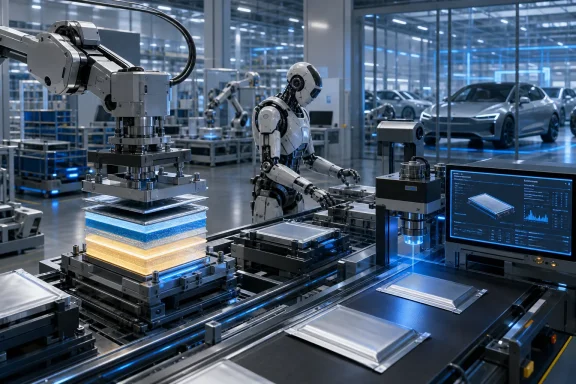
Samsung SDI has committed 25 trillion won through 2040 across its Ulsan and Cheonan sites. The company has allocated 16 trillion won for Ulsan, where it plans lines for all-solid-state batteries as well as LFP energy-storage cells and sodium-ion products.
The remaining 9 trillion won is directed at Cheonan, which Samsung SDI describes as a next-generation technology verification base. The company says its dry-electrode pilot line there is already operating, a notable detail because dry-electrode manufacturing is intended to reduce cost and energy use compared with conventional wet-coating processes.
That division gives Samsung SDI a practical path: validate chemistry and process changes at Cheonan, then transfer a proven recipe to Ulsan for production. Scaling laboratory cell performance to consistent high-volume yields remains the central challenge for solid-state batteries, so the handoff between those sites will matter as much as the 2027 date.
Its Suwon R&D center houses a 6,500-square-meter S-Line pilot facility that has completed multiple formulation and process-validation rounds, according to Gasgoo. Samsung SDI says the Ulsan manufacturing line will build directly on that pilot work.
Samples have reportedly been supplied to prospective customers for evaluation, spanning EVs, embodied-AI products and humanoid robots. Samsung SDI told the Korea JoongAng Daily earlier this month that global customers had responded positively to early sample testing on energy density and safety, though customer names and production volumes have not been disclosed.
For IT organizations evaluating autonomous mobile robots, warehouse systems or edge-AI hardware, solid-state batteries are not an immediate procurement change. Samsung SDI’s 2027 plan instead marks the beginning of a supply-and-reliability test that could shape the next generation of long-runtime, safety-sensitive robotic hardware.
Samsung SDI had already publicly targeted the second half of 2027 during InterBattery 2026. Its latest Ulsan investment plan gives that timetable a clearer industrial foundation rather than leaving it as an R&D roadmap.
Ulsan Gets the Scale, Cheonan Gets the Verification Work
Samsung SDI has committed 25 trillion won through 2040 across its Ulsan and Cheonan sites. The company has allocated 16 trillion won for Ulsan, where it plans lines for all-solid-state batteries as well as LFP energy-storage cells and sodium-ion products.The remaining 9 trillion won is directed at Cheonan, which Samsung SDI describes as a next-generation technology verification base. The company says its dry-electrode pilot line there is already operating, a notable detail because dry-electrode manufacturing is intended to reduce cost and energy use compared with conventional wet-coating processes.
That division gives Samsung SDI a practical path: validate chemistry and process changes at Cheonan, then transfer a proven recipe to Ulsan for production. Scaling laboratory cell performance to consistent high-volume yields remains the central challenge for solid-state batteries, so the handoff between those sites will matter as much as the 2027 date.
Sulfide Chemistry and a 900 Wh/L Target
Samsung SDI is pursuing sulfide-based solid electrolytes, replacing the flammable liquid electrolyte used in conventional lithium-ion cells with a solid material. The company has previously set a volumetric energy-density goal above 900 Wh/L, a measure that is particularly relevant to compact robotic platforms and EV battery packs constrained by physical space.Its Suwon R&D center houses a 6,500-square-meter S-Line pilot facility that has completed multiple formulation and process-validation rounds, according to Gasgoo. Samsung SDI says the Ulsan manufacturing line will build directly on that pilot work.
Samples have reportedly been supplied to prospective customers for evaluation, spanning EVs, embodied-AI products and humanoid robots. Samsung SDI told the Korea JoongAng Daily earlier this month that global customers had responded positively to early sample testing on energy density and safety, though customer names and production volumes have not been disclosed.
The 2027 Test Is Manufacturing, Not Marketing
The company has branded its all-solid-state platform SolidStack and has presented pouch-cell versions for robotics alongside its broader battery roadmap. But the decisive milestone is not a prototype demonstration: it is whether Ulsan can make cells at usable yield, quality and cost.For IT organizations evaluating autonomous mobile robots, warehouse systems or edge-AI hardware, solid-state batteries are not an immediate procurement change. Samsung SDI’s 2027 plan instead marks the beginning of a supply-and-reliability test that could shape the next generation of long-runtime, safety-sensitive robotic hardware.
References
- Primary source: Gasgoo
Published: 2026-07-31T22:02:00+00:00
Samsung SDI to Start Mass Production of All-Solid-State Batteries in 2027 | Gasgoo
body { font-size: 16px; line-height: 34px; ...autonews.gasgoo.com - Related coverage: news.metal.com
- Related coverage: koreajoongangdaily.com
Samsung SDI targets 2027 mass production of solid-state batteries as global clients praise safety
Samsung SDI says it is aiming to mass-produce solid-state batteries in the second half of 2027, with global customers praising their safety and energy density. The company’s progress sets it apart from rivals like CATL and BYD as the race for next-generation EV batteries intensifies.www.koreajoongangdaily.com - Related coverage: techradar.com
The 8-Hour challenge: SK On says solid-state robot batteries must justify a 4x manufacturing cost jump to replace 'inferior' lithium-ion | TechRadar
Robots clock out after 2 hours; humans work for 8 hourswww.techradar.com