
The wired controller starts at $119.99, while the wireless version starts at $199.99. Pre-orders began August 26, and SCUF has given only “fall 2026” for shipping, without a specific release date. GamesRadar+ has handled the controller at Gamescom, while APH Networks and other hardware outlets have published SCUF’s launch announcement; no independent latency testing of retail hardware is available yet.
For PC players, the practical appeal is straightforward: SCUF is bringing its premium-controller formula to a Windows-only product line and matching the headline polling figure offered by high-end rivals such as Razer’s Wolverine V3 Pro 8K PC. The complication is equally straightforward: a polling-rate claim tells buyers the maximum frequency at which the controller can report, not the total button-to-screen latency that decides whether an input feels faster in a game.
 The wireless 8K claim changes the comparison
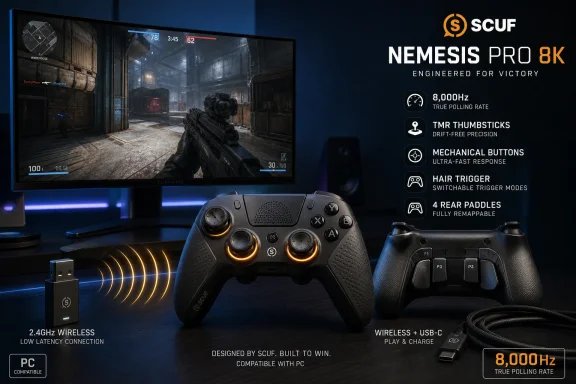
The submitted launch report suggested that the wireless Nemesis Pro might operate below 8,000Hz in ordinary 2.4GHz use. SCUF’s own announced specification says otherwise: the Wireless model supports up to 8K polling through both its proprietary 2.4GHz wireless connection and USB-C, while the Wired model reaches the same stated maximum only through USB-C.
That is a material distinction, particularly given the $80 premium for the wireless model. A buyer choosing the $199.99 version is not merely paying for cable-free play and a USB fallback; according to SCUF, they are paying for the same advertised report-rate ceiling in both connection modes.
There is precedent for treating that carefully rather than dismissing it. Windows Central’s testing of Razer’s Wolverine V3 Pro 8K PC found very similar measured results over its wireless dongle and USB, though the actual rate varied depending on the PC’s USB port. The outlet reported roughly 7,500Hz in repeated tests and lower results through a front-panel port than a motherboard-connected port. That does not verify SCUF’s new controller, but it demonstrates why “up to 8,000Hz” should be read as a ceiling contingent on the host PC, USB path, driver behavior, and test method.
SCUF has not yet published a public technical explanation of how the Nemesis Wireless maintains that rate over 2.4GHz, nor has it supplied measured end-to-end latency figures, battery-life estimates at different polling settings, or a list of selectable polling-rate modes. Those omissions matter more than the marketing shorthand of “sub-1ms response.” Eight thousand reports per second corresponds to a 0.125ms polling interval in the best case, but that is only one stage in the route from stick movement to an image on screen.
8,000Hz is a narrow advantage, not a universal upgrade
At 1,000Hz, the controller has an opportunity to report its latest state every 1ms. At 8,000Hz, that theoretical interval falls to 0.125ms. The maximum improvement in report timing is therefore less than 1ms, before accounting for the controller’s internal scan time, USB or radio transmission, Windows input handling, game-engine processing, frame pacing, display scanout, and pixel response.
That does not make high polling meaningless. In a competitive shooter running at very high and stable frame rates, with a fast display and a player sensitive to timing consistency, shaving fractions of a millisecond from one segment of the chain can be worthwhile. It is also a credible specification for a PC-focused controller aimed at the same audience that buys high-refresh monitors and low-latency mice.
But it will not transform a controller-centric game running at 60fps. One 60fps frame lasts about 16.7ms; a 120fps frame lasts about 8.3ms. A controller report interval reduced from 1ms to 0.125ms is substantially smaller than the cadence of either display scenario. Frame-time spikes, an inconsistent in-game frame cap, a poorly implemented controller input path, and network delay in multiplayer games can all swamp the difference.
Recent reviews of the GameSir G7 Pro 8K, another 8K controller, have reached a similar practical conclusion: reviewers found the feature technically interesting but difficult to perceive outside demanding high-frame-rate play. PC Gamer specifically argued that 1,000Hz is already sufficient for most users and that a CPU powerful enough to sustain high game frame rates is a prerequisite for any small timing benefit to have a chance of surfacing.
The sensible buying rule is to treat the Nemesis Pro 8K’s polling rate as a competitive feature, not a reason by itself to replace a reliable 1,000Hz controller. SCUF needs independent testing to show its actual button, trigger, and stick latency; the current launch material supplies a report-rate target rather than that evidence.
TMR sticks and paddles are the more durable hardware story
The more consequential changes may be the parts that are less easily summarized on a retail box. SCUF says both Nemesis models use tunnel magnetoresistance, or TMR, thumbstick sensors. These magnetic sensors avoid the conventional potentiometer contact wear associated with one common cause of stick drift. They do not guarantee that a controller will never develop faults, because drift-like behavior can originate in calibration, firmware, mechanical centering, dead-zone settings, contaminants, or other components. Still, TMR is a meaningful improvement in a category where buyers reasonably expect a premium controller to stay accurate over time.
The face buttons use mechanical switches, which SCUF describes as mouse-click-style ABXY controls. Early reporting calling them “Omron buttons” goes beyond SCUF’s published launch wording: the company identifies them as mechanical ABXY switches but does not name Omron as the switch supplier in the announcement. Buyers who care about switch life, actuation force, or repairability should wait for an official component specification or retail teardown rather than treat that brand attribution as confirmed.
SCUF is also retaining four customizable rear paddles, with the two inner paddles removable and blanking plates supplied for a two-paddle arrangement. That is useful for players who map jumping, sliding, reloading, melee, or gear changes to rear inputs while keeping both thumbs on the sticks. The controller’s dual-mode triggers are designed around the same split: a short mouse-click-like stop for shooters and a full analog travel mode for racing or driving games.
GamesRadar+ reports from its Gamescom hands-on that the Nemesis shares much of the shape and feel of SCUF’s Valor Pro but omits extra side-button controls that some users had found easy to press accidentally. That is an ergonomic choice worth watching in review coverage. More programmable inputs are valuable only when they can be reached deliberately under pressure.
Windows support is clear; software details are still thin
SCUF lists Windows 10 and Windows 11 as the supported platforms and describes a companion PC app for button and paddle remapping, saved profiles, stick and trigger response curves, dead-zone and sensitivity adjustment, and calibration. That gives the Nemesis family the minimum software toolset expected from a premium PC controller.
What SCUF has not detailed is equally relevant to Windows users. The announcement does not state whether the controllers expose XInput only, whether there is a separate DirectInput mode, whether profiles live entirely on the controller, how many profiles can be stored, or whether settings persist identically between wired and wireless operation. It also does not address Steam Input interaction, firmware-update policy, headset support, or the warranty terms that will apply to TMR stick assemblies and removable paddles.
Those are not trivial housekeeping questions. The last generation of high-end controllers has repeatedly shown that a good physical layout can be undermined by profile bugs, unstable firmware, poor Windows detection, or configuration software that does not correctly apply settings in every connection mode. SCUF’s app promises are relevant, but the company has supplied no public evidence yet that the Nemesis software avoids those pitfalls.
The $119.99 wired model is consequently the easier recommendation on paper for a Windows player who specifically wants TMR sticks, rear paddles, mechanical face buttons, and a high polling ceiling. The $199.99 wireless model only earns its premium if SCUF’s claim of full 8K operation over 2.4GHz holds up in independent testing and if its battery life and software behavior remain solid outside a launch demonstration.
SCUF has announced the hardware and opened orders, but it has not yet put retail units in reviewers’ hands or set a firm fall delivery date. Until that happens, the Nemesis Pro 8K should be viewed as a promising specification sheet with one corrected headline: the 8,000Hz claim applies to the wireless receiver as well as USB-C.