
SEMI announced the change on July 30, while ABC15 Arizona’s subsequent report put local context around the decision. The San Francisco Chronicle independently confirmed that the 2026 show at Moscone Center will be the final scheduled San Francisco edition before the longer-term Phoenix arrangement begins. For IT professionals following the hardware supply chain, this moves a major annual checkpoint for manufacturing equipment, advanced packaging, chip security, AI infrastructure and component availability out of Silicon Valley’s traditional conference circuit.
The conference relocation does not mean semiconductor production has moved wholesale from California to Arizona, nor does it signal an immediate change in PC, server or GPU pricing. It does show where SEMI believes the U.S. manufacturing side of the industry now has enough density to support its flagship event every year.
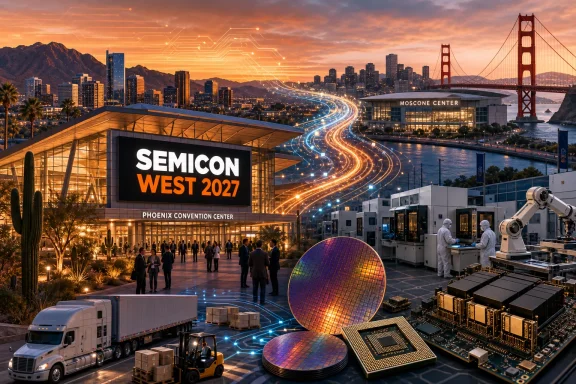 The 2023 Rotation Plan Has Been Replaced
SEMI’s January 2023 announcement described a five-year October rotation: Phoenix in 2025, San Francisco in 2026, Phoenix again in 2027, then San Francisco in 2028 and Phoenix in 2029. That was already an unusually visible acknowledgment that the industry’s center of gravity was spreading beyond the Bay Area.
The new arrangement eliminates both the alternation and the October slot. Phoenix is now set to host SEMICON West every spring, with 2027, 2028 and 2029 dates confirmed. SEMI says the new timing gives its global event calendar more flexibility, a point the San Francisco Chronicle reported as reducing clashes with related SEMICON events in Taiwan, Japan, Europe and India.
That scheduling change has a practical effect beyond convention logistics. Autumn is crowded with enterprise planning, vendor launches and regional semiconductor events. A fixed spring date gives exhibitors and customers a more predictable point to show manufacturing tools, discuss procurement plans and line up partnerships before many companies finalize later-year capital-spending decisions.
For visitors, there is one last Bay Area date to note: SEMICON West remains scheduled for October 13–15, 2026 at San Francisco’s Moscone Center. Anyone planning around the older rotation should update calendars now; there will be no return to San Francisco in October 2028 under the newly announced plan.
Phoenix Won the Conference, Not a Manufacturing Guarantee
Arizona’s semiconductor credentials are substantial. Intel has operated in Chandler for decades, while TSMC’s north Phoenix expansion has drawn equipment, materials, packaging and construction suppliers into the region. Amkor also has a major Arizona advanced-packaging project in its plans. Those projects help explain why SEMI sees Phoenix as a more natural gathering place for manufacturing executives than it did a few years ago.
But the numbers used to describe that growth deserve more scrutiny than the celebratory announcements usually receive. ABC15 cited more than $200 billion in announced Arizona semiconductor investments since 2020. The San Francisco Chronicle used more than $205 billion, attributing the figure to the Arizona Commerce Authority. A City of Phoenix statement published this month went further, referring to TSMC’s $265 billion investment.
Those figures are not directly interchangeable. They appear to use different dates, project scopes and definitions of “announced” investment. They also should not be mistaken for money already spent, operating fabs already online, or chip capacity available to PC and server buyers. The relevant reader takeaway is the direction of investment and supplier concentration, not a single headline dollar total.
SEMI’s decision is therefore better read as a business-development judgment than as a production metric. A trade association wants exhibitors, decision-makers and potential workers within reach of its show floor. Phoenix has enough current and announced activity to meet that test. Whether every high-profile project arrives on schedule, reaches its promised scale or creates the projected employment is a separate question that the conference move cannot answer.
The 2025 Show Supplied the Evidence SEMI Needed
Phoenix first hosted SEMICON West on October 7–9, 2025. According to SEMI and local officials, the debut delivered stronger attendance and exhibitor results than organizers expected. The City of Phoenix now says it expects 35,000 decision-makers and innovators annually, while the San Francisco Chronicle reported that the 2025 event drew more than 20,000 people.
The difference is important: 20,000 is a reported result from the first Phoenix event, while 35,000 is a forward-looking city expectation. The two figures should not be presented as if they measure the same thing.
ABC15 quoted SEMI Americas President Joe Stockunas describing a 50% year-over-year growth result. SEMI’s own press materials highlight a separate industry report claiming exhibitors increased 45% and first-day attendance doubled from 2024. Those are encouraging indicators, but they are still organizer-linked event measures, not independently audited evidence that Arizona has overtaken every other U.S. semiconductor center.
What the 2025 result did establish was operational viability. Large manufacturing exhibitions live or die on floor space, hotel capacity, freight handling, exhibitor satisfaction and the willingness of suppliers to send technical staff. The return commitment through 2029 indicates SEMI was satisfied enough with those basics to abandon the hedge of a rotating model.
Why This Matters to Windows and Enterprise IT Readers
SEMICON West is not a consumer electronics launch show. Windows users should not expect Microsoft Surface hardware, next-generation PCs or Windows feature announcements to emerge from Phoenix simply because the event has relocated. The event is principally where companies that make the chips—and the tools, chemicals, wafers, test systems and packaging technologies behind them—meet one another.
Still, enterprise IT increasingly feels the consequences of decisions made far upstream from a finished laptop or server. AI infrastructure demand has made accelerator availability, high-bandwidth memory, advanced packaging and power-efficient compute central concerns for organizations buying data-center capacity. A fixed U.S. gathering that convenes the manufacturing supply chain gives hardware vendors and large buyers a more stable annual place to compare roadmaps and identify bottlenecks.
Cybersecurity also has a legitimate place on the agenda, though readers should be clear about the distinction. Semiconductor security discussions typically concern supply-chain integrity, manufacturing systems, intellectual-property protection and hardware assurance. They are not a replacement for Microsoft Patch Tuesday, endpoint hardening or vulnerability management in a Windows estate. The conference may surface useful industry direction, but it does not create an actionable security advisory for administrators by itself.
For developers and infrastructure teams, the more immediate value is awareness. Semiconductor roadmaps affect when new client processors, server platforms, memory configurations and AI accelerators become feasible at volume. The conference’s move will make Phoenix a recurring place where those upstream constraints are discussed, months or years before they are visible in an OEM configuration tool or a corporate refresh cycle.
San Francisco Loses a Fixture, but the Industry Keeps Its Bay Area Presence
The relocation ends a relationship that dates back more than five decades. The San Francisco Chronicle reports that the first SEMICON exhibition was held in 1971 at the San Mateo County Fairgrounds, later becoming a fixture at Moscone Center. The conference’s departure removes a recognized technology gathering from San Francisco’s convention calendar at a time the city is trying to restore downtown business travel.
That is a real loss for San Francisco hospitality businesses, but it should not be exaggerated into a verdict on the Bay Area’s relevance to technology. California remains home to chip design companies, venture capital, software firms, research institutions and semiconductor equipment operations. SEMI itself is based in Milpitas, California.
The narrower conclusion is that the conference now follows the physical expansion of U.S. chip manufacturing and its supplier base. Design, software and manufacturing do not have to occupy the same metro area, and they increasingly do not. Phoenix’s gain reflects that division of labor.
The next milestone is concrete: SEMICON West will run in San Francisco on October 13–15, 2026, then reopen in Phoenix on March 30, 2027. For exhibitors and attendees, the old alternating schedule is finished; for the U.S. chip industry, Phoenix has secured a recurring convening point without yet proving that every announced factory and supplier expansion will translate into available silicon.
