
Boris FX’s Sequoia 2026.5 introduces a Spatial Panner intended to let Windows-based mastering, broadcast and post-production teams edit stereo, surround, Dolby Atmos and ADM panning from one control surface rather than maintaining parallel placement decisions in separate format-specific views. The practical benefit is real for sessions that must deliver several monitoring and distribution targets—but, on August 6, the release has a deployment problem: Digital Production is the only published account located for the update, while Boris FX’s own Sequoia product page, documentation index and press newsroom still identify the current product as Sequoia 2026.
That discrepancy does not make the feature report false. It does mean studios should treat 2026.5 as a newly reported release awaiting its normal primary record: a Boris FX announcement, downloadable build number, release notes, revised documentation, and a clear statement of eligibility for subscription, perpetual and upgrade customers. Those omissions matter more in Sequoia than they would in a consumer DAW, because projects often carry automation, object metadata, external control-surface mappings and video hardware dependencies that cannot be meaningfully validated from a feature description.
According to Digital Production, the new Spatial Panner can show all sources feeding a selected target, with track colours, peak metering, solo/mute controls, hiding and multi-selection. The reported interface supports mono through 22.2 layouts, with two-dimensional front, top and side views plus an optional 3D cube to visualise the active speaker arrangement.
The important distinction is between authoring and rendering. Spatial Panner appears to be a new control and routing workflow—one that supplies new placement behaviour for surround and immersive work—not a replacement Dolby Atmos renderer or a new public spatial-audio API. Sequoia’s existing ADM Editor and Atmos workflow remain the components responsible for the associated metadata and master-file path.
For an engineer, that means the update should reduce the friction of editing position across multiple delivery targets. It does not eliminate the separate job of monitoring those targets, checking downmixes, reviewing object behaviour, validating ADM metadata, or signing off the rendered master. A panner can make intent more consistent; it cannot prove that a stereo fold-down, 5.1 broadcast version and Atmos master will behave acceptably in their respective playback environments.
Boris FX’s public Sequoia 2026 page already presents the DAW as an immersive production system with an ADM editor and Dolby Atmos rendering. It also documents the 2026 release’s FX I/O Matrix for complex multichannel plug-in routing. The reported 2026.5 change is therefore a workflow layer above an established feature set: it brings visual source management and cross-target pan editing closer to the point where engineers make creative and technical placement decisions.
That is a sensible answer to a recurring problem in long-form classical recording, broadcast mixing and post: the same source may appear in more than one deliverable, but identical coordinates do not mean identical listening results. A stereo bus has only left-right placement. An Atmos target can carry height and depth. A surround target may use its own speaker geometry and monitoring conventions.
The danger is assuming linked editing creates an automatic downmix or a guaranteed translation between formats. It does not. A violin section, effects stem or spot microphone that sounds naturally placed in an immersive layout can acquire an inappropriate prominence, phantom-centre shift or ambience imbalance when folded into stereo. Digital Production’s description explicitly notes that an individual target can be unlinked for its own placement and automation. That is not a small exception to the workflow; it is the control that makes the workflow usable in professional delivery.
Teams should read the chain control as a way to establish a shared starting state, then deliberately create exceptions where the listening result demands them. The right operational rule is still to audition every delivery bus on its intended monitoring path—not to accept cross-format synchronization as evidence of cross-format equivalence.
Those controls point to more than a cosmetic reorganisation. A stereo pair needs different creative constraints from a point-like mono object; it may remain parallel, turn toward the listening position, or separate into independently placed channels. A surround source has different constraints again. Putting those source models and target configurations into a common workspace could save operators from repeatedly opening and reconciling isolated panner windows.
But the release description should not be oversold as a format-agnostic spatial processor. Sequoia’s established stereo panning remains available, and Digital Production says Matrix mode, panning presets and external VST panners are retained. That preservation is valuable for compatibility: sessions built around known third-party panners or established pan laws should not have to migrate creative choices merely because a new unified panel is available.
It also underlines a missing technical detail. Neither the currently public Boris FX documentation nor the reporting examined here supplies a build-by-build migration note explaining how existing panning automation appears in Spatial Panner, whether legacy pan modes are translated non-destructively, or how projects behave when opened again in Sequoia 2026. Those are the questions a facility needs answered before putting 2026.5 into a shared production environment.
Sequoia 2026’s public materials already position the product for ADM and Atmos work. The 2026.5 reporting adds a more direct editing environment ahead of that pipeline. The new panel may make it easier to see the relationship between microphones, beds and objects, but it does not relax the technical requirements that govern a valid immersive deliverable.
In particular, operators should continue to verify bed and object assignments, LFE routing, binaural monitoring choices, automation boundaries and the final ADM master in the intended renderer path. Production templates may contain special routing for low-frequency content because Atmos objects themselves do not carry LFE in the same way a bed does. A more elegant panning interface cannot be allowed to obscure that underlying routing design.
This portion has an independent primary-source foundation, though not yet specifically for Sequoia 2026.5. Boris FX announced SoundApp ARA in May for use in Sequoia, Samplitude, Pro Tools, Reaper, Cubase and other ARA-capable hosts. The company described full-clip analysis and cached processing designed to avoid export-and-reimport cycles. What remains unconfirmed in Boris FX’s Sequoia materials is whether 2026.5 changes the host implementation beyond existing ARA2 compatibility, which Sequoia 2026 already advertised.
The same version discipline applies to video. Boris FX’s Sequoia 2026 page confirms that the base 2026 release added GPU-accelerated video playback, AVC, HEVC and AV1 support, native Apple ProRes support, and 4K playback up to 60 fps. Digital Production attributes improved timecode synchronization, more flexible Blackmagic hardware support, multistream audio and a revised preview to 2026.5.
Those are plausible and potentially consequential upgrades for post rooms, but they are presently single-sourced. Blackmagic I/O and timecode changes should be tested with the exact card, driver, signal format, reference setup and external deck or router used in production. A generic “improved support” claim is not compatibility certification for a facility’s particular hardware chain.
That makes confirmation of 2026.5 eligibility more than administrative detail. Annual subscribers should expect an answer on whether the update appears immediately in Boris FX Hub; perpetual owners need to know whether an active Upgrade and Support term is required; and licence administrators need a documented build number before approving deployment. Boris FX’s currently available Sequoia FAQ still contains an outdated reference to activating “Sequoia 2025,” a reminder that storefront and support text can lag the product cycle.
For now, the sensible move is to preserve a known-good Sequoia 2026 installation and use a non-production Windows workstation to test 2026.5 once Boris FX publishes the installer and release notes. Test panning automation, linked versus unlinked targets, existing ADM projects, external VST and ARA plug-in recall, AAF/OMF interchange, video synchronization, Blackmagic I/O, EUCON control and the full monitoring chain.
Spatial Panner could remove a meaningful amount of duplicated placement work from immersive sessions. Until Boris FX publishes the primary release record and a verifiable build, however, it is a feature to evaluate—not an update to roll across a facility.
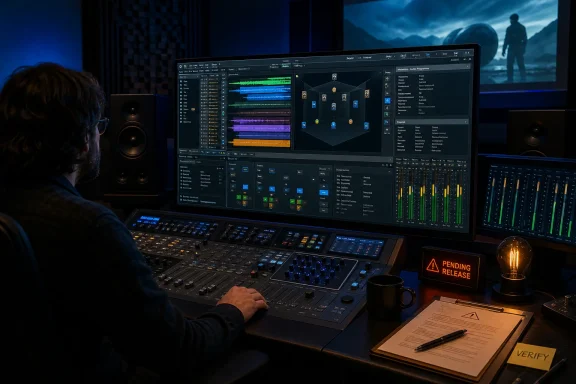 Spatial Panner consolidates editing, not delivery
According to Digital Production, the new Spatial Panner can show all sources feeding a selected target, with track colours, peak metering, solo/mute controls, hiding and multi-selection. The reported interface supports mono through 22.2 layouts, with two-dimensional front, top and side views plus an optional 3D cube to visualise the active speaker arrangement.The important distinction is between authoring and rendering. Spatial Panner appears to be a new control and routing workflow—one that supplies new placement behaviour for surround and immersive work—not a replacement Dolby Atmos renderer or a new public spatial-audio API. Sequoia’s existing ADM Editor and Atmos workflow remain the components responsible for the associated metadata and master-file path.
For an engineer, that means the update should reduce the friction of editing position across multiple delivery targets. It does not eliminate the separate job of monitoring those targets, checking downmixes, reviewing object behaviour, validating ADM metadata, or signing off the rendered master. A panner can make intent more consistent; it cannot prove that a stereo fold-down, 5.1 broadcast version and Atmos master will behave acceptably in their respective playback environments.
Boris FX’s public Sequoia 2026 page already presents the DAW as an immersive production system with an ADM editor and Dolby Atmos rendering. It also documents the 2026 release’s FX I/O Matrix for complex multichannel plug-in routing. The reported 2026.5 change is therefore a workflow layer above an established feature set: it brings visual source management and cross-target pan editing closer to the point where engineers make creative and technical placement decisions.
Linked targets are useful, but not automatic translation
The pivotal reported feature is a chain control that links a source’s panning across several target buses. Move a source while the link is active and its stereo, surround and immersive routes can move together; unlink a particular target and subsequent panning and automation become specific to that route.That is a sensible answer to a recurring problem in long-form classical recording, broadcast mixing and post: the same source may appear in more than one deliverable, but identical coordinates do not mean identical listening results. A stereo bus has only left-right placement. An Atmos target can carry height and depth. A surround target may use its own speaker geometry and monitoring conventions.
The danger is assuming linked editing creates an automatic downmix or a guaranteed translation between formats. It does not. A violin section, effects stem or spot microphone that sounds naturally placed in an immersive layout can acquire an inappropriate prominence, phantom-centre shift or ambience imbalance when folded into stereo. Digital Production’s description explicitly notes that an individual target can be unlinked for its own placement and automation. That is not a small exception to the workflow; it is the control that makes the workflow usable in professional delivery.
Teams should read the chain control as a way to establish a shared starting state, then deliberately create exceptions where the listening result demands them. The right operational rule is still to audition every delivery bus on its intended monitoring path—not to accept cross-format synchronization as evidence of cross-format equivalence.
Stereo and multichannel controls show this is more than a new viewport
Digital Production reports that mono and multichannel sources can move on left-right, front-back and bottom-top axes, with Speaker Snap for direct placement on loudspeaker positions, centre divergence, independent LFE level, rotation, movement modifiers and position presets. Stereo sources reportedly gain a pair handle, width control and three symmetry behaviours: Parallel, Angle and Independent.Those controls point to more than a cosmetic reorganisation. A stereo pair needs different creative constraints from a point-like mono object; it may remain parallel, turn toward the listening position, or separate into independently placed channels. A surround source has different constraints again. Putting those source models and target configurations into a common workspace could save operators from repeatedly opening and reconciling isolated panner windows.
But the release description should not be oversold as a format-agnostic spatial processor. Sequoia’s established stereo panning remains available, and Digital Production says Matrix mode, panning presets and external VST panners are retained. That preservation is valuable for compatibility: sessions built around known third-party panners or established pan laws should not have to migrate creative choices merely because a new unified panel is available.
It also underlines a missing technical detail. Neither the currently public Boris FX documentation nor the reporting examined here supplies a build-by-build migration note explaining how existing panning automation appears in Spatial Panner, whether legacy pan modes are translated non-destructively, or how projects behave when opened again in Sequoia 2026. Those are the questions a facility needs answered before putting 2026.5 into a shared production environment.
ADM and Atmos remain the checkpoint for deliverables
The reported release retains Sequoia’s ADM Editor and Dolby Atmos integration, rather than absorbing those stages into the new panner. That separation is correct. Audio Definition Model metadata describes the technical and positional structure associated with an immersive programme, while the renderer turns audio plus authored metadata into monitoring and deliverable outputs.Sequoia 2026’s public materials already position the product for ADM and Atmos work. The 2026.5 reporting adds a more direct editing environment ahead of that pipeline. The new panel may make it easier to see the relationship between microphones, beds and objects, but it does not relax the technical requirements that govern a valid immersive deliverable.
In particular, operators should continue to verify bed and object assignments, LFE routing, binaural monitoring choices, automation boundaries and the final ADM master in the intended renderer path. Production templates may contain special routing for low-frequency content because Atmos objects themselves do not carry LFE in the same way a bed does. A more elegant panning interface cannot be allowed to obscure that underlying routing design.
ARA and video improvements need separate verification
Digital Production also reports expanded ARA support, with compatible ARA plug-ins automatically detected and capable of full-clip analysis from Sequoia’s arranger. The named workflow is SoundApp ARA, Boris FX’s stem-separation and audio-cleanup tool.This portion has an independent primary-source foundation, though not yet specifically for Sequoia 2026.5. Boris FX announced SoundApp ARA in May for use in Sequoia, Samplitude, Pro Tools, Reaper, Cubase and other ARA-capable hosts. The company described full-clip analysis and cached processing designed to avoid export-and-reimport cycles. What remains unconfirmed in Boris FX’s Sequoia materials is whether 2026.5 changes the host implementation beyond existing ARA2 compatibility, which Sequoia 2026 already advertised.
The same version discipline applies to video. Boris FX’s Sequoia 2026 page confirms that the base 2026 release added GPU-accelerated video playback, AVC, HEVC and AV1 support, native Apple ProRes support, and 4K playback up to 60 fps. Digital Production attributes improved timecode synchronization, more flexible Blackmagic hardware support, multistream audio and a revised preview to 2026.5.
Those are plausible and potentially consequential upgrades for post rooms, but they are presently single-sourced. Blackmagic I/O and timecode changes should be tested with the exact card, driver, signal format, reference setup and external deck or router used in production. A generic “improved support” claim is not compatibility certification for a facility’s particular hardware chain.
The Windows deployment advice is to wait for the primary record
Sequoia remains a 64-bit Windows-only application for Windows 10 and Windows 11. Boris FX lists subscriptions at $95 per month or $595 per year, a $1,695 perpetual licence with one year of Upgrade and Support, and a $595 upgrade from a prior Sequoia version. Its public FAQ says perpetual licences continue functioning after Upgrade and Support expires, although access to later releases depends on renewed entitlement.That makes confirmation of 2026.5 eligibility more than administrative detail. Annual subscribers should expect an answer on whether the update appears immediately in Boris FX Hub; perpetual owners need to know whether an active Upgrade and Support term is required; and licence administrators need a documented build number before approving deployment. Boris FX’s currently available Sequoia FAQ still contains an outdated reference to activating “Sequoia 2025,” a reminder that storefront and support text can lag the product cycle.
For now, the sensible move is to preserve a known-good Sequoia 2026 installation and use a non-production Windows workstation to test 2026.5 once Boris FX publishes the installer and release notes. Test panning automation, linked versus unlinked targets, existing ADM projects, external VST and ARA plug-in recall, AAF/OMF interchange, video synchronization, Blackmagic I/O, EUCON control and the full monitoring chain.
Spatial Panner could remove a meaningful amount of duplicated placement work from immersive sessions. Until Boris FX publishes the primary release record and a verifiable build, however, it is a feature to evaluate—not an update to roll across a facility.