
That distinction changes the practical reading of the news. Siloton is developing a promising chip-based optical coherence tomography, or OCT, platform for a genuine astronaut health problem. But there is no public evidence that its scanner has been selected for NASA’s Artemis hardware, scheduled for the International Space Station, or cleared to replace the eye-imaging equipment now used in orbit. For space-medicine watchers, this is a progress report on an existing technology effort—not a newly funded flight program.
 Siloton’s ESA relationship predates the current report
Siloton’s October 29, 2024 announcement said ESA was among its customers and described the agency’s need for a long-term way to monitor eye problems astronauts can develop in space. The company repeated that language in a July 2025 announcement concerning an Australian deployment of its terrestrial imaging equipment. Bloomberg then covered the ESA-related work in its November 7, 2025 newsletter on the vision risks of long-duration spaceflight.
Those records support the core claim that ESA has engaged Siloton. They do not establish the details implied by a fresh commissioning announcement: how much ESA is paying, which ESA program owns the work, what technical requirements the scanner must meet, whether it will fly, or when it could be delivered.
ESA’s public newsroom and press-release archive do not currently show a corresponding 2026 announcement naming Siloton or a new astronaut-eye-scanner contract. That absence does not prove there is no active procurement or technical study; agencies routinely conduct work through contracts and programs that receive little public promotion. It does mean readers should not treat the August 10 report as confirmation of a new ESA milestone.
Siloton itself has been careful in its formal releases to frame its technology as a developing product. Its commercial roadmap has centered on portable eye imaging for clinics, community care, home monitoring, and underserved locations on Earth. In November 2025, the company said an Innovate UK contract would help it prepare a roadmap for NHS adoption by 2030. That is a notably different maturity level from a human-rated spaceflight medical device.
SANS is serious, but its cause is still unsettled
The medical rationale is not speculative. NASA calls Spaceflight-Associated Neuro-ocular Syndrome, or SANS, a top human-health risk for longer missions. NASA says about 70% of astronauts aboard the ISS experience some swelling in the back of their eyes, though the agency also stresses that effects range from mild changes to clinically significant outcomes.
SANS can include optic-disc swelling, choroidal or retinal folds, flattening of the rear of the eyeball, and a hyperopic shift that reduces near-vision performance. NASA’s current evidence points to several possible contributors rather than a closed case: the headward redistribution of blood and cerebrospinal fluid in microgravity is central to the investigation, but carbon-dioxide exposure, inflammation, genetics, radiation, nutrition, and other physiological factors remain under study.
The widely repeated John Phillips example illustrates why the issue has endured. Phillips spent nearly six months aboard the ISS during Expedition 11 in 2005. Accounts later reported that his vision changed from 20/20 to 20/100 after the mission, with structural changes including posterior-eye flattening and optic-nerve effects. His sight improved after returning to Earth, but not completely to its prior level.
The important operational consequence is that better imaging is valuable even before a prevention or treatment is found. A crew needs to know whether an apparent vision change is a temporary refractive issue, a developing structural change, or evidence that a countermeasure should be adjusted. For Mars-class missions, delayed or limited access to specialists makes the quality and repeatability of self-collected medical data as important as the scanner’s size.
The current ISS OCT setup is exactly what smaller systems aim to change
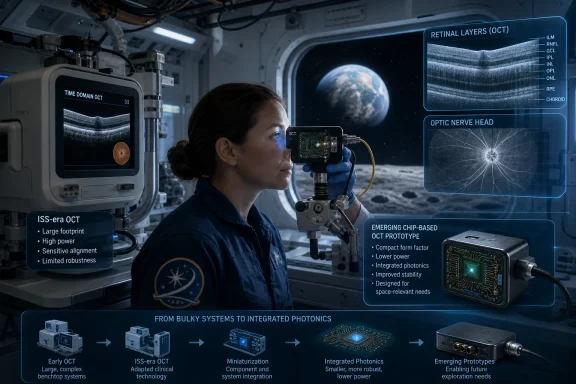
NASA already uses OCT in orbit. The technique creates micrometer-scale, cross-sectional images of tissue using light; for SANS, it gives clinicians a far more useful view of retinal layers and the optic-nerve region than a simple vision chart can provide. NASA has flown the Heidelberg Spectralis OCT platform on the ISS and uses OCT alongside visual-acuity testing, ocular ultrasound, and other eye-health checks.
The limitations are documented in NASA’s own operational material. In-flight OCT procedures currently require two crew members, and NASA training material says the activity relies on live video streaming to the ground and active coaching from a remote guider. That model is manageable on the ISS, where near-continuous communications and a large ground medical team are available. It is a poor fit for a smaller lunar crew and worse for a Mars mission, where communications delays can run into minutes each way.
NASA’s response is already in development. Its Mini OCT project is intended to cut the mass and volume of the current ISS-class system, eliminate the need for eye dilation, and allow the astronaut being examined to operate the device without a second crew member. NASA’s TechPort database still lists an ISS technical demonstration for 2027.
That date is the concrete benchmark omitted by the current Siloton coverage. NASA’s Mini OCT is a publicly documented project with a stated ISS demonstration target. Siloton’s ESA work may eventually complement it, compete with it, provide a component-level alternative, or serve a different agency requirement. Publicly available material does not yet say which.
A photonic chip solves only part of the flight problem
Siloton’s technical proposition is credible and straightforward: place much of the optical path that normally requires a tabletop of mirrors, lenses, and fiber-optic components onto a photonic integrated circuit smaller than a coin. Its first-generation Akepa chip contains more than 300 optical and electronic elements, and the company said it obtained its first live human-eye OCT image with the chip in October 2024 before acquiring patient images in April 2025.
This kind of integration could make OCT systems smaller, sturdier, cheaper to manufacture, and more suitable for use outside a hospital. The same qualities matter in space, where volume, mass, crew time, maintenance needs, and the number of trained operators all compete with mission priorities.
But a smaller photonic chip is not automatically a smaller or flight-ready eye scanner. A clinical OCT instrument still needs a light source, detectors, scan mechanics or optical steering, power management, onboard processing, calibration, stable alignment, protective housing, a usable interface, and a way to transmit or interpret the scans. For a spacecraft deployment, it must also satisfy stringent reliability, electromagnetic compatibility, safety, environmental, and human-factors requirements.
Siloton has demonstrated the key photonic-imaging concept in people. It has not publicly announced that a complete self-operated device has passed the spaceflight qualification campaign those requirements would demand. The company’s most visible commercial deployments remain terrestrial: in July 2025 it announced the sale of two chip modules and one full chip-OCT imaging system to Australia’s Project Ginan for feasibility work in remote First Nations communities.
That Earth-side work is relevant. Devices designed for remote care have to tolerate travel, limited infrastructure, non-specialist use, and inconsistent access to expert assistance—conditions that overlap with some spaceflight constraints. Still, clinical field feasibility and astronaut medical-device certification are separate stages, with separate failure modes.
The near-term story is medical autonomy, not an Artemis scanner
The strongest conclusion is that ESA’s relationship with Siloton is a legitimate sign that chip-scale OCT has attracted attention from space medicine. It should not be described as a newly disclosed Artemis deployment, and it is too early to present the company’s system as a NASA-ready substitute for the ISS OCT workflow.
NASA’s planned Mini OCT demonstration in 2027 is the nearer public milestone. Until ESA, Siloton, or NASA publishes an award value, a qualification plan, an ISS demonstration date, or a named Artemis integration path, Siloton’s scanner remains an enabling technology under development rather than equipment astronauts can rely on in deep space.
References
- Primary source: en.softonic.com
Published: August 10, 2026 at 9:20 AM UTC
Loading…
en.softonic.com - Related coverage: esa.int
Loading…
www.esa.int - Related coverage: siloton.com
Loading…
siloton.com - Related coverage: siloton.com
Loading…
siloton.com - Related coverage: bloomberg.com
Loading…
www.bloomberg.com