
SonicWall’s endpoint-security pitch has an important problem for Windows administrators: the product described as “Native EDR/EPP” does not match SonicWall’s own current product record. IT Voice’s August 6 post presents a new, entirely in-house SonicWall endpoint agent that combines next-generation antivirus and EDR, but SonicWall’s documented endpoint offering remains Capture Client, whose threat protection and hunting capabilities are explicitly powered by SentinelOne.
That is more than branding semantics. An IT team evaluating endpoint protection needs to know which agent is installed, who supplies its underlying detection engine, what operating systems it supports today, how it behaves alongside Microsoft Defender, and whether there is actually a newly available product to buy. On those points, the published pitch leaves out pricing, SKUs, release dates, management-console details, migration terms and a support matrix — while contradicting several details in SonicWall’s own documentation.
The practical conclusion is straightforward: treat “SonicWall Native EDR/EPP” as an unverified marketing label, not a confirmed new SonicWall endpoint platform, until SonicWall publishes a product announcement, licensing information, technical documentation and supported-agent details. Existing SonicWall customers should assess Capture Client on its documented SentinelOne-based architecture rather than assume a new in-house replacement has arrived.
SonicWall’s current endpoint-security page identifies Capture Client as its unified EDR platform. It advertises behavior-based malware protection, advanced threat hunting, vulnerability visibility, attack visualization, rollback, remediation, network control and remote-shell functions managed through Capture Security Center.
But the same official product page says Capture Client’s threat-hunting capability is “powered by SentinelOne.” Its package comparison also labels the next-generation antivirus component as SentinelOne-powered, including the edition with rollback capability. That is a direct conflict with the IT Voice assertion that SonicWall’s endpoint security is entirely developed in-house rather than OEM’d or rebranded.
SonicWall’s support documentation is even less ambiguous. Its Capture Client agent-compatibility knowledge base says SonicWall validates SentinelOne’s general-availability agent builds before integrating them with Capture Client. The published compatibility table maps Capture Client releases to specific SentinelOne Windows, macOS and Linux agent versions.
For Windows administrators, the deployment evidence is visible on endpoints as well. SonicWall documentation refers to the installed protection component as the SentinelOne agent, while older validation guidance points administrators to the SentinelOne installation path and
SonicWall may own the Capture Client management experience, policy layer, tenant controls and integration with its firewall and Capture ATP products. That can still be valuable, particularly for MSPs that want one portal for customers already using SonicWall appliances. It does not turn the underlying endpoint detection engine into an in-house SonicWall product.
RTDMI is designed to analyze suspicious code in memory while it executes in a protected analysis environment. SonicWall says the method is intended to expose malware that conceals malicious code through packing, encryption or evasion techniques, including previously unknown malware. Those are meaningful capabilities, and they are part of SonicWall’s longstanding advanced-threat analysis story.
The operational distinction is important. SonicWall’s Capture Client product page says Capture Client integrates with Capture ATP so that suspicious files can be sent for analysis that an endpoint cannot perform locally. In other words, RTDMI is part of an integrated security stack, not evidence that the endpoint sensor itself is a SonicWall-built EDR engine.
That does not diminish the case for layered protection. A Windows endpoint agent can generate telemetry and block or remediate local activity, while a cloud sandbox provides a separate verdict on suspicious files and shares intelligence back into the platform. But buyers should not confuse a SonicWall cloud-analysis service with an agent architecture that SonicWall has not publicly documented.
The IT Voice description also treats fileless attacks as though RTDMI alone settles the question. Fileless and living-off-the-land activity require visibility into process execution, scripting engines, credential access, persistence mechanisms and network behavior on the device. Those are EDR functions. SonicWall’s own documentation attributes its Capture Client deep visibility, remote shell and threat-hunting workflows to the SentinelOne-backed portion of the service.
SonicWall’s Capture Client system-requirements page identifies the product as an endpoint-security solution for Windows, macOS and Linux. Separate support pages list supported Linux distributions and macOS releases, plus the required SentinelOne agent versions. The Linux guide covers enterprise distributions including Red Hat Enterprise Linux, Ubuntu, Debian, SUSE, Amazon Linux, Oracle Linux and Rocky Linux; it also spells out architecture, kernel and container constraints.
SonicWall’s Capture Client Premier documentation states that Remote Shell works on Windows, macOS and Linux. It further notes that the feature requires multifactor authentication and is available on request. That is the sort of condition administrators need in a deployment plan, and it is absent from the “one agent, full lifecycle” claim.
The existing Windows support matrix is broader than the IT Voice post suggests, but it also contains caveats. SonicWall documents differing agent tracks for modern and legacy Windows versions. For example, current Windows 11 and Windows 10 64-bit devices, along with Windows Server 2012 R2 through Windows Server 2022 and newer Server releases, use newer agent versions; older Windows and Windows Server editions may require an older SentinelOne build.
That matters for organizations still carrying Windows 7, Windows 8, Windows Server 2008 R2 or Server 2012 workloads. “Windows supported” is not enough information. Administrators need exact OS build coverage, agent branch, kernel-driver compatibility, reboot requirements, exclusion handling and an upgrade plan.
For Windows 10, SonicWall says that when the Capture Client protection agent registers with Windows Security Center, SentinelOne becomes the primary virus-and-threat-protection provider instead of Microsoft Defender unless a policy override is configured to allow Defender. For Windows Server 2016 and Windows Server 2019, SonicWall says administrators should consider uninstalling Microsoft Defender Antivirus to prevent interoperability issues.
Those are not unusual warnings in the endpoint-security industry. Running multiple real-time security products can introduce competing file-system filters, process hooks, performance degradation and alert confusion. The problem is the unqualified claim of coexistence: it can lead a Windows team to treat parallel protection as a default-safe configuration rather than a configuration requiring lab testing, documented exclusions and clear ownership of incident response.
Before rollout, an IT department should establish which product owns real-time prevention, whether Defender runs in active, passive or disabled mode, whether the server fleet needs a different policy from user endpoints, and how Microsoft Defender for Endpoint telemetry will coexist with Capture Client telemetry. If third-party EDR, backup agents, database engines or line-of-business software need exclusions, test them under actual workload before broad deployment.
Those numbers may still be useful historical context, but on August 6, 2026, they are not evidence about the current ransomware rate in India or the efficacy of a newly described SonicWall endpoint product. The “past year” language in the promotional copy strips away the survey period and makes a two-year-old data point sound current.
More importantly, the Sophos research does not validate the platform claims attached to it. A high ransomware incidence supports the need for endpoint controls, tested backups, identity hardening, network segmentation and incident-response planning. It does not prove that a particular agent is native, lightweight, capable of restoring files, or ready to replace an incumbent EDR product.
Administrators should obtain written answers to several deployment questions before accepting the new framing:
The practical conclusion is straightforward: treat “SonicWall Native EDR/EPP” as an unverified marketing label, not a confirmed new SonicWall endpoint platform, until SonicWall publishes a product announcement, licensing information, technical documentation and supported-agent details. Existing SonicWall customers should assess Capture Client on its documented SentinelOne-based architecture rather than assume a new in-house replacement has arrived.
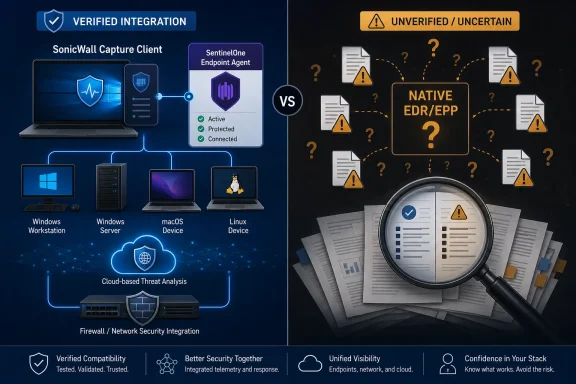 Capture Client is the documented SonicWall endpoint product
SonicWall’s current endpoint-security page identifies Capture Client as its unified EDR platform. It advertises behavior-based malware protection, advanced threat hunting, vulnerability visibility, attack visualization, rollback, remediation, network control and remote-shell functions managed through Capture Security Center.But the same official product page says Capture Client’s threat-hunting capability is “powered by SentinelOne.” Its package comparison also labels the next-generation antivirus component as SentinelOne-powered, including the edition with rollback capability. That is a direct conflict with the IT Voice assertion that SonicWall’s endpoint security is entirely developed in-house rather than OEM’d or rebranded.
SonicWall’s support documentation is even less ambiguous. Its Capture Client agent-compatibility knowledge base says SonicWall validates SentinelOne’s general-availability agent builds before integrating them with Capture Client. The published compatibility table maps Capture Client releases to specific SentinelOne Windows, macOS and Linux agent versions.
For Windows administrators, the deployment evidence is visible on endpoints as well. SonicWall documentation refers to the installed protection component as the SentinelOne agent, while older validation guidance points administrators to the SentinelOne installation path and
sentinelctl management utility. A current SonicWall interoperability article also describes SentinelOne threat-protection DLLs injecting into monitored Windows processes.SonicWall may own the Capture Client management experience, policy layer, tenant controls and integration with its firewall and Capture ATP products. That can still be valuable, particularly for MSPs that want one portal for customers already using SonicWall appliances. It does not turn the underlying endpoint detection engine into an in-house SonicWall product.
RTDMI is a cloud-analysis capability, not proof of a native endpoint engine
The IT Voice post places SonicWall’s Real-Time Deep Memory Inspection, or RTDMI, at the center of the claimed native EDR/EPP agent. SonicWall’s public technical record places RTDMI elsewhere: in its Capture Cloud and Capture Advanced Threat Protection service.RTDMI is designed to analyze suspicious code in memory while it executes in a protected analysis environment. SonicWall says the method is intended to expose malware that conceals malicious code through packing, encryption or evasion techniques, including previously unknown malware. Those are meaningful capabilities, and they are part of SonicWall’s longstanding advanced-threat analysis story.
The operational distinction is important. SonicWall’s Capture Client product page says Capture Client integrates with Capture ATP so that suspicious files can be sent for analysis that an endpoint cannot perform locally. In other words, RTDMI is part of an integrated security stack, not evidence that the endpoint sensor itself is a SonicWall-built EDR engine.
That does not diminish the case for layered protection. A Windows endpoint agent can generate telemetry and block or remediate local activity, while a cloud sandbox provides a separate verdict on suspicious files and shares intelligence back into the platform. But buyers should not confuse a SonicWall cloud-analysis service with an agent architecture that SonicWall has not publicly documented.
The IT Voice description also treats fileless attacks as though RTDMI alone settles the question. Fileless and living-off-the-land activity require visibility into process execution, scripting engines, credential access, persistence mechanisms and network behavior on the device. Those are EDR functions. SonicWall’s own documentation attributes its Capture Client deep visibility, remote shell and threat-hunting workflows to the SentinelOne-backed portion of the service.
macOS and Linux are already supported, not merely on a roadmap
The claim that Windows PCs and Windows Server are supported “at launch,” with macOS and Linux still on the roadmap, is also inconsistent with existing SonicWall documentation.SonicWall’s Capture Client system-requirements page identifies the product as an endpoint-security solution for Windows, macOS and Linux. Separate support pages list supported Linux distributions and macOS releases, plus the required SentinelOne agent versions. The Linux guide covers enterprise distributions including Red Hat Enterprise Linux, Ubuntu, Debian, SUSE, Amazon Linux, Oracle Linux and Rocky Linux; it also spells out architecture, kernel and container constraints.
SonicWall’s Capture Client Premier documentation states that Remote Shell works on Windows, macOS and Linux. It further notes that the feature requires multifactor authentication and is available on request. That is the sort of condition administrators need in a deployment plan, and it is absent from the “one agent, full lifecycle” claim.
The existing Windows support matrix is broader than the IT Voice post suggests, but it also contains caveats. SonicWall documents differing agent tracks for modern and legacy Windows versions. For example, current Windows 11 and Windows 10 64-bit devices, along with Windows Server 2012 R2 through Windows Server 2022 and newer Server releases, use newer agent versions; older Windows and Windows Server editions may require an older SentinelOne build.
That matters for organizations still carrying Windows 7, Windows 8, Windows Server 2008 R2 or Server 2012 workloads. “Windows supported” is not enough information. Administrators need exact OS build coverage, agent branch, kernel-driver compatibility, reboot requirements, exclusion handling and an upgrade plan.
Defender coexistence needs validation, not a slogan
The post says the proposed agent coexists with Microsoft Defender and other tools, avoiding a rip-and-replace deployment. SonicWall’s published Windows guidance supports a much more qualified reading.For Windows 10, SonicWall says that when the Capture Client protection agent registers with Windows Security Center, SentinelOne becomes the primary virus-and-threat-protection provider instead of Microsoft Defender unless a policy override is configured to allow Defender. For Windows Server 2016 and Windows Server 2019, SonicWall says administrators should consider uninstalling Microsoft Defender Antivirus to prevent interoperability issues.
Those are not unusual warnings in the endpoint-security industry. Running multiple real-time security products can introduce competing file-system filters, process hooks, performance degradation and alert confusion. The problem is the unqualified claim of coexistence: it can lead a Windows team to treat parallel protection as a default-safe configuration rather than a configuration requiring lab testing, documented exclusions and clear ownership of incident response.
Before rollout, an IT department should establish which product owns real-time prevention, whether Defender runs in active, passive or disabled mode, whether the server fleet needs a different policy from user endpoints, and how Microsoft Defender for Endpoint telemetry will coexist with Capture Client telemetry. If third-party EDR, backup agents, database engines or line-of-business software need exclusions, test them under actual workload before broad deployment.
The ransomware statistic is old and does not prove a product claim
The IT Voice article’s Indian ransomware figures come from Sophos’s State of Ransomware in India 2024 research, as reported by TechCircle in May 2024. The survey covered 500 Indian IT decision-makers and was conducted in January and February 2024. It found that 64% of surveyed organizations reported ransomware in the prior year and that 65% of affected organizations paid a ransom to recover data.Those numbers may still be useful historical context, but on August 6, 2026, they are not evidence about the current ransomware rate in India or the efficacy of a newly described SonicWall endpoint product. The “past year” language in the promotional copy strips away the survey period and makes a two-year-old data point sound current.
More importantly, the Sophos research does not validate the platform claims attached to it. A high ransomware incidence supports the need for endpoint controls, tested backups, identity hardening, network segmentation and incident-response planning. It does not prove that a particular agent is native, lightweight, capable of restoring files, or ready to replace an incumbent EDR product.
What SonicWall customers should verify before acting
The existing Capture Client offering may still be a rational choice for a SonicWall-heavy environment. Its central management, multi-tenant view, firewall integration, Capture ATP connection, remote shell and policy features can reduce operational friction for MSPs and smaller IT teams. The issue is that those benefits should be evaluated as Capture Client capabilities, with a SentinelOne-based protection layer, rather than under an unverified claim of a new native EDR/EPP platform.Administrators should obtain written answers to several deployment questions before accepting the new framing:
- SonicWall should identify the exact product name, SKU, licensing model and general-availability date for any “Native EDR/EPP” offering.
- SonicWall should state whether the endpoint sensor is distinct from Capture Client and whether it replaces, supplements or continues to rely on SentinelOne technology.
- Buyers should request a current Windows, Windows Server, macOS and Linux support matrix, including the agent versions, unsupported operating systems and hardware requirements.
- Teams running Microsoft Defender should require vendor-supported coexistence guidance for Windows clients and Windows Server, rather than assume both products can run in fully active modes.
- MSPs should confirm which multi-tenant, ticketing, RBAC, threat-hunting, rollback and file-restoration functions are included in the license being quoted.
References
- Primary source: IT Voice Media Pvt. Ltd.
Published: 2026-08-06T07:27:08+00:00
Loading…
www.itvoice.in - Related coverage: sonicwall.com
Loading…
www.sonicwall.com - Related coverage: sonicwall.com
Loading…
www.sonicwall.com - Related coverage: cse-docs.sonicwall.com
Loading…
cse-docs.sonicwall.com - Related coverage: sonicwall.com.hk
Loading…
www.sonicwall.com.hk - Related coverage: sonicwall.com.hk
Loading…
www.sonicwall.com.hk - Related coverage: secaas.sonicwall.com
Loading…
secaas.sonicwall.com - Related coverage: linkedin.com
Loading…
www.linkedin.com - Related coverage: webobjects2.cdw.com
Loading…
webobjects2.cdw.com - Related coverage: primeq.se
Loading…
www.primeq.se