
That number demands attention, but it also demands restraint. The announced total is not a single cash transaction, a single construction commitment, or a guaranteed order book. It aggregates memorandums of understanding, strategic frameworks, prospective supply relationships and investment plans involving companies including Samsung Electronics, SK Group, Nvidia, Broadcom, Anthropic, Naver, Hyundai Motor Group and SK Telecom. The agreements may still reshape the global AI supply chain, yet their eventual value will depend on execution, demand, financing, power availability and the pace at which AI infrastructure moves from ambitious planning to deployed capacity.
For Windows users, PC builders and enterprise IT leaders, the summit matters because AI is increasingly defined not only by the models people use, but by the hardware, memory, power systems and data centers beneath them. South Korea is positioning itself as the manufacturing and deployment engine for that next phase. Silicon Valley provides the AI platforms, accelerator designs, cloud demand and capital. Seoul wants to supply the crucial components—and become one of the first national-scale proving grounds for AI everywhere from factories to logistics networks.
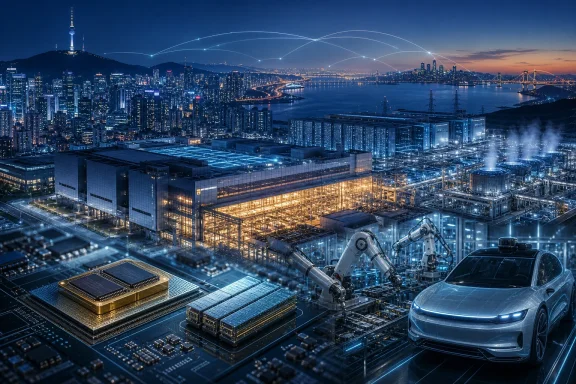 From Chimaek Diplomacy to AI Industrial Strategy
The phrase “chimaek diplomacy” may sound lighthearted, but it captures a serious strategic reality. Nvidia chief executive Jensen Huang has become closely associated with highly public appearances in South Korea, where his informal meals and enthusiasm for local food have reinforced the country’s reputation as one of the world’s most AI-focused technology markets.
During President Lee Jae Myung’s San Francisco visit on July 24, 2026, that cultural connection was folded into an overt industrial agenda. Lee met separately with Huang, OpenAI chief executive Sam Altman, Anthropic chief executive Dario Amodei and Broadcom chief executive Hock Tan. The gathering also brought together leaders from South Korea’s largest conglomerates, particularly Samsung and SK.
The message was straightforward: South Korea does not merely want to sell memory chips into the AI boom. It wants to become an indispensable AI supply-chain nation, a high-capacity site for AI infrastructure, and a place where companies can test large-scale deployments of AI in physical industries.
That ambition was formalized through the San Francisco AI Declaration, which presented South Korea as both a trusted production base and a testbed for real-world AI adoption. The wording matters. “Trusted production base” addresses the manufacturing side of AI, particularly advanced memory and semiconductor fabrication. “Testbed” addresses the harder challenge of proving that AI can improve factories, transportation, robotics, vehicles, public services and enterprise operations outside the chatbot window.
What the $950 Billion Figure Actually Represents
The $950 billion figure is large enough to invite comparisons with national economies, but it should not be treated as if it were a single completed deal. Officials have characterized the package as a set of long-term cooperation frameworks and planned business arrangements spread across five years.
That distinction is essential.
A memorandum of understanding can establish direction without obligating either party to spend the entire headline amount. A supply agreement may be contingent on future capacity, technology qualifications and end-market demand. A planned data center can require years of permitting, grid expansion, financing, land acquisition and equipment deliveries before it becomes operational.
The value of the announcements lies less in a one-day financial total than in the signal they send: major Korean and American technology companies increasingly view AI infrastructure as a connected industrial system rather than a collection of separate products.
The three pillars of the Korean strategy
The summit package is organized around three broad areas:
- Advanced semiconductors, especially high-bandwidth memory and custom AI chip manufacturing
- AI data centers, including large-scale GPU and accelerator deployments
- Physical AI, covering robotics, autonomous vehicles, smart factories and industrial automation
This approach reflects the realities of modern AI. Powerful models require accelerators. Accelerators require huge amounts of advanced memory. Those systems need data centers, networking, electrical infrastructure and cooling. To create durable economic value, the computing capacity then needs to be applied to business workflows and physical operations.
South Korea’s strategy is to participate in every stage of that stack.
The largest announced components
The biggest announced commitment centers on SK Group, which is expected to pursue long-term advanced-memory supply cooperation valued at about $750 billion over five years with Nvidia and other global technology firms. The figure includes a broader group of customers and opportunities, rather than representing only a bilateral Nvidia-SK arrangement.
Samsung Electronics, meanwhile, signed a memorandum of understanding with Broadcom covering approximately $200 billion over five years. The cooperation is expected to encompass advanced-memory supply and foundry work for AI chips. That is strategically important because Broadcom has become a major player in custom AI accelerators designed for large cloud operators and hyperscale infrastructure.
The two figures make up the bulk of the announced $950 billion total. Yet they also illustrate why caution is required: the numbers are best understood as forward-looking frameworks tied to an AI demand cycle, not as cash already booked or hardware already shipped.
Why Advanced Memory Has Become the Critical AI Bottleneck
The most significant technical theme of the summit is not the GPU alone. It is memory.
For years, public discussion of AI infrastructure has focused heavily on Nvidia’s GPUs. That focus is understandable; accelerators drive much of the training and inference workload behind modern generative AI. But an AI accelerator is only as useful as its ability to move enormous volumes of data quickly. That makes advanced memory, especially high-bandwidth memory, central to the economics and performance of AI systems.
GPUs need memory bandwidth, not just raw compute
Training and running large AI models require models, parameters, activations and intermediate data to move rapidly between compute units and memory. If memory cannot keep pace, expensive accelerators sit idle or operate inefficiently.
This is why companies such as SK hynix and Samsung occupy such pivotal positions. They are not peripheral suppliers to the AI boom. They are among the companies producing the advanced memory technologies that enable high-performance AI accelerators and servers to function at scale.
For Nvidia, Broadcom, cloud providers and AI model developers, securing dependable access to advanced memory is increasingly as important as securing access to chip fabrication capacity. For South Korea, that creates a rare strategic advantage: it already possesses deep manufacturing expertise in the component category that AI infrastructure cannot easily do without.
Samsung’s foundry opportunity
Samsung’s agreement with Broadcom is particularly notable because it reaches beyond memory. Samsung operates both a major memory business and a contract chipmaking operation. In principle, that gives it an opportunity to participate in AI infrastructure at multiple levels:
- Supplying advanced DRAM and high-bandwidth memory
- Manufacturing custom AI processors for external chip designers
- Providing packaging and integration capabilities
- Supporting an ecosystem built around specialized, workload-specific accelerators
Broadcom’s role in custom silicon is important here. Not every cloud company wants to rely entirely on general-purpose GPUs. Large operators increasingly pursue custom chips optimized for their own models, networks, software stacks and power constraints. If those designs reach mass deployment, the market for AI hardware could become more diverse—even if Nvidia remains the dominant platform supplier.
That diversification could benefit Samsung. It could also increase competitive pressure across the semiconductor supply chain, where manufacturing yields, packaging capacity and advanced-memory availability can determine whether a chip roadmap succeeds.
Nvidia, SK and the Scale of the AI Infrastructure Race
Nvidia and SK Group have placed the most eye-catching number at the center of the summit: a partnership described in terms exceeding $500 billion. Subsequent official accounting placed SK’s wider memory cooperation with Nvidia and other global technology customers at approximately $750 billion.
The gap between the two figures should not be viewed as a contradiction so much as a reminder that large strategic announcements often contain multiple layers. A bilateral relationship can sit within a broader set of multibuyer supply plans. Still, the underlying documentation, purchase schedules and delivery obligations will matter far more than the headline.
A broader partnership than memory supply
The Nvidia-SK relationship is not limited to memory chips. It includes work around AI data centers, cloud infrastructure and next-generation systems based on Nvidia platforms.
SK Telecom is expected to work with Nvidia on AI data-center expansion, including infrastructure tied to Nvidia’s newer Vera Rubin systems. The companies have discussed capacity on a scale that would be measured in gigawatts, a unit more commonly associated with power plants than with conventional corporate IT.
That is the new reality of frontier AI infrastructure. The limiting factors are no longer confined to server racks and software licenses. They include:
- Access to power at industrial scale
- Transmission and grid capacity
- Cooling systems and water management
- Land and construction timelines
- High-speed networking
- Memory and accelerator supply
- Skilled operations teams
- Regulatory approval and local-community acceptance
An AI factory is, in many respects, a modern utility-scale industrial facility. It may deliver digital services, but it must be planned with the discipline of an energy-intensive manufacturing project.
The promise and risk of two million GPUs
Officials have discussed cooperation around roughly five gigawatts of AI data-center capacity and approximately two million GPUs. Those are staggering figures. Even if the final mix includes multiple generations of hardware and a range of accelerator types, the scale would place South Korea among the world’s most aggressive AI infrastructure builders.
But building capacity is not the same as using it productively.
A country can install hardware and still struggle to generate a proportionate economic return. The profitability of AI infrastructure depends on whether demand emerges for enterprise AI, industrial automation, sovereign computing, cloud services, research workloads and consumer applications. It also depends on utilization. Idle capacity is expensive, particularly when it consumes power, occupies specialized facilities and depreciates rapidly.
South Korea’s advantage is that it is not attempting to build an AI ecosystem from scratch. It has semiconductor manufacturing, broadband networks, globally competitive electronics companies, advanced industrial firms and a technically sophisticated population. The challenge is converting those ingredients into sustainable AI services and productivity gains rather than simply producing more hardware for overseas customers.
The “AI Testbed” Argument: Why Korea Wants Deployment, Not Just Production
The San Francisco AI Declaration frames South Korea as a country that can put AI to work quickly. That may be the most important part of the strategy.
The global AI race has moved beyond model benchmarks and chatbot features. The next contest will center on deployment: who can safely integrate AI into manufacturing, logistics, automotive systems, robot fleets, customer operations, software development and public infrastructure.
South Korea has several strengths that make it a compelling location for this experiment.
Dense infrastructure and industrial depth
South Korea combines dense urban areas, advanced connectivity, a highly digitized consumer economy and large industrial groups that operate across manufacturing, automobiles, telecommunications, construction and electronics.
That provides a potentially powerful environment for physical AI. A company developing a warehouse robot, factory-automation platform or autonomous delivery system can find highly connected facilities, technically mature suppliers and sophisticated industrial customers within a compact geography.
The government’s approach is therefore not simply to subsidize data centers. It is to create a feedback loop:
- Build AI compute and semiconductor capacity.
- Make that capacity accessible to Korean companies and institutions.
- Deploy AI into industrial and civic environments.
- Gather operational lessons.
- Export the resulting hardware, software and deployment expertise.
If successful, that model could help South Korea move from being a critical supplier to becoming a higher-value owner of AI platforms, services and intellectual property.
Physical AI is an ambitious but difficult category
The summit also featured cooperation involving Hyundai Motor Group and Nvidia on a robot reference platform, intended to provide a standardized base for developing and validating AI-driven robots. There were also references to autonomous-vehicle collaboration involving Waymo, though public details remain limited.
“Physical AI” is a compelling phrase, but it covers some of the most difficult problems in technology. A language model can generate text in a relatively controlled software environment. A robot or autonomous vehicle must interpret unpredictable conditions, work safely around people and make decisions in real time.
The risks are higher:
- Hardware failures can have physical consequences.
- Sensors can be affected by weather, lighting and obstruction.
- AI systems must deal with rare events that may not appear in training data.
- Cybersecurity failures can become safety failures.
- Liability and regulation can delay deployment even when a prototype performs well.
South Korea’s testbed approach could accelerate progress, but it must not become a shortcut around safety validation. The world has seen that real-world autonomy is harder than demonstration videos suggest.
What This Means for Windows PCs and Enterprise IT
The summit may appear focused on hyperscale data centers, but its consequences will reach Windows PCs, workstations and business networks.
AI hardware demand affects virtually every part of the computing market. When data centers consume large shares of advanced memory, packaging capacity and leading-edge semiconductor production, the ripple effects can reach consumer hardware pricing, PC component availability and enterprise refresh cycles.
Memory demand can affect the PC market
High-bandwidth memory is not the same product as the DDR5 memory used in most desktop and laptop PCs. Still, the same global semiconductor manufacturers and supply chains are involved. When AI accelerators command extraordinary margins and capacity priority, suppliers may allocate more engineering effort, packaging capacity and capital expenditure toward AI-focused memory products.
For Windows PC enthusiasts, that can mean several things:
- Consumer memory pricing may become more volatile.
- High-end graphics cards may face continuing supply pressure.
- AI workstation components may command a premium.
- Laptop makers may emphasize integrated NPUs and memory efficiency.
- Enterprise buyers may have to plan longer hardware procurement cycles.
The impact will not be uniform. Consumer DRAM markets remain influenced by many factors, including smartphone demand, inventory levels and broader PC shipments. But AI’s appetite for advanced memory has turned memory suppliers into a strategic choke point in a way that is impossible to ignore.
Local AI and the Copilot+ PC era
Windows is increasingly moving toward hybrid AI computing. Some AI workloads run in the cloud, where vast GPU clusters process requests. Others are shifting to the device, where NPUs, GPUs and CPUs handle smaller tasks locally for better latency, lower cloud costs and improved privacy.
South Korea’s semiconductor push supports both models. Large AI data centers enable cloud-hosted assistants, enterprise agents and model training. Advanced chips and memory development can also help drive more capable edge devices, including Windows laptops, workstations, industrial PCs and robotics controllers.
For organizations using Windows, the practical outcome is likely to be a more fragmented but more capable AI landscape:
- Cloud AI for large-scale analysis and generative tasks
- Local AI for privacy-sensitive or latency-sensitive workflows
- On-premises AI systems for regulated industries
- Industrial AI for manufacturing equipment and robotics
- AI-enabled PCs that offload less work to remote servers
The key question is not whether AI will reach the Windows desktop. It already has. The question is whether the ecosystem can provide enough compute, memory, power efficiency and software reliability to make AI features genuinely useful rather than merely promotional.
The Strengths of the Korea–Silicon Valley Model
The summit’s biggest strength is its recognition that no single company or country can own the entire AI stack.
The United States leads in many of the most influential AI platforms, accelerator architectures, cloud services and frontier-model developers. South Korea has exceptional strength in memory, electronics manufacturing, industrial deployment and telecommunications. The partnership model links those strengths rather than treating them as separate markets.
Strong alignment with real demand
The deals are rooted in a tangible problem: AI companies and cloud providers need far more advanced memory, compute capacity and data-center infrastructure than previous forecasts assumed.
South Korea’s leading firms are not attempting to create demand from nothing. They are responding to a supply-chain constraint created by the rapid expansion of generative AI, custom accelerators and high-performance data centers.
A fuller view of the AI stack
The three-pillar framework—chips, data centers and physical AI—is more coherent than a strategy focused exclusively on national-language models or consumer chatbot access.
It acknowledges that AI competitiveness requires:
- Hardware production
- Compute infrastructure
- Power systems
- Networking
- Software and model development
- Industrial integration
- Workforce training
- Safety and security practices
That is a more credible foundation for long-term national AI policy than treating AI as a standalone app category.
Potential gains for research and skills
Nvidia and the Korea Advanced Institute of Science and Technology have also announced a joint AI research effort with a multi-year commitment. Research partnerships of this kind matter because hardware supply alone does not build domestic capability.
A sustainable AI ecosystem needs engineers who understand distributed systems, accelerator programming, model optimization, cybersecurity, robotics, data governance and sector-specific deployment. The more of that expertise South Korea develops internally, the less it will depend on external vendors for the highest-value layers of the AI economy.
The Risks Behind the Record Headlines
The sheer scale of the announcements creates equally large risks.
Frameworks can fail to become projects
The most immediate concern is execution. A long-term cooperation figure may be strategically meaningful, but it is not equivalent to a signed, financed and fully scheduled purchase order.
Demand forecasts can change. AI models may become more efficient. New chip architectures can alter procurement plans. Governments can tighten export controls. Data-center projects can be slowed by power shortages, local opposition or construction delays.
The real test will come in quarterly results, capacity additions, construction milestones and long-term supply disclosures—not in summit-stage estimates.
Power is the AI industry’s hard limit
AI infrastructure consumes enormous amounts of electricity. A multi-gigawatt data-center plan is not merely a technology project; it is a national energy and grid-planning challenge.
South Korea will need to balance AI expansion with energy affordability, grid resilience and climate commitments. Building data centers without securing reliable power risks producing expensive facilities that cannot operate at intended utilization levels. Building them with carbon-intensive power could create political and environmental backlash.
Geopolitical concentration remains a vulnerability
Closer U.S.-South Korea AI cooperation can strengthen supply-chain resilience among aligned partners. Yet it can also deepen dependence on a narrow set of countries and companies.
The AI stack already relies heavily on a limited number of advanced-chip designers, foundries, memory suppliers, cloud operators and equipment makers. Concentration can accelerate innovation, but it also increases exposure to export restrictions, trade disputes, regional instability and corporate pricing power.
AI safety, privacy and sovereignty cannot be afterthoughts
South Korea’s ambition to become an AI testbed raises important governance questions. Large-scale deployment can generate sensitive data from workers, consumers, factories, vehicles and public infrastructure.
The push for speed must be matched by clear safeguards around:
- Personal-data protection
- Cybersecurity standards
- Model security and misuse prevention
- Industrial-system resilience
- Accountability for automated decisions
- Safety validation for robots and autonomous systems
- Access and competition in AI services
The value of an AI testbed lies in producing trustworthy deployments, not merely fast ones.
A Defining Moment, Not a Finished Deal
The San Francisco AI Summit has given South Korea a powerful narrative: the country that helped supply the digital economy’s memory backbone now wants to help build the infrastructure, industrial systems and real-world applications of the AI era.
The $950 billion figure will dominate headlines, and rightly so. It reflects the extraordinary scale of capital and capacity now being mobilized around AI. But the more important story is structural. Samsung, SK, Nvidia, Broadcom, Anthropic, Naver, Hyundai and other players are aligning around an AI supply chain in which memory, foundry services, data centers, cloud platforms, robotics and software are inseparable.
For the Windows ecosystem, the implications will emerge gradually through component markets, AI PCs, developer tools, enterprise deployments and the availability of cloud compute. The next generation of Windows hardware will not be shaped only by what happens inside a laptop or desktop tower. It will be shaped by whether the global AI infrastructure race can deliver affordable compute, abundant memory, reliable power and software that earns users’ trust.
South Korea’s Silicon Valley makeover is therefore more than a diplomatic photo opportunity, and more than a chimaek-flavored anecdote. It is a high-stakes bet that the country can turn its semiconductor leadership into durable influence across the full AI stack. The summit has established the ambition. The difficult work now is turning frameworks into factories, capacity into useful services, and vast AI infrastructure into measurable economic value.
Update: Opposition criticizes summit’s AI declaration as political branding (July 27, 2026)
As reported by Maeil Business Newspaper on July 27, South Korean opposition floor leader Choi Jeong-sik criticized President Lee Jae Myung’s San Francisco AI Declaration, arguing that its announcement during a U.S. trip turned corporate cooperation into an “image-making” event.
The criticism does not add new details about the semiconductor, data-center or physical-AI arrangements themselves, nor does it alter the reported scale of the announced frameworks. It does, however, introduce domestic political pressure around how the summit’s outcomes are presented and who should receive credit for them.
For technology leaders and investors, the practical implication is that South Korea’s AI industrial push may face more scrutiny at home over transparency, the specificity of commitments and the use of major conglomerates in government-led announcements. The underlying projects will still be judged by contracts, production capacity, data-center construction and delivered systems—not political messaging around the declaration.
