
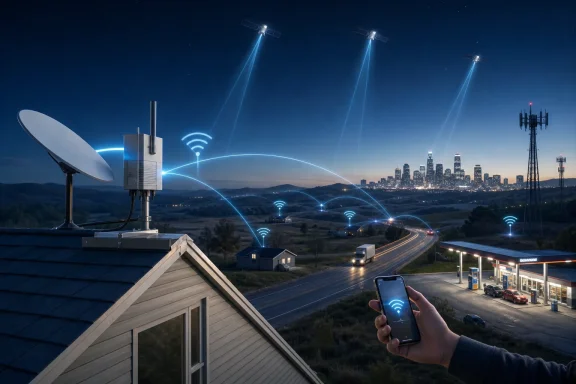
SpaceX is preparing to build a terrestrial cellular layer for Starlink Mobile, with President Gwynne Shotwell describing small cellular base stations mounted alongside Starlink broadband hardware as a way to deploy coverage incrementally rather than replicate the tower-heavy buildouts of Verizon, AT&T, and T-Mobile. The important correction to the “skip the CapEx” framing is that SpaceX has not said it can avoid capital spending; Shotwell explicitly declined to put a number on the required investment, while the FCC record shows the company has accepted new terrestrial buildout obligations tied to the spectrum it is acquiring.
Wccftech first highlighted the remarks from SpaceX’s August 4 second-quarter earnings call. The broader event is independently confirmed by SpaceX’s Form 8-K, its earnings release, and reporting by the Associated Press and Axios: SpaceX posted $7.8 billion in quarterly revenue, including $4.29 billion from its Connectivity segment, and reported a $541 million net loss. But the potential cellular-network architecture, rather than Musk’s $1 trillion 2030 revenue target, is the part that could reshape the company’s relationship with U.S. mobile carriers.
Shotwell’s proposal is not a plan to turn ordinary consumer dishes into public cell sites overnight. It is a design direction: use locations already suitable for a Starlink terminal—places with power, a clear sky view, local installation access, and a ready-made satellite backhaul path—to attach low-power radio equipment where demand warrants it. That could make SpaceX a facilities-based mobile operator without first building a nationwide inventory of traditional macro towers.
A Starlink terminal is fundamentally an electronically steered satellite antenna. It can provide the backhaul connection that a small cell needs, but it does not itself become a licensed cellular base station merely by adding a radio nearby. The actual mobile service would need radio units operating in SpaceX-controlled spectrum, a core network to authenticate devices and route calls and data, interference coordination, lawful-intercept capability, emergency-service handling, and a way to manage thousands or millions of distributed sites.
That distinction is more than technical pedantry. Starlink’s existing Direct to Cell service works by making satellites function as cell sites in space, generally using a partner carrier’s spectrum and serving locations beyond ordinary terrestrial coverage. SpaceX’s own Direct to Cell materials have described the service as an extension of a mobile operator’s network, with the operator providing the LTE spectrum.
The new plan points in the opposite direction: build a SpaceX-operated terrestrial radio network that can work with the satellite layer. That is the architecture of a hybrid mobile network, and it gives SpaceX a route to sell a full retail phone service rather than remain a supplemental coverage partner.
SpaceX has already been considering that broader retail move. The Financial Times, as summarized by Fierce Network in June, reported that Shotwell told IPO-roadshow investors SpaceX was considering a Starlink-branded mobile product for U.S. consumers and could build its own land-based network. The August call turned that broad possibility into a more concrete deployment concept.
That portfolio is material. It provides SpaceX with licensed frequencies that can support terrestrial and satellite-enabled service rather than forcing the company to rely entirely on an MVNO agreement with a larger carrier. SpaceX also bought two licenses in the AWS-3 auction earlier this year, though those local purchases are minor beside the national EchoStar package.
The more revealing part of the FCC record is why the company is pursuing a smaller-cell architecture. SpaceX argued that applying conventional terrestrial construction requirements to its licenses would force a far more extensive base-station build than its direct-to-device model needs, calling that deployment inefficient and wasteful. The company sought waivers because it wants to use the same spectrum for satellite-based service and terrestrial coverage, which cannot operate at the same location in the same way without careful coordination.
The FCC did not simply hand SpaceX a license to leave the spectrum unused. It waived EchoStar’s old obligations and imposed new deadlines and performance commitments. The order states that the company will hold exclusive terrestrial and mobile-satellite rights for the AWS-4/2 GHz spectrum after the transfer is consummated, excluding Puerto Rico and the U.S. Virgin Islands for the relevant AWS-4 licenses.
So SpaceX’s advantage is not “no network build.” It is the chance to build fewer, smaller, more selectively placed sites than a conventional greenfield nationwide carrier would need, while using satellites to fill the holes between them.
Fierce Network reported in May that Verizon joined AT&T and T-Mobile in rejecting an MVNO relationship with Starlink. Verizon said satellite communications could complement terrestrial networks but did not see a Starlink MVNO as adding a new customer segment or otherwise meeting its partnership criteria. AT&T and T-Mobile executives made similar arguments during their quarterly calls.
That refusal explains why SpaceX is now discussing physical radio infrastructure. It cannot sell a conventional nationwide smartphone plan simply by having satellites in orbit; urban and indoor coverage demand terrestrial spectrum, terrestrial radios, dense backhaul, and handoff behavior that resembles an ordinary carrier network. The incumbents control those assets at national scale. SpaceX’s spectrum transaction gives it an alternative, but it also transfers the cost and operational burden that the MVNO model would have avoided.
T-Mobile remains a special case. It has worked with SpaceX on satellite-to-phone service, but that relationship is an extension of T-Mobile coverage, not evidence that T-Mobile intends to host Starlink as a competing nationwide retail carrier. A future Starlink Mobile offering could therefore compete with T-Mobile in ordinary coverage areas while continuing to use satellite service as a differentiated coverage feature elsewhere.
But low-power cells have low-power coverage footprints. They are not a replacement for the broad propagation of a tall macro-cell site, especially across highways, large suburbs, dense urban streets, or inside buildings. A nationwide carrier-quality network still requires site density, spectrum planning, power resiliency, equipment maintenance, device certification, customer support, emergency calling, roaming arrangements, and enough aggregate capacity to withstand peak demand.
The backhaul question also cuts both ways. Starlink makes it possible to place a cell site where fiber is unavailable or costly, which is valuable in underserved locations. In places where Verizon, AT&T, and T-Mobile are strongest—dense, high-traffic markets—the incumbents already have extensive fiber, transport, tower, and small-cell infrastructure. Starlink can lower the entry cost for isolated nodes; it does not erase the capacity advantage of a mature terrestrial network.
For IT teams, public-safety organizations, and businesses with remote sites, the near-term significance is more practical than revolutionary. A SpaceX-operated small cell with satellite backhaul could eventually provide an alternative for areas now served by expensive private LTE deployments, weak carrier coverage, or temporary connectivity kits. There is no announced product, rate plan, device list, activation date, coverage map, or enterprise service-level agreement yet.
The cellular announcement belongs in the same category for now: a credible strategic direction supported by spectrum assets and FCC approvals, but not a finished consumer service. SpaceX has not said how many small cells it will deploy, where they will go first, whether existing Starlink subscribers will be eligible to host them, what compensation hosts would receive, or whether the company will build its own voice and roaming stack.
What changed on August 4 is that SpaceX has publicly outlined a way around the carrier gatekeepers. The company’s next obligation is harder than the pitch: convert spectrum rights, a satellite constellation, and a few proposed femtocells into a mobile network customers can actually use where Verizon, AT&T, and T-Mobile already set the standard.
Shotwell’s proposal is not a plan to turn ordinary consumer dishes into public cell sites overnight. It is a design direction: use locations already suitable for a Starlink terminal—places with power, a clear sky view, local installation access, and a ready-made satellite backhaul path—to attach low-power radio equipment where demand warrants it. That could make SpaceX a facilities-based mobile operator without first building a nationwide inventory of traditional macro towers.
 The Dish Is the Backhaul, Not the Cell Tower
A Starlink terminal is fundamentally an electronically steered satellite antenna. It can provide the backhaul connection that a small cell needs, but it does not itself become a licensed cellular base station merely by adding a radio nearby. The actual mobile service would need radio units operating in SpaceX-controlled spectrum, a core network to authenticate devices and route calls and data, interference coordination, lawful-intercept capability, emergency-service handling, and a way to manage thousands or millions of distributed sites.That distinction is more than technical pedantry. Starlink’s existing Direct to Cell service works by making satellites function as cell sites in space, generally using a partner carrier’s spectrum and serving locations beyond ordinary terrestrial coverage. SpaceX’s own Direct to Cell materials have described the service as an extension of a mobile operator’s network, with the operator providing the LTE spectrum.
The new plan points in the opposite direction: build a SpaceX-operated terrestrial radio network that can work with the satellite layer. That is the architecture of a hybrid mobile network, and it gives SpaceX a route to sell a full retail phone service rather than remain a supplemental coverage partner.
SpaceX has already been considering that broader retail move. The Financial Times, as summarized by Fierce Network in June, reported that Shotwell told IPO-roadshow investors SpaceX was considering a Starlink-branded mobile product for U.S. consumers and could build its own land-based network. The August call turned that broad possibility into a more concrete deployment concept.
SpaceX Has Spectrum, but It Still Has a Construction Problem
The claim that SpaceX lacks enough terrestrial spectrum to compete needs updating. The Federal Communications Commission approved a two-stage transaction that will transfer EchoStar licenses covering 10 MHz of H Block spectrum, 40 MHz of AWS-4 spectrum, and between 5 MHz and 15 MHz of AWS-3 spectrum across most U.S. economic areas. The FCC’s order says the final transfer from a trust to SpaceX is expected around November 30, 2027, although an earlier closing remains possible.That portfolio is material. It provides SpaceX with licensed frequencies that can support terrestrial and satellite-enabled service rather than forcing the company to rely entirely on an MVNO agreement with a larger carrier. SpaceX also bought two licenses in the AWS-3 auction earlier this year, though those local purchases are minor beside the national EchoStar package.
The more revealing part of the FCC record is why the company is pursuing a smaller-cell architecture. SpaceX argued that applying conventional terrestrial construction requirements to its licenses would force a far more extensive base-station build than its direct-to-device model needs, calling that deployment inefficient and wasteful. The company sought waivers because it wants to use the same spectrum for satellite-based service and terrestrial coverage, which cannot operate at the same location in the same way without careful coordination.
The FCC did not simply hand SpaceX a license to leave the spectrum unused. It waived EchoStar’s old obligations and imposed new deadlines and performance commitments. The order states that the company will hold exclusive terrestrial and mobile-satellite rights for the AWS-4/2 GHz spectrum after the transfer is consummated, excluding Puerto Rico and the U.S. Virgin Islands for the relevant AWS-4 licenses.
So SpaceX’s advantage is not “no network build.” It is the chance to build fewer, smaller, more selectively placed sites than a conventional greenfield nationwide carrier would need, while using satellites to fill the holes between them.
The Big Three Rejected the Easier Route
An MVNO arrangement would have allowed SpaceX to sell phone service under its own brand while using an incumbent carrier’s radio network. That would have been much faster and cheaper than operating cellular radios itself. Verizon, AT&T, and T-Mobile have all publicly signaled that they do not want that deal.Fierce Network reported in May that Verizon joined AT&T and T-Mobile in rejecting an MVNO relationship with Starlink. Verizon said satellite communications could complement terrestrial networks but did not see a Starlink MVNO as adding a new customer segment or otherwise meeting its partnership criteria. AT&T and T-Mobile executives made similar arguments during their quarterly calls.
That refusal explains why SpaceX is now discussing physical radio infrastructure. It cannot sell a conventional nationwide smartphone plan simply by having satellites in orbit; urban and indoor coverage demand terrestrial spectrum, terrestrial radios, dense backhaul, and handoff behavior that resembles an ordinary carrier network. The incumbents control those assets at national scale. SpaceX’s spectrum transaction gives it an alternative, but it also transfers the cost and operational burden that the MVNO model would have avoided.
T-Mobile remains a special case. It has worked with SpaceX on satellite-to-phone service, but that relationship is an extension of T-Mobile coverage, not evidence that T-Mobile intends to host Starlink as a competing nationwide retail carrier. A future Starlink Mobile offering could therefore compete with T-Mobile in ordinary coverage areas while continuing to use satellite service as a differentiated coverage feature elsewhere.
Femtocells Solve Site Acquisition, Not Network Economics
Small cells can be cheaper and faster to install than macro towers because they do not always need a new tower, a long permitting process, or a dedicated fiber build. A Starlink-connected site could be useful at rural stores, service stations, industrial facilities, disaster-response locations, campgrounds, transportation corridors, or scattered suburban dead zones where a full tower would be difficult to justify.But low-power cells have low-power coverage footprints. They are not a replacement for the broad propagation of a tall macro-cell site, especially across highways, large suburbs, dense urban streets, or inside buildings. A nationwide carrier-quality network still requires site density, spectrum planning, power resiliency, equipment maintenance, device certification, customer support, emergency calling, roaming arrangements, and enough aggregate capacity to withstand peak demand.
The backhaul question also cuts both ways. Starlink makes it possible to place a cell site where fiber is unavailable or costly, which is valuable in underserved locations. In places where Verizon, AT&T, and T-Mobile are strongest—dense, high-traffic markets—the incumbents already have extensive fiber, transport, tower, and small-cell infrastructure. Starlink can lower the entry cost for isolated nodes; it does not erase the capacity advantage of a mature terrestrial network.
For IT teams, public-safety organizations, and businesses with remote sites, the near-term significance is more practical than revolutionary. A SpaceX-operated small cell with satellite backhaul could eventually provide an alternative for areas now served by expensive private LTE deployments, weak carrier coverage, or temporary connectivity kits. There is no announced product, rate plan, device list, activation date, coverage map, or enterprise service-level agreement yet.
The Earnings Call Adds Ambition, Not a Launch Schedule
SpaceX’s first public-company quarter gave investors plenty of larger promises: Musk said the company now expects $1 trillion in annual revenue in 2030 rather than 2031, while Shotwell said SpaceX wants humans on the Moon in 2028. The company also expects substantial continuing capital expenditures as it builds AI compute infrastructure and advances Starship.The cellular announcement belongs in the same category for now: a credible strategic direction supported by spectrum assets and FCC approvals, but not a finished consumer service. SpaceX has not said how many small cells it will deploy, where they will go first, whether existing Starlink subscribers will be eligible to host them, what compensation hosts would receive, or whether the company will build its own voice and roaming stack.
What changed on August 4 is that SpaceX has publicly outlined a way around the carrier gatekeepers. The company’s next obligation is harder than the pitch: convert spectrum rights, a satellite constellation, and a few proposed femtocells into a mobile network customers can actually use where Verizon, AT&T, and T-Mobile already set the standard.
References
- Primary source: Wccftech
Published: 2026-08-05T00:45:12+00:00
Elon Musk Declares War On Verizon, AT&T, And T-Mobile, As SpaceX Now Wants To Turn Starlink Dishes Into Cellular Base Stations To Skip The CapEx
Elon Musk says memory supply is growing by 20 percent per year but demand for memory chips is growing by 200 percent per year right now.wccftech.com
- Related coverage: axios.com
SpaceX earnings: SpaceX tops revenue expectations after IPO
Investors have been looking for Elon Musk to deliver AI advancements.www.axios.com
- Related coverage: ir.spacex.com
SpaceX - SpaceX to Post Second Quarter 2026 Results and Host Webcast on August 4, 2026
SpaceX will post financial and operational results for the second quarter of 2026 after market close on Tuesday, August 4, 2026. SpaceX management will host a live audio-only webcast to discuss the results at 3:30 p.m. CT / 4:30 p.m. ET the same day. The webcast and replay will be available at...ir.spacex.com
- Related coverage: broadbandbreakfast.com
SpaceX to Host First Public Earnings Call on August 4
The company will hold a live audio-only call at 4:30 ET to discuss earnings after the market closes. broadbandbreakfast.com
- Related coverage: investing.com
Musk says SpaceX could bring $1 trillion in revenue by 2030 By Reuters
Musk says SpaceX could bring $1 trillion in revenue by 2030www.investing.com - Related coverage: investing.com
SpaceX sets date for maiden earnings report: Why August 4 is make-or-break By Investing.com
SpaceX sets date for maiden earnings report: Why August 4 is make-or-breakwww.investing.com - Related coverage: fool.com
SpaceX Hosts First Earnings Call Since Its IPO. Is SpaceX a Buy Ahead of the Aug. 4 Earnings Release? | The Motley Fool
SpaceX must bridge the gap between its visionary long-term plans and the reality of its current operations.www.fool.com - Related coverage: morningstar.com
- Related coverage: starpath.global
SpaceX to Post First Earnings as Public Company on August 4th
SpaceX has set August 4th as the date for its first earnings call since going public.starpath.global - Related coverage: benzinga.com
SpaceX Reports Public Earnings On August 4: Details & Estimates - SpaceX (NASDAQ:SPCX) - Benzinga
Elon Musk's SpaceX will release its first public earnings report and hold a conference call on August 4, 2026.www.benzinga.com - Related coverage: content.spacex.com
- Related coverage: cadenaser.com
- Related coverage: theweek.com
Musk’s wealth sinks as SpaceX shares slide | The Week
The CEO’s net worth has fallen from $1.45 trillion to below $700 billiontheweek.com - Related coverage: omni.se
Musk: Space X intäkter kan öka 5 000 procent på fem år
Space X omsättning kan växa från fjolårets 18,7 miljarder dollar till cirka 1 000 miljarder dollar redan 2030, enligt Elon Musk. ”Och jag skulle vara förvånad om omsättningen inte är högre än 1 000 miljarder dollar 2031”, skriver han på plattformen X. Det vore i så fall en ökning med mer än 5...omni.se - Related coverage: techradar.com
Starlink sends the telecoms world off in a spin, but what is the big picture? | TechRadar
Telecoms sees disruption. Musk may see more.www.techradar.com - Related coverage: spacex.com
SpaceX
SpaceX designs, manufactures and launches advanced rockets and spacecraft. The company was founded in 2002 to revolutionize space technology, with the ultimate goal of enabling people to live on other planets.www.spacex.com - Related coverage: fierce-network.com
Verizon: No to an MVNO with Starlink
Verizon joins AT&T and T-Mobile in basically saying “no” to a SpaceX/Starlink MVNO.www.fierce-network.com - Related coverage: spacex.com
SpaceX
SpaceX designs, manufactures and launches advanced rockets and spacecraft. The company was founded in 2002 to revolutionize space technology, with the ultimate goal of enabling people to live on other planets.www.spacex.com - Related coverage: fierce-network.com
Starlink Mobile’s MVNO odds look strong: analyst
Alex Besen, founder and CEO of The Besen Group, says Starlink Mobile has a good shot at negotiating an MVNO deal with one of the Big 3 mobile operators despite their current pushback.www.fierce-network.com - Related coverage: techradar.com
SpaceX could be planning to offer a Starlink mobile network for consumers, reports say — but some experts think it's pie in the sky | TechRadar
Starlink for your phone?www.techradar.com - Related coverage: techrepublic.com
SpaceX Eyes Starlink Mobile Service for Consumers, Challenging Verizon, AT&T
SpaceX is reportedly considering a Starlink mobile service for US consumers, but spectrum and ground-network costs could complicate the plan.www.techrepublic.com
- Related coverage: phonearena.com
T-Mobile, AT&T and Verizon reject Starlink's MVNO, but the Starlink MVNO may be closing in - PhoneArena
What's more, Starlink could become a key player in the telecom industry.www.phonearena.com - Related coverage: starlink.com
- Related coverage: geekblog.net
Starlink Mobile: SpaceX's Plan to Rival Verizon & AT&T
SpaceX wants to sell phone plans directly to consumers. Here's how Starlink Mobile could work, the spectrum it has, and why carriers should worry.geekblog.net - Related coverage: tradeglobaltr.com
- Related coverage: starlink.com
- Related coverage: sacra-pdfs.s3.us-east-2.amazonaws.com

