
That is a more consequential development than a routine compatibility patch. The game arrived on PC as a strong Nixxes conversion with unlocked frame rates, ray-traced reflections, ultrawide support, DLSS and FSR 2.0, but it was built around 2022-era graphics technology. Its 2026 patch trail now includes AMD FSR 3.1 frame generation, XeSS 1.3, CPU improvements for ray tracing and crowd spawning, and newer AMD GPU fixes. For a game whose best moments depend on moving through a densely streamed Manhattan at speed, those are practical upgrades rather than an options-menu checklist.
A recent Games.gg overview correctly identifies Marvel’s Spider-Man Remastered as the complete package: Insomniac’s 2018 campaign, the three-part The City That Never Sleeps expansion, and the PS5 remaster’s visual enhancements. But it treats the PC version as though it froze at launch. It did not. Players reinstalling the game in 2026 should update it before judging performance, and should not assume old launch-day benchmarks fully describe its present capabilities.
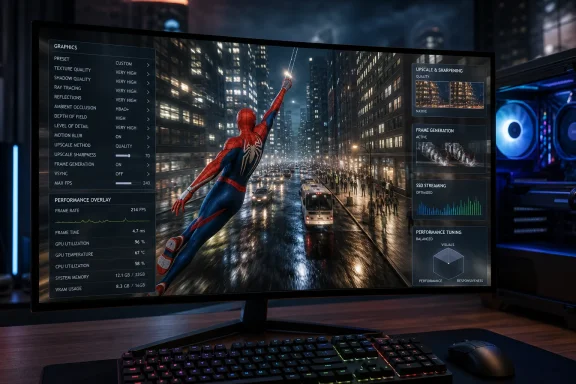 Version 4.630.0.0 Brings Modern Frame Generation to an Older Port
Nixxes’ January 2026 update added AMD FSR 3.1, including Frame Generation and Native AA, plus Intel XeSS 1.3 with a Native AA mode. February’s version 2.1012.0.0 followed with ray-tracing CPU and crowd-spawning improvements, better ray-tracing stability on AMD GPUs, and a correction for severe blur when upscalers were used at very low resolutions.
The July 8 patch is narrower, but it confirms the studio is still maintaining the rendering stack rather than merely keeping the launcher alive. Radeon RX 9000-series owners using AMD driver 25.12.1 or later can access the new FSR Redstone Frame Generation compatibility. The patch also makes FSR 4 enabled through the driver visible in both the game menu and launcher, avoiding the common uncertainty over whether a driver-level override is active.
There is an important limit to the headline: frame generation improves the displayed frame rate, but it does not eliminate a CPU bottleneck. Spider-Man Remastered can shift from GPU-bound to CPU-bound during fast traversal, especially when ray tracing, high traffic density, and high crowd density are enabled. Frame generation is most useful when the game already has a reasonably stable base frame rate; it is a poor substitute for fixing stutter, storage bottlenecks, or an overtaxed processor.
Tom’s Hardware found at launch that ray tracing could make the game CPU-limited at lower resolutions, while GameSpot similarly observed that rapidly crossing the open world could constrain performance even on high-end test hardware. Nixxes’ own tuning guide still advises lowering traffic density, crowd density, ray-tracing object range, and level of detail when the CPU becomes the limiting factor. The new patches improve the situation, but they do not change the basic architecture of the game’s busiest scenes.
The SSD Requirement Is More Than a Fine-Print Recommendation
The game’s official minimum requirements remain surprisingly forgiving: a Core i3-4610-class processor, 8GB of RAM, a GeForce GTX 950 or Radeon RX 470, and 75GB of hard-drive space for 720p at 30 fps on the Very Low preset. The recommended target is 1080p at 60 fps with 16GB of memory, a GTX 1060 6GB or RX 580 8GB, and an SSD.
The distinction matters more here than it does in many older PC releases. Nixxes now explicitly says that installing the game on a hard disk can cause long pauses, freezing, lag, and stuttering while swinging at speed, with the risk rising at higher graphics presets. An HDD is technically supported for the low-end 720p target; it is not a sensible configuration for the experience most people mean when they buy an open-world Spider-Man game.
This is the consequence of the game’s defining strength. Web-swinging turns Manhattan into a high-speed streaming test: buildings, traffic, pedestrians, mission triggers, reflections, and geometry are continually entering view. A static indoor benchmark can look excellent while a fast trip through Midtown exposes storage latency and CPU limitations. Install the game on an SSD before reducing image-quality settings, because the wrong drive can produce pauses that no upscaler will solve.
Windows version can also affect features that appear to be GPU problems. Nixxes says ray tracing may be grayed out on otherwise compatible hardware when Windows lacks Shader Model 6.6 support. The game uses the DirectX Agility SDK and requires Windows 10 version 1909, build 18363, or newer; specific older revisions of Windows 10 1909, 2004, and 20H2 also lack the necessary support. Updating Windows and graphics drivers is therefore part of enabling ray tracing, not generic support-script boilerplate.
Ray Tracing Still Carries a Real Performance Price
The original PC release drew deserved praise for its range of graphics controls. PlayStation and Marvel advertised support for 21:9 ultrawide, 32:9 super-ultrawide, and 48:9 triple-monitor configurations, alongside uncapped frame rates and multiple reconstruction methods. That breadth remains one of the port’s strongest assets, particularly for players moving from console to a high-refresh Windows setup.
But “ray-traced reflections” should not be read as a free visual upgrade. The setting accurately reflects off-screen and moving objects in glass, windows, puddles, and vehicle surfaces where screen-space reflections cannot. It is especially noticeable in rainy nighttime scenes and in the vertical canyons of Manhattan. Nixxes also warns that Very High reflection resolution can sharply reduce performance, while high object range increases CPU work.
Independent launch testing from PC Gamer, GameSpot, and Tom’s Hardware reached the same broad conclusion: ray tracing looked better, but its performance cost was substantial, and image reconstruction could complicate the result. DLSS generally offered the best image-quality tradeoff on supported Nvidia hardware, while FSR provided a useful path for Radeon and older GeForce cards. Insomniac Games’ own Temporal Injection could deliver larger frame-rate gains, but its image quality was less convincing in the original comparisons.
The current software stack gives players more choices, not an automatic best setting. A reliable approach on a midrange system is to start at native resolution or a high-quality upscaling mode, use High rather than Very High ray-tracing settings, and cut ray-tracing object range before dropping texture quality. Texture settings are chiefly a VRAM question; crowd density, traffic density, and object range are the controls more likely to help when a fast traversal sequence is CPU-limited.
The Combat Description Needs One Correction
The Games.gg overview calls out “dodge and parry windows tied to Spider-Sense.” The dodge half is right; the parry half belongs to the later Marvel’s Spider-Man 2, not this game. Marvel’s Spider-Man Remastered has no conventional block-and-parry system. Peter evades attacks, and a well-timed Perfect Dodge can trigger slow motion and follow-up advantages such as webbing a foe.
That sounds like a small terminology issue, but it changes combat expectations. This is not an Arkham-style counter game where players wait for a prompt and reverse an enemy’s attack. Insomniac’s system asks the player to keep moving, use air launches, web attacks, gadgets, environmental throws, suit powers, finishers, and crowd control to stop encounters from becoming a stationary fistfight.
The comparison to Rocksteady’s Batman: Arkham series is still useful as a shorthand for rhythmic freeflow combat, but it understates what makes Spider-Man work. The game’s best encounters come from combining evasion with verticality and improvisation: webbing a gunman to a wall, yanking an object into a cluster, launching a brute, and retreating to the air before the crowd can reset around Peter. The combat can become repetitive in late-game side activities, yet it is far more flexible than a simple counter loop.
The Complete Edition Has One Content Caveat
The three The City That Never Sleeps chapters are included in the PC release, with Black Cat, Hammerhead, and Silver Sable extending the main campaign’s aftermath. That remains meaningful value: this is not the base 2018 game with a separate DLC checkout waiting after the credits.
However, the DLC is post-campaign material in design as well as story placement. GameSpot noted that it can be accessed early but advised against doing so because the encounters do not gracefully scale for a new character. Players should finish the main story first, build out gadgets and suit upgrades, and then enter The Heist, Turf Wars, and Silver Lining in sequence. The DLC’s enemy pressure and encounter expectations make considerably more sense that way.
The Peter Parker face change is also frequently misreported as a PC-version alteration. Insomniac recast Peter’s face model from John Bubniak to Ben Jordan for the PS5 remaster to better match Yuri Lowenthal’s facial performance capture. The Windows release inherited that remastered version; it did not independently replace the original PS4 face.
For Windows players in 2026, Marvel’s Spider-Man Remastered remains the sensible starting point for Insomniac’s Spider-Man trilogy: it has the full first story, keyboard-and-mouse support, broad controller support, ultrawide modes, and a graphics stack that has been kept current enough to use modern Radeon and Intel features. Put it on an SSD, update the game and GPU driver, treat ray tracing as a premium setting rather than a default, and judge performance while swinging through Manhattan—not while standing still on a rooftop.
References
- Primary source: games.gg
Published: August 8, 2026 at 12:20 PM UTC
Loading…
games.gg - Related coverage: pcgamer.com
Loading…
www.pcgamer.com - Related coverage: support.nixxes.com
Loading…
support.nixxes.com - Related coverage: pcgamesn.com
Loading…
www.pcgamesn.com - Related coverage: tomshardware.com
Loading…
www.tomshardware.com - Related coverage: gamespot.com
Loading…
www.gamespot.com - Related coverage: support.insomniac.games
Loading…
support.insomniac.games - Related coverage: insomniac.games
Loading…
insomniac.games - Related coverage: store.steampowered.com
Loading…
store.steampowered.com - Related coverage: digitaltrends.com
Loading…
www.digitaltrends.com - Related coverage: dsogaming.com
Loading…
www.dsogaming.com - Related coverage: techspot.com
Loading…
www.techspot.com - Related coverage: as.com
Loading…
as.com - Related coverage: gamesradar.com
Loading…
www.gamesradar.com - Related coverage: as.com
Loading…
as.com - Related coverage: gamesradar.com
Loading…
www.gamesradar.com - Related coverage: los40.com
Loading…
los40.com - Related coverage: marvel.com
Loading…
www.marvel.com - Related coverage: blog.playstation.com
Loading…
blog.playstation.com - Related coverage: gamefaqs.gamespot.com
Loading…
gamefaqs.gamespot.com - Related coverage: playstationtrophies.org
Loading…
www.playstationtrophies.org - Related coverage: game8.co
Loading…
game8.co - Related coverage: digitaltrends.com
Loading…
www.digitaltrends.com - Related coverage: h5gamemobile.com
Loading…
h5gamemobile.com - Related coverage: gamefaqs.gamespot.com
Loading…
gamefaqs.gamespot.com - Related coverage: marvels-spider-man.fandom.com
Loading…
marvels-spider-man.fandom.com - Related coverage: ogxbox.co.uk
Loading…
www.ogxbox.co.uk - Related coverage: gamesdatabase.org
Loading…
www.gamesdatabase.org