
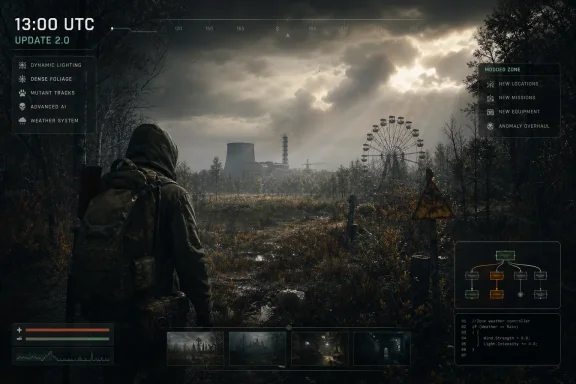
The launch timing and storage details circulating in a Sportskeeda countdown need correction before anyone clears drive space or expects an early morning unlock. The article labels the release as “9 AM EST,” but the regional times it provides correspond to 9:00 a.m. EDT, not Eastern Standard Time. August 20 is daylight-saving time in New York; 9:00 a.m. EDT is 13:00 UTC, while 9:00 a.m. EST would be 14:00 UTC.
Steam’s release metadata independently lists the expansion for 13:00 UTC. As of the morning of August 20, Steam still showed the DLC as unavailable and counting down to that time, so there is no evidence of a staggered platform rollout or an early unlock for one PC storefront.
 The correct regional unlock times
For players planning a download window, the synchronized launch translates to the following local times:
| Region | Unlock time |
|---|---|
| New York / Eastern Daylight Time | 9:00 a.m., August 20 |
| Chicago / Central Daylight Time | 8:00 a.m., August 20 |
| Denver / Mountain Daylight Time | 7:00 a.m., August 20 |
| Los Angeles / Pacific Daylight Time | 6:00 a.m., August 20 |
| Toronto | 9:00 a.m., August 20 |
| São Paulo | 10:00 a.m., August 20 |
| London | 2:00 p.m., August 20 |
| Paris and Johannesburg | 3:00 p.m., August 20 |
| Dubai | 5:00 p.m., August 20 |
| Pakistan | 6:00 p.m., August 20 |
| India | 6:30 p.m., August 20 |
| Bangladesh | 7:00 p.m., August 20 |
| Bangkok | 8:00 p.m., August 20 |
| Singapore and Beijing | 9:00 p.m., August 20 |
| Tokyo and Seoul | 10:00 p.m., August 20 |
| Sydney | 11:00 p.m., August 20 |
| Auckland | 1:00 a.m., August 21 |
The important distinction is that these are local daylight-saving conversions of one global release time. Calling the U.S. release “EST” in August is technically wrong, even though the 9:00 a.m. clock time is right for East Coast players.
GSC announced August 20 as the date through its official S.T.A.L.K.E.R. 2 channels, while SteamDB’s tracking of Steam storefront records identifies the precise 13:00 UTC unlock. Steam lists Cost of Hope as DLC that requires the base Heart of Chornobyl game; it is not a standalone release.
The 20 GB download claim is not confirmed
The Sportskeeda article says the Steam version will have a download size of “around 20 GB,” then presents a system-requirements table that also lists 20 GB of SSD storage. Steam’s own listing contradicts that table: its minimum PC requirements specify 160 GB of available SSD storage, not 20 GB.
That does not prove the DLC download itself is 160 GB. It does establish that 20 GB should not be treated as an official storage requirement or a reliable estimate of the installation process. Steam’s public store page does not currently publish a separate download-size figure for Cost of Hope.
For an existing PC installation, the practical requirement may depend on how GSC distributes Update 2.0. A large Unreal Engine migration can involve substantially more disk activity than the net size of the changed files, particularly if archives are repacked, shaders are rebuilt, or the launcher needs working space to replace core assets. The studio has not detailed the patch size, whether preload is supported, or whether Steam, GOG Galaxy, Epic Games Store, and the Xbox PC app will handle the update identically.
Players should therefore keep at least the full 160 GB Steam requirement free, plus sensible overhead if their system drive is tight, rather than planning around a 20 GB DLC-only figure. That advice is particularly relevant for handheld PCs, compact gaming laptops, and desktop systems using 256 GB or 512 GB SSDs shared with other large games.
Steam’s listed PC targets remain demanding:
- The minimum specification calls for Windows 10 or Windows 11 64-bit, 16 GB of dual-channel RAM, an Intel Core i7-7700K or AMD Ryzen 5 1600X, and a GeForce GTX 1060 6 GB, Radeon RX 580 8 GB, or Intel Arc A750 for 1080p at a 30 fps target using low settings.
- The recommended specification calls for 32 GB of dual-channel RAM, an Intel Core i7-11700 or Ryzen 7 5800X, and a GeForce RTX 3070 Ti, RTX 4070, or Radeon RX 6800 XT for 1440p at a 60 fps target using high settings.
- An SSD is required at both tiers, and GSC says those targets were evaluated using TSR and comparable reconstruction technologies.
Those specifications are published against the DLC’s Steam listing, but they should be read as requirements for the updated S.T.A.L.K.E.R. 2 installation, not a neat measure of the expansion’s file size.
Update 2.0 is the real PC story
GSC’s Back to the Zone Update 2.0 arrives free for base-game owners at the same time as Cost of Hope. PC Gamer and Windows Central, reporting from GSC’s update materials and showcase, describe changes to the game’s environment lighting, foliage, interior illumination, dynamic fog, weapons, enemy behavior, custom difficulty controls, and the Zone Kit modding tools.
The biggest technical change is the Unreal Engine upgrade from version 5.1 to 5.5.4. That is a major move for a game that has already received repeated performance, stability, quest, rendering, and AI fixes. It is not a guarantee of a universal frame-rate gain: an engine migration can improve some workloads while creating compatibility problems for mods, overlays, shader caches, or specific GPU-driver combinations.
GSC has framed the update as a visual and systemic refresh rather than a narrowly targeted performance patch. The developer says revised sunlight, reflections, shadows, interior lighting, terrain, and vegetation should make the Zone feel less visually static. It is also revising A-Life behavior so mutants and stalkers have more places to gather, rest, travel, fight, and loot beyond the player’s immediate view.
For returning players, those systems matter more than new guns alone. The earlier 1.5 update had already attempted to make off-screen NPC simulation more persistent, reduce obvious character pop-in, and move encounter generation farther from the player. Update 2.0 appears intended to extend that direction by making the world feel less like a sequence of combat spawns and more like a simulated place with independent activity.
GSC is also adding a Custom Rules difficulty mode, binoculars, new weapons and scopes, and fog that affects both sight and hearing. These are player-facing features, but the modding changes may have the longer life: Windows Central reports that Zone Kit receives additional narrative scripting, audio, and localization tools. That gives creators more room to build quests and localized content, provided their existing mods survive the engine transition.
Mod users should assume disruption until proven otherwise
GSC has repeatedly warned that major S.T.A.L.K.E.R. 2 updates can break modifications. Its support guidance for earlier patches advises players with post-update stability or performance issues to disable mods before troubleshooting further. Update 2.0 is more disruptive than a routine balance pass because it combines gameplay revisions with an Unreal Engine version change.
The cautious approach is simple:
- Back up saves and configuration files before Steam or another launcher applies the update.
- Record or export a mod list before updating, especially manual installations outside Steam Workshop.
- Do not assume an existing performance tweak, reshade, DLL-based frame-generation mod, or UI mod will work with Unreal Engine 5.5.4.
- Verify game files after the update if the launcher completes unusually quickly, crashes on startup, or leaves missing assets and broken menus.
There is a further reason not to race into a modded playthrough at 13:00 UTC: Cost of Hope runs in parallel with the main campaign. In GSC’s March announcement on Xbox Wire, the studio said an installed expansion begins when Skif receives a PDA signal during the base game. That makes campaign state more important than a conventional post-game DLC unlock, and it means players should avoid assuming that any old save, mission checkpoint, or modded quest state will behave cleanly under the revised systems.
Cost of Hope opens two new regions
The paid expansion itself is a substantial story addition, not a cosmetic content pack. GSC says it centers on the fracturing relationship between Duty and Freedom, two factions whose opposing views of the Zone have been central to the series. Skif returns as protagonist, and player decisions will shape how the expansion’s storyline resolves.
The expansion adds Iron Forest and the Chornobyl Nuclear Power Plant, each described by GSC as a large region with a hub, smaller locations, quests, and activities. The studio has promised dozens of hours for the core story, although that remains a developer estimate rather than a measure established by completed player runs.
GSC also describes Cost of Hope as the middle chapter of a planned second S.T.A.L.K.E.R. trilogy, with another story expansion still to come. That makes today’s release both a DLC launch and a checkpoint for the base game: Update 2.0 will determine whether the Unreal Engine migration and new A-Life work deliver the smoother, more credible PC experience that the original release often struggled to provide.