
Reuters and TechCrunch reported that data associated with more than 31 million Star Health policyholders and millions of insurance claims was exposed through Telegram-based tools after attackers alleged they had obtained the insurer’s records. The material reportedly included contact information, policy and claim data, medical reports, and identity and tax documents. Star Health confirmed it had suffered a malicious cyberattack, but confirmation of an incident does not independently validate every claim attackers made about the full dataset or how it was obtained.
That distinction matters for victims. An attacker does not need a perfect copy of every record to cause harm. A partial file containing a policy number, diagnosis history and PAN details can be used to make a phishing call much more convincing than a generic scam text. The person on the other end may know the insurer’s name, a recent claim, an address, or a legitimate-looking document number. That turns a familiar fraud script into a targeted impersonation attempt.
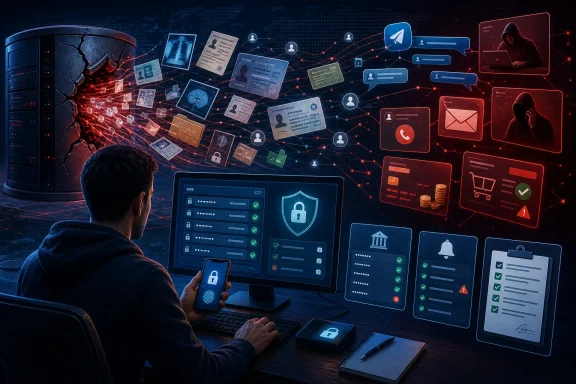 A breach becomes an identity-fraud supply chain
A leaked password is usually perishable: changing it ends its immediate usefulness, assuming it was not reused elsewhere. Personal data is different. Addresses, dates of birth, PAN numbers, insurance-policy details and medical information cannot simply be reset, and attackers can combine them with data from unrelated leaks to create a more complete profile.
For Windows and PC users, the most common follow-on risk is still account takeover. A breached email address paired with an old password can be fed into automated credential-stuffing attempts against Microsoft accounts, Gmail, banking portals, insurer apps and shopping sites. If the original password was reused, changing it only at the breached service leaves every other account exposed.
The second risk is social engineering. A criminal who knows that a person holds a health policy can pose as an insurer representative, a hospital billing desk, a bank fraud team or a government official. They may ask the victim to “verify” a claim, download a remote-support tool, approve a UPI payment, share an OTP, or install a fake update. The personal details make the approach credible; the fraud succeeds only when the victim is pushed into taking an action.
Medical records create a separate and particularly personal problem. A diagnosis, test result, prescription or claim history can be used for extortion, targeted harassment or fraudulent treatment and insurance claims. Victims should be cautious about assuming every unexpected call from a hospital, pharmacy or insurer is legitimate, even when the caller correctly cites information that was not publicly known.
Star Health’s case did not end with the Telegram takedown fight
The Star Health episode is often remembered for its unusual distribution mechanism: attackers used Telegram chatbots to make records searchable. But the larger lesson is that removing a public-facing bot or website does not recall data already copied by other people. Once a dataset is downloaded, traded, repackaged or merged into criminal databases, the organization can limit further exposure but cannot make the information private again.
There was also a regulatory consequence. In July 2025, India’s insurance regulator, the Insurance Regulatory and Development Authority of India, imposed a ₹3.39 crore penalty and issued a warning to Star Health for violations of its Information and Cyber Security Guidelines, 2023. The regulator’s action establishes that it found cybersecurity-control failures; it should not be read as a compensation fund for affected policyholders.
That gap is important. A regulator’s fine punishes or corrects the company, but it does not automatically repair a damaged credit record, reverse a fraudulent loan application, recover money from a scam, or remove leaked health information from criminal circulation. Affected customers need their own records, evidence and escalation trail.
India’s DPDP rules set a tighter reporting expectation, but the clock has not fully started
The article’s central warning about India’s Digital Personal Data Protection framework is directionally correct, but the implementation detail deserves precision. The Digital Personal Data Protection Rules, 2025 were notified in November 2025, while several substantive compliance provisions—including the detailed breach-notification requirements—were given an 18-month transition period. That places the key operational deadline in May 2027, not at the time of the Star Health breach.
When those provisions take effect, a Data Fiduciary must notify affected Data Principals of a personal data breach without delay and must send the Data Protection Board an initial notification without delay, followed by more detailed information within 72 hours. The rules make breach reporting a formal operational duty rather than an optional public-relations decision.
The penalty figures also need to be separated. Under the DPDP Act, failure to take reasonable security safeguards can draw a penalty of up to ₹250 crore. Failure to notify the Board or affected individuals of a breach can carry a penalty of up to ₹200 crore. The maximum is not an automatic fine, and it does not mean every breach will result in the highest amount; it establishes the regulator’s available ceiling.
For IT administrators, the practical implication is less about waiting for May 2027 and more about preparing now. A company that cannot identify which data was held, which systems processed it, which vendors had access, and which individuals were affected will struggle to produce a credible notification on a 72-hour schedule. A breach playbook that begins with “find out what happened” is already too late.
The RBI’s zero-liability rule has limits that phishing exploits
India’s existing Reserve Bank of India framework is useful, but victims should not assume it makes every digital-fraud loss automatically refundable. Under the RBI’s 2017 customer-liability rules for unauthorised electronic banking transactions, customers generally have zero liability if they report a qualifying transaction within three working days of receiving the bank’s communication, where the loss is due to bank negligence or a third-party breach.
The distinction is whether the payment was unauthorised. When a victim is tricked into sharing an OTP, entering credentials on a phishing page, or approving a UPI collect request, the bank may argue that the customer authenticated the payment. That makes the case more complicated than a card or account transaction initiated without the customer’s participation.
The submitted report refers to an expanded framework for certain authorised-payment scams from January 2027. Victims should not rely on that proposed protection until the RBI publishes and banks implement the final directions. Today, speed remains the decisive factor: contact the bank through its official fraud channel, preserve screenshots and transaction identifiers, call 1930, and file a report through India’s National Cyber Crime Reporting Portal.
What to do in the first hour after a breach alert
A breach alert should trigger containment, not panic. Start with the account most likely to be used as a recovery channel—usually email—because control of that inbox can be used to reset many other accounts.
- Change the exposed password immediately, then change it anywhere it was reused. Use a password manager to create a different, long password for every service.
- Enable multi-factor authentication on email, banking, cloud-storage, insurer and social-media accounts. Prefer an authenticator app or hardware security key over SMS where the service supports it.
- Review recent sign-ins on Microsoft, Google, Apple and email accounts, and revoke unknown sessions, devices, app passwords and forwarding rules. Mail forwarding is a common way for an intruder to quietly monitor password-reset messages.
- Call the insurer and bank using numbers from their official websites or existing statements, not numbers in a breach email, SMS or caller-ID display. Ask whether there are new policies, claims, address changes, payment instructions or account-recovery attempts in your name.
- Monitor bank, card and UPI activity for at least a year. A data leak can be stored and exploited long after public discussion has stopped.
- Obtain and review credit reports for unfamiliar loans, cards or enquiries. If a lender or telecom provider contacts you about an account you did not open, dispute it in writing and retain the case number.
Cyber insurance may help with defined costs such as fraud response, credit monitoring, device restoration or identity-recovery assistance, depending on the policy. It is not a substitute for account security, and policyholders should read exclusions closely—especially notification deadlines, proof requirements, pre-existing incidents and losses arising from voluntarily approved transactions.
The uncomfortable reality after a major leak is that the victim’s data may remain in circulation indefinitely. The practical response is to reduce what criminals can do with it: eliminate password reuse, harden recovery accounts, distrust unsolicited requests that cite personal facts, and keep a documented path to the bank, insurer, telecom provider and cybercrime authorities when the first suspicious transaction appears.
