
TwistedVoxel reported on August 1 that XR commentator Brad Lynch, known online as SadlyItsBradley, spotted Valve’s Android-to-Linux layer Lepton and x86-to-Arm translator FEX becoming available through Steam, alongside what appears to be a hidden Steam Frame Arm64 compatibility list. Those changes are relevant to the headset’s preparation. They do not, however, establish a price, order date, regional availability, or a specific launch day.
Valve’s own June 4 Steamworks announcement remains the clearest statement on timing: Steam Frame and the new Steam Machine are “shipping this summer.” As of August 2, Valve has not attached a calendar date or price to that window. That omission matters more to prospective buyers than another Steam package entry, because Frame’s rollout will be constrained by inventory and commercial terms rather than whether its already-announced compatibility layers have a visible Steam client package.
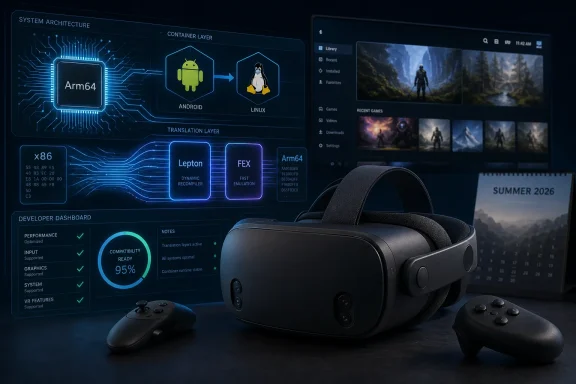 Lepton and FEX are core Steam Frame infrastructure, not a last-minute addition
Steam Frame is a standalone SteamOS headset powered by an Arm64 Snapdragon 8 Gen 3 processor. Its challenge is straightforward: much of Steam’s existing VR catalog was compiled for x86 PCs, commonly for Windows, while a large share of standalone VR software was built as Android packages for Meta Quest-class devices.
Valve’s answer is a three-part stack:
- Proton translates Windows game environments and graphics calls for Linux.
- FEX dynamically translates x86 and x86-64 code to Arm64 instructions.
- Lepton runs Android software in a Linux-based container environment.
That is a substantial technical bet, especially for Valve’s PC-centric catalog. It is also not a surprise. Valve’s Steam Frame developer documentation has long described Windows x86 titles running through Proton and FEX, Android APKs running through Lepton, and native Linux Arm64 as another option. The documentation even gives developers instructions for launching “Lepton Development” from their Steam library and connecting to a headset through Android Debug Bridge.
SteamDB’s history is more specific than the launch-imminent framing. The database identifies Lepton Development as Steam application 3056000, first seen on June 14, 2024. Its visible library assets date to December 4, 2025. A package linked to it was updated on July 23, 2026, which may explain the fresh attention, but that is an update to a long-running internal and developer-facing project—not the first sign that Valve has put Lepton on Steam.
FEX has followed the same trajectory. It is an essential part of Valve’s Arm strategy, but Valve has been publicly telling Frame developers to target the compatibility route for months. SteamDB’s own 2025 report on the Steam Frame announcement described FEX as part of the headset’s intended software design. The practical significance of making these components easier to distribute through Steam is that Valve is hardening its deployment path; it does not prove the hardware is ready to sell.
Steam Frame Verified already shows Valve is past the concept stage
The stronger launch signal came nearly two months ago, when Valve expanded its hardware verification program to Steam Machine and Steam Frame. Valve calls the headset classification Steam Frame Standalone Verified, a label aimed at the experience on the device without a connected gaming PC.
That distinction is important. Steam Frame is primarily marketed as a low-latency PC streaming headset, where a desktop PC handles the demanding rendering work. In standalone mode, the headset must run software locally on a mobile-class Arm chip while simultaneously maintaining tracking, display output, controller input, wireless connections, and thermals. A title that works over Steam Link from a powerful Windows PC does not automatically qualify as a good standalone experience.
Valve’s verification criteria focus on default graphics performance, readable text and interface elements, and working default controller configurations. The company said in June that many titles had already been tested and that Steamworks partners could see results in their dashboard.
That makes the reported hidden compatibility list plausible, but it changes how the discovery should be read. Valve is not suddenly creating an Arm64 support program in late July. It has already created the public-facing verification program, distributed development hardware, written documentation for Windows, Linux, and Android targets, and tested games. A hidden list could be a store-facing implementation detail, a staging asset, or an internal catalog. Without Valve exposing it publicly or assigning games a customer-visible status, it cannot tell buyers which games will actually be available and usable at launch.
The important unresolved issue is not whether Valve has an internal list. It is how many VR games will earn standalone verification, at what default settings, and whether buyers can distinguish a locally playable game from one that is best streamed from a PC.
Half-Life: Alyx has not received a confirmed native Arm64 version
TwistedVoxel also points to a recent Half-Life: Alyx update as a possible sign of Arm64 compatibility. The public SteamDB record does confirm activity on the title in July, but it does not show a newly listed Arm64 depot.
SteamDB currently lists the game’s main content depot, a Windows binary depot, a Linux binary depot, and the Workshop Tools depot. There is no public depot labeled for Linux Arm64 or another clearly native Arm build. The existing Linux version is relevant because Steam Frame runs SteamOS, but it is not evidence that the game now runs natively on the headset’s Arm processor.
That is not merely a naming technicality. A native Arm64 build would mean Valve had compiled or ported the game for the processor architecture used in Steam Frame. Running the existing x86 build through FEX is different: the game code is translated at runtime, while compatible system and graphics calls can be handled through native host libraries. Valve’s own developer guidance presents FEX as an expected way to run existing Windows x86 games on Frame.
For Half-Life: Alyx, those two paths lead to very different expectations. A native port could permit deeper optimization for battery life, memory allocation, rendering resolution, and frame pacing on a standalone headset. FEX makes it possible to preserve an established PC codebase and avoid a costly platform-specific port, but translation still has a performance and power cost. VR is unusually sensitive to missed frames, so “it launches” and “it is a comfortable standalone VR experience” are far apart.
Valve has not announced that Half-Life: Alyx will be Steam Frame Standalone Verified, nor has it publicly committed to a native Arm64 build. Until it does, readers should treat the update as evidence of ongoing maintenance or preparation, not confirmation that the flagship 2020 VR game will be the headset’s standalone showcase.
FCC approval removes a U.S. hurdle, but it does not answer the buyer’s questions
TwistedVoxel reports that Valve’s headset received FCC equipment authorization on July 29, following an application filed May 13, and that key documents remain confidential until November 10. If accurate, the grant is a meaningful regulatory milestone: a wireless headset intended for U.S. sale needs authorization before it reaches consumers.
But it is not a sales announcement. An FCC filing does not set a manufacturer’s retail schedule, lock in the device’s price, or guarantee that retailers have stock. Companies commonly submit hardware for certification while they are still finalizing manufacturing volume, distribution, packaging, support procedures, and launch logistics.
Valve’s public silence leaves several buyer-critical facts unanswered:
- Valve has not announced a U.S. price for either storage configuration.
- Valve has not said when reservations or direct orders will open.
- Valve has not explained the initial launch regions or whether availability will be limited by invitation, queue, or retail allocation.
- Valve has not published the initial Steam Frame Standalone Verified catalog for customers.
- Valve has not confirmed whether Half-Life: Alyx is designed to run locally on Frame or is meant to be streamed from a PC.
The FCC milestone should therefore be read as the removal of one obstacle, not confirmation that all commercial decisions are complete.
What the Steam changes actually mean for Windows and SteamVR users
For Windows gamers, the Steam Frame story is less about another Linux handheld-style compatibility experiment and more about whether Valve can make PC VR feel portable without fragmenting a player’s library. The headset’s streaming-first design offers the cleanest answer for demanding Windows VR games: keep the heavy workload on a GeForce or Radeon-equipped PC and use Steam Link for the wireless display and input path.
FEX and Proton matter when a user wants to leave the PC behind. Lepton matters because it gives Valve a way to accommodate Android-based VR ports without forcing every developer to create a separate Linux Arm64 version. That approach can widen the standalone catalog, but it also creates three performance classes that Steam must communicate clearly: streamed PC games, translated PC games, and Android-native games.
Valve’s existing Standalone Verified program is the tool meant to prevent that complexity from falling entirely on buyers. The next useful Frame announcement is therefore not another database discovery. It is a customer-facing catalog, a price, an order date, and a clear explanation of which games run locally at launch versus which games remain best played from a Windows PC.
Update: Leak points to a possible four-figure Steam Frame price (August 3, 2026)
PC Guide reports that Valve watcher Tyler McVicker has claimed the Steam Frame may start well above $1,100 while remaining below $1,500. The claim came in a YouTube video that has since been removed, and Valve has not confirmed any pricing.
If accurate, that range would put Steam Frame above the original $999 Valve Index at the entry level and make its standalone capability, streaming performance, and launch catalog more consequential for buyers assessing value. It would also mean that speculation around a low-cost SteamOS headset is misplaced.
McVicker reportedly also expects an announcement soon, potentially during the week of August 3. That timing remains speculative. Until Valve publishes a price and opens orders, neither the reported range nor the suggested announcement window should be treated as a retail commitment.
Update: Steam Frame Verified target now specifies 72 FPS at a fixed render resolution (August 5, 2026)
VR.org reports that Valve’s current Steam Frame partner documentation sets the Standalone Verified performance requirement at a minimum of 72 FPS at 1728×1728 per eye during normal play. Games that render below 1440×1440 per eye receive an Unsupported badge rather than a lower-quality Verified classification.
This supersedes the previously reported 90 FPS target from Valve’s March GDC presentation. According to VR.org, Internet Archive captures show the 72 FPS, 1728×1728 requirement was already present by May 13, meaning the change was made quietly on or before that date.
For buyers, the revision may expand the number of PC-derived VR games that can qualify for local standalone play on Frame’s Snapdragon hardware. The specified resolution is below the headset’s 2160×2160-per-eye panel resolution, however, so a Verified badge will not necessarily mean native-resolution rendering.
Valve also now recommends that developers provide motion-vector and depth data for improved reprojection, allowing users to opt into higher display refresh rates even where the game itself renders at 72 FPS. That shifts more responsibility for smooth higher-refresh output to SteamVR’s compositor, while making the underlying Verified target closer to the 72Hz baseline used by other standalone VR platforms.
Update: New shipment record suggests Valve is continuing to build Steam Frame inventory (August 8, 2026)
Notebookcheck reports that Valve received another Steam Frame shipment on August 6, described in shipping data as containing a VR headset, controllers, and a controller accessory. The outlet says this brings the number of recorded Steam Frame shipments to 22.
The shipment does not provide a release date, price, or confirmation that retail units are ready to ship. Still, its listed contents suggest Valve is receiving complete headset-and-controller hardware rather than only individual components, consistent with ongoing inventory preparation.
Notebookcheck also speculates that the accessory could be a comfort kit with an additional top strap, but Valve has not announced such a product. Buyers should therefore treat the accessory description as an unverified logistics detail, not a confirmed launch-bundle feature.
For prospective Windows and SteamVR users, the practical takeaway is limited: Valve’s behind-the-scenes supply activity appears to be continuing after FCC authorization, but the buyer-critical announcements—availability, regions, price, and the launch software catalog—remain absent.
