
Valve’s July 2026 Steam Hardware & Software Survey puts 16GB of VRAM ahead of 8GB for the first time, with 25.90% of surveyed systems in the 16GB bucket versus 25.32% at 8GB. That is a real crossover, and it is useful evidence that newer GPU purchases are changing the installed base. It is not, however, evidence that 16GB has become the typical Steam gaming PC.
The more revealing number is 62.89%. Adding Valve’s 512MB, 1GB, 2GB, 3GB, 4GB, 6GB, 8GB, 10GB, 11GB, and 12GB categories shows that nearly two-thirds of surveyed Steam systems still report less than 16GB of video memory. Neowin highlighted the same distinction in its coverage of the survey, but the distribution carries a sharper conclusion: 16GB is the biggest single slice of a fragmented market, not the midpoint of it.
In fact, the median reported VRAM capacity remains 12GB. The cumulative total reaches 49.91% by the 11GB tier and moves to 62.79% once 12GB systems are included. For developers deciding where to set texture presets and for buyers judging whether an 8GB card is already obsolete, that says far more than the headline crossover.
Valve reports that 16GB gained 1.40 percentage points in July while 8GB fell 0.32 points. That leaves the two tiers separated by 0.58 percentage points — a lead, but not a durable gulf. Steam’s survey is a monthly voluntary and anonymous sample, not a census of every active PC, so very small movements should be read as directionally useful rather than as a precise measure of retail sales.
The larger trend is still hard to miss. A 16GB configuration had been closing on 8GB for months, and July is the first result in which it moved ahead. The 12GB tier remained substantial at 12.88%, while 24GB accounted for 5.43%. Above 16GB, the 20GB, 22GB, 24GB, 32GB, 64GB, and “Other” categories collectively totaled roughly 11.23%, subject to rounding.
That leaves the market divided three ways:
That distinction matters for interpreting the 16GB result. The RTX 3060’s dominant 12GB desktop model remains one of the most common cards on Steam, and the 12GB tier is not a legacy footnote. It is the actual middle of the current distribution. Meanwhile, the RTX 4060 Laptop GPU — an 8GB part — remains the second-most-common single GPU, underscoring the continuing weight of gaming notebooks and mainstream 8GB configurations.
The 16GB aggregate is being built from many products rather than one runaway model: 16GB editions of the RTX 5060 Ti and RTX 4060 Ti, AMD’s Radeon RX 7800 XT and RX 9070 XT, older Radeon RX 6800-series cards, and higher-tier Radeon and GeForce products all feed that bucket. It is a sign of product turnover across several price bands, not proof that one current-generation card has displaced the installed base.
This is also why hardware buyers should not use Steam’s VRAM chart as a performance ranking. A 16GB Radeon RX 7800 XT, a 16GB RTX 5060 Ti, and a 16GB RTX 4060 Ti may share a memory-capacity label, but their GPU throughput, memory bandwidth, feature sets, power limits, and laptop-versus-desktop behavior are materially different. Capacity determines whether a game can keep a chosen set of assets resident without severe compromises; it does not determine frame rate by itself.
That correction was necessary, but it complicates comparisons with earlier survey charts. A shift in a VRAM tier can reflect genuine upgrades, changed detection behavior, or both. Valve does not publish the raw sample size, per-device corrections, confidence intervals, or a revision history that would allow outside analysts to separate those effects cleanly.
The July data should therefore be treated as the best available current snapshot rather than an exact retail-sales ledger. It is strong enough to establish the crossover — Valve’s own live survey reports it — but it cannot say precisely how many systems migrated from 8GB to 16GB through purchases alone. The survey’s monthly movements are also too coarse to identify whether the increase came disproportionately from desktop GPUs, laptops, multi-GPU workstations, or systems whose adapter reporting changed after the fix.
The broader interpretation holds: modern 16GB cards have accumulated enough installed share to become the plurality category. The exact speed of that transition remains less certain than the chart makes it appear.
That should temper claims that every new PC game needs to make 16GB its default expectation. VRAM demand rises sharply with texture resolution, ray-tracing data, render resolution, caching strategy, mods, and poorly managed asset streaming. But a well-scaled 1080p mode is not the same workload as native 4K with ultra textures and heavy ray tracing. Developers that conflate the two turn a high-end option into an unnecessary minimum requirement.
For players, the result is more straightforward. An existing 8GB card has not suddenly stopped being viable because 16GB became Steam’s largest individual category. The more immediate warning is for anyone buying a new GPU intended to last several years, especially for 1440p, high-resolution texture packs, ray tracing, or demanding Unreal Engine 5 releases. VRAM is soldered to the board; it cannot be upgraded later when a game crosses a memory threshold.
The small Windows 11 decline does not reverse the migration trend reported in June, when Neowin and other outlets noted that the OS first moved above 70%. It does show why one month of Steam survey movement should never be mistaken for a permanent directional change. The operating-system figures, like the VRAM figures, are a rolling signal from a sampled population.
For Windows gamers and IT admins supporting gaming fleets, the immediate takeaway is less dramatic than the 16GB headline: Windows 11 is the default Steam platform, 1080p remains the baseline display target, and the median system reports 12GB of VRAM. That is the machine software makers still need to support, even as 16GB cards finally become the largest individual memory tier.
In fact, the median reported VRAM capacity remains 12GB. The cumulative total reaches 49.91% by the 11GB tier and moves to 62.79% once 12GB systems are included. For developers deciding where to set texture presets and for buyers judging whether an 8GB card is already obsolete, that says far more than the headline crossover.
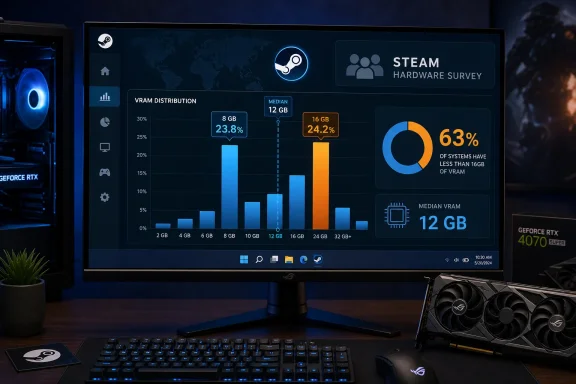 The 16GB lead is only 0.58 percentage points
Valve reports that 16GB gained 1.40 percentage points in July while 8GB fell 0.32 points. That leaves the two tiers separated by 0.58 percentage points — a lead, but not a durable gulf. Steam’s survey is a monthly voluntary and anonymous sample, not a census of every active PC, so very small movements should be read as directionally useful rather than as a precise measure of retail sales.The larger trend is still hard to miss. A 16GB configuration had been closing on 8GB for months, and July is the first result in which it moved ahead. The 12GB tier remained substantial at 12.88%, while 24GB accounted for 5.43%. Above 16GB, the 20GB, 22GB, 24GB, 32GB, 64GB, and “Other” categories collectively totaled roughly 11.23%, subject to rounding.
That leaves the market divided three ways:
- Systems below 16GB account for 62.89% of the survey.
- Systems with exactly 16GB account for 25.90%.
- Systems above 16GB account for roughly 11.23%.
The RTX 3060 explains why 12GB still matters
The individual-GPU chart tells a different story from the aggregate VRAM chart. The NVIDIA GeForce RTX 3060 regained first place at 3.71%, just ahead of the RTX 4060 Laptop GPU at 3.44%. Valve’s results show the RTX 3060 slipping only 0.02 percentage points for the month, while the RTX 4060 Laptop GPU dropped 0.37 points.That distinction matters for interpreting the 16GB result. The RTX 3060’s dominant 12GB desktop model remains one of the most common cards on Steam, and the 12GB tier is not a legacy footnote. It is the actual middle of the current distribution. Meanwhile, the RTX 4060 Laptop GPU — an 8GB part — remains the second-most-common single GPU, underscoring the continuing weight of gaming notebooks and mainstream 8GB configurations.
The 16GB aggregate is being built from many products rather than one runaway model: 16GB editions of the RTX 5060 Ti and RTX 4060 Ti, AMD’s Radeon RX 7800 XT and RX 9070 XT, older Radeon RX 6800-series cards, and higher-tier Radeon and GeForce products all feed that bucket. It is a sign of product turnover across several price bands, not proof that one current-generation card has displaced the installed base.
This is also why hardware buyers should not use Steam’s VRAM chart as a performance ranking. A 16GB Radeon RX 7800 XT, a 16GB RTX 5060 Ti, and a 16GB RTX 4060 Ti may share a memory-capacity label, but their GPU throughput, memory bandwidth, feature sets, power limits, and laptop-versus-desktop behavior are materially different. Capacity determines whether a game can keep a chosen set of assets resident without severe compromises; it does not determine frame rate by itself.
Valve’s earlier VRAM reporting error still limits historical comparisons
There is another reason not to overstate one month’s ranking. In February, Valve acknowledged in Steam Client Beta release notes that VRAM on some graphics cards had not been reported correctly in the Hardware Survey. PC Gamer and Tom’s Hardware independently reported the correction and Valve’s related change for systems with multiple display adapters: the survey would report the adapter with the most memory.That correction was necessary, but it complicates comparisons with earlier survey charts. A shift in a VRAM tier can reflect genuine upgrades, changed detection behavior, or both. Valve does not publish the raw sample size, per-device corrections, confidence intervals, or a revision history that would allow outside analysts to separate those effects cleanly.
The July data should therefore be treated as the best available current snapshot rather than an exact retail-sales ledger. It is strong enough to establish the crossover — Valve’s own live survey reports it — but it cannot say precisely how many systems migrated from 8GB to 16GB through purchases alone. The survey’s monthly movements are also too coarse to identify whether the increase came disproportionately from desktop GPUs, laptops, multi-GPU workstations, or systems whose adapter reporting changed after the fix.
The broader interpretation holds: modern 16GB cards have accumulated enough installed share to become the plurality category. The exact speed of that transition remains less certain than the chart makes it appear.
1080p is still the dominant target
Valve’s July results add a crucial constraint to the VRAM narrative: 1920 × 1080 remains the leading primary display resolution at 51.10% of surveyed systems. The most common Steam PC is not built around a 4K display and maximum texture packs. It is still a 1080p machine, often running an older 8GB or 12GB graphics card.That should temper claims that every new PC game needs to make 16GB its default expectation. VRAM demand rises sharply with texture resolution, ray-tracing data, render resolution, caching strategy, mods, and poorly managed asset streaming. But a well-scaled 1080p mode is not the same workload as native 4K with ultra textures and heavy ray tracing. Developers that conflate the two turn a high-end option into an unnecessary minimum requirement.
For players, the result is more straightforward. An existing 8GB card has not suddenly stopped being viable because 16GB became Steam’s largest individual category. The more immediate warning is for anyone buying a new GPU intended to last several years, especially for 1440p, high-resolution texture packs, ray tracing, or demanding Unreal Engine 5 releases. VRAM is soldered to the board; it cannot be upgraded later when a game crosses a memory threshold.
Windows 11 remains the clear Steam default
The survey also confirms that Windows 11 remains above the 70% line among all Steam participants. Valve lists Windows 11 64-bit at 70.26%, down 0.18 percentage points from June, while Windows 10 64-bit fell to 23.30%. Windows overall declined 0.43 points to 93.67%, as Linux rose to 4.01% and macOS reached 2.32%.The small Windows 11 decline does not reverse the migration trend reported in June, when Neowin and other outlets noted that the OS first moved above 70%. It does show why one month of Steam survey movement should never be mistaken for a permanent directional change. The operating-system figures, like the VRAM figures, are a rolling signal from a sampled population.
For Windows gamers and IT admins supporting gaming fleets, the immediate takeaway is less dramatic than the 16GB headline: Windows 11 is the default Steam platform, 1080p remains the baseline display target, and the median system reports 12GB of VRAM. That is the machine software makers still need to support, even as 16GB cards finally become the largest individual memory tier.
References
- Primary source: Neowin
Published: 2026-08-03T21:10:01+00:00
16GB is now the most common VRAM amount on Steam, but most gamers still have less | Neowin
Despite the ongoing hardware pricing crisis, the latest Steam Hardware Survey shows that 16GB of VRAM is now the most common amount among gamers. www.neowin.net
- Related coverage: neowin.net
Windows 11 finally climbs over 70% of all users on Steam | Neowin
The latest report from Valve shows that Windows 11 just crossed 70% market share on Steam, and AMD keeps closing the gap on Intel.
www.neowin.net
- Related coverage: golem.de
- Related coverage: itc.ua
Loading…
itc.ua - Related coverage: windowsreport.com
Steam Survey Shows Windows 11 Growing as RTX 4060 Laptop GPU Takes Lead
Valve’s June 2026 Steam survey shows Windows 11 rising to 70.44%, while the RTX 4060 Laptop GPU becomes the top GPU. windowsreport.com
- Related coverage: hwupgrade.it
L'adozione di Windows 11 continua a crescere tra gli utenti di Steam | Hardware Upgrade
Il sondaggio di giugno 2026 di Steam conferma il primato di Windows 11, che supera il 70,44% di quota (+0,68%). Calano Windows 10, stabile comunque al 23,56%, e Linux, che scende al 3,69% (Steam OS leader al 0,84%). Chiude macOS al 2,21%, consolidando Microsoft come riferimento assoluto del PC...www.hwupgrade.it - Related coverage: windowscentral.com
Windows 11 hits a new PC gaming milestone on Steam with over 70% market share — Windows 10's time is running out | Windows Central
Steam's June 2026 Hardware Survey shows Windows 11 surpassing 70% market share as Windows 10 continues to decline ahead of end of support.www.windowscentral.com - Related coverage: pcgamer.com
6 months after Windows 10 was put to pasture, over a quarter of Steam users are still on the dying OS | PC Gamer
It's likely not a matter of preference.www.pcgamer.com - Related coverage: tomshardware.com
- Related coverage: windowscentral.com
Linux is losing ground on Steam as Windows 11 continues its rise among PC gamers — is Microsoft repairing its reputation? | Windows Central
Steam's latest hardware survey shows Windows 11 continuing to grow while Linux loses ground after reaching a high point earlier this year.www.windowscentral.com - Related coverage: techradar.com
Nvidia brings the RTX 3060 back from the dead to beat the RAM crisis — there's a reason why it still tops the Steam Hardware Survey after all these years | TechRadar
The RAM crisis caused thiswww.techradar.com - Related coverage: tomsguide.com
Microsoft promises to improve PC gaming in 2026, but will it be enough to topple Steam? | Tom's Guide
Microsoft has improved gaming on Windows this year but it has even bigger plans for 2026.www.tomsguide.com - Related coverage: dudarik.com
Steam Machine launches today: Specs, SteamOS updates, … | dudarik.com
Valve ships the Steam Machine with a semi-custom Zen 4/RDNA 3 config and a major SteamOS update. Here is what changed, what matters for development workflows, … dudarik.com
- Related coverage: technave.com
Steam Machine and Frame could arrive on the market this July 2026 | TechNave
Recently, Valve announced that the Steam Machine console and Steam Frame headset will go on sale this summer. There's no firm date for when they'technave.com - Related coverage: tomshardware.com
AMD CPUs, 64GB RAM, and Windows 11 show strong gains in the latest Steam Hardware Survey | Tom's Hardware
6GB VRAM takes a dive, but 70% of GPUs still have 8GB of less.www.tomshardware.com - Related coverage: thefpsreview.com
Trends from the April 2026 Steam Hardware Survey
Valve has published the April 2026 Steam Hardware Survey, and the big story this month is normalization. Last month’s data was a statistical mess, with Linux at an improbable 5.33%, the 16 GB RAM tier jumping wildly, and the RTX 5070 temporarily sitting at an anomalous position. April looks a...www.thefpsreview.com - Related coverage: gamespot.com
Steam Hardware Survey Breakdown And Analysis (September 2017) - GameSpot
You may be surprised to hear how popular 4K gaming is.www.gamespot.com - Related coverage: pcworld.com
How to make your PC take the Steam Hardware Survey | PCWorld
Make your PC hardware count by taking the Steam Hardware Survey.www.pcworld.com
- Related coverage: nvlpubs.nist.gov
- Related coverage: pcgamer.com
Valve owns up to inaccurate Steam hardware survey findings, saying 'VRAM on some graphics cards was not reported correctly' | PC Gamer
Still, it's reassuring that not everyone but you is gaming on the shiniest hardware.www.pcgamer.com