
Germany’s Munich Regional Court has ruled that Suno infringed copyright by training its AI music system on GEMA-represented songs without a licence, according to reporting by Law Commentary and Tech Times. The decision grants GEMA an injunction, revenue-disclosure rights and damages to be determined later—putting immediate pressure on Suno’s European operations even if the company appeals.
The reported case, 42 O 763/25, is significant because it treats a generative model’s alleged retention of recognizable musical works as a reproduction problem, rather than merely a question of whether an output is substantially similar to a source song. That distinction matters far beyond an AI music service.
Tech Times reports that the court found Suno’s outputs could reproduce protected elements of six works, including songs associated with Alphaville, Lou Bega and Boney M. The court reportedly concluded that storing the works in model parameters and making matching outputs available infringed Germany’s reproduction and public-communication rights.
Suno argued that its system learned mathematical patterns, not copies, and invoked U.S. fair use and European text-and-data-mining protections. The Munich court rejected that approach, according to the reports, finding that the relevant legal exception does not extend to permanent storage of works in a form that can yield recognizable reproductions.
Germany’s Copyright Act defines text and data mining as automated analysis used to obtain information such as patterns, trends and correlations. It also allows rightsholders to reserve commercial use. The reported decision turns on the court’s view that memorization is not analysis when a model can be prompted into producing material that closely tracks a protected work.
For Suno, the immediate practical stakes are threefold:
For organizations building or deploying generative AI on Windows and Azure environments, the operational lesson is not that every model is automatically unlawful. It is that “we trained on publicly accessible material” is becoming a far weaker compliance position in Europe—especially where a rights holder reserved mining rights or where the system can reproduce source material too closely.
That raises the value of a few controls that are increasingly technical as well as legal: documented training-data provenance, contractually licensed datasets, output similarity testing, prompt-abuse monitoring and retention limits for customer-uploaded data. Teams integrating third-party models should also identify whether a supplier will indemnify them for training-data claims and whether its geographic deployment terms change after a court order.
The ruling does not decide Suno’s separate U.S. disputes, and an appeal could narrow or overturn Munich’s reasoning. But unless that happens, Europe’s AI market now has a concrete judicial warning: a model’s weights may no longer be treated as an untouchable black box when the system can be shown to reproduce the works used to train it.
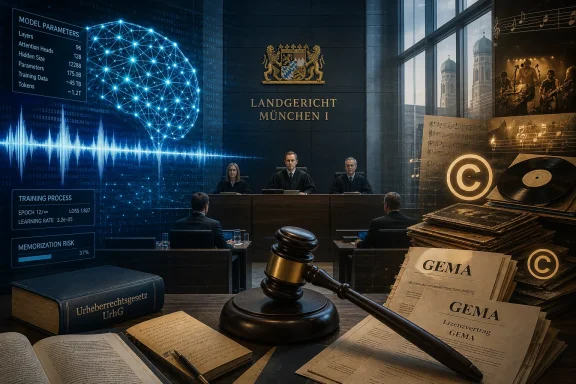 Munich Draws a Line Between Analysis and Memorization
Tech Times reports that the court found Suno’s outputs could reproduce protected elements of six works, including songs associated with Alphaville, Lou Bega and Boney M. The court reportedly concluded that storing the works in model parameters and making matching outputs available infringed Germany’s reproduction and public-communication rights.Suno argued that its system learned mathematical patterns, not copies, and invoked U.S. fair use and European text-and-data-mining protections. The Munich court rejected that approach, according to the reports, finding that the relevant legal exception does not extend to permanent storage of works in a form that can yield recognizable reproductions.
Germany’s Copyright Act defines text and data mining as automated analysis used to obtain information such as patterns, trends and correlations. It also allows rightsholders to reserve commercial use. The reported decision turns on the court’s view that memorization is not analysis when a model can be prompted into producing material that closely tracks a protected work.
The Order Is Not a Europe-Wide Shutdown
The ruling reportedly targets Suno’s unlicensed reproduction of the six works litigated by GEMA; it is not a blanket order to take Suno offline across Europe. Still, first-instance German judgments can be provisionally enforceable, meaning GEMA may seek to enforce the injunction while an appeal proceeds.For Suno, the immediate practical stakes are threefold:
- The company may need to prevent generation of the works covered by the injunction without relying solely on post-output moderation.
- Revenue disclosures could establish the basis for a separate damages proceeding.
- A licensing settlement may become more attractive than defending a precedent-setting appeal.
Why Windows Developers and IT Teams Should Pay Attention
The case is nominally about music, but the legal theory described by Law Commentary and Tech Times is not inherently limited to audio. If European courts accept that model weights can constitute unlawful reproductions where they retain and emit recognizable copyrighted material, the same argument may be brought against systems trained on code, documents, images, video or enterprise data.For organizations building or deploying generative AI on Windows and Azure environments, the operational lesson is not that every model is automatically unlawful. It is that “we trained on publicly accessible material” is becoming a far weaker compliance position in Europe—especially where a rights holder reserved mining rights or where the system can reproduce source material too closely.
That raises the value of a few controls that are increasingly technical as well as legal: documented training-data provenance, contractually licensed datasets, output similarity testing, prompt-abuse monitoring and retention limits for customer-uploaded data. Teams integrating third-party models should also identify whether a supplier will indemnify them for training-data claims and whether its geographic deployment terms change after a court order.
The ruling does not decide Suno’s separate U.S. disputes, and an appeal could narrow or overturn Munich’s reasoning. But unless that happens, Europe’s AI market now has a concrete judicial warning: a model’s weights may no longer be treated as an untouchable black box when the system can be shown to reproduce the works used to train it.
References
- Primary source: Law Commentary
Published: 2026-07-31T20:39:00+00:00
German Court Rules Suno Illegally Trained AI Model on Copyrighted Songs | Law Commentary
A Munich court has dealt a significant legal setback to Suno, ruling on Friday that the AI music company violated German copyright law by training its model on songs without securing licenses from the rights holders. The decision, issued by the Munich Regional Court, hands a major victory to... www.lawcommentary.com
- Independent coverage: Tech Times
Published: 2026-07-31T15:58:56+00:00
Suno Loses Europe's First AI Music Copyright Ruling: Training Without Licensing Is Infringement
Suno copyright ruling: Germany’s Munich Regional Court found the AI music company violated GEMA-represented composers’ rights by permanently encoding songs in its model weights, awarding injunctivewww.techtimes.com