
PBS, Engadget, Asahi Shimbun, Reuters and Taiwan’s Central News Agency all reported the August 24 indictments. Eight defendants, including one Nvidia Taiwan employee and two employees of Supermicro’s Taiwan operation, were charged with breach of trust and document forgery. The ninth faces a separate, connected allegation involving funds from a distributor associated with the transaction. These are criminal charges against individuals, not findings of guilt, and Taiwan’s prosecutors have not charged Nvidia or Supermicro as companies.
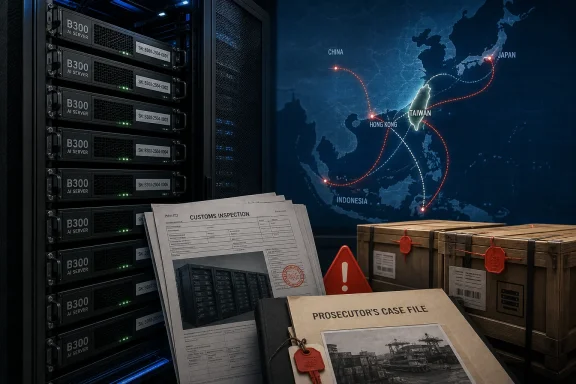
Prosecutors say the group arranged the purchase of 130 Supermicro B300 systems on the representation that they would be installed at a leased Taiwanese server facility. Instead, 74 allegedly reached Chinese customers, either directly or through routes involving Indonesia, Japan and Hong Kong. Taiwan authorities stopped the remaining 56 servers before export after identifying irregularities in the paperwork.
 The alleged failure was in the customer record, not the box
AI export enforcement is often described as a semiconductor problem, but the Keelung case is more specifically an end-user verification problem. A B300-class server is difficult to mistake for ordinary commodity hardware: it is a high-value, dense AI computing system whose buyer, deployment site, power requirements, networking environment and support relationship should all leave a substantial documentary trail.
According to the prosecutors’ account reported by Reuters and CNA, the defendants allegedly created documents to make a Taiwanese facility appear to be the intended destination. That means the alleged diversion was not simply a shipment lost after it left a warehouse. The case centers on whether purchase approvals, deployment claims and export paperwork were used to establish a false domestic end use before the systems entered outbound logistics channels.
This detail changes the practical reading of the indictments. A policy that checks only the name on an order form cannot reliably block diversion if the named customer is legitimate on paper but the claimed installation is fictitious or temporary. For server manufacturers, distributors and large resellers, the relevant compliance evidence has to extend beyond a signed end-user statement: rack delivery, serial-number custody, site access, commissioning records, payment flows and post-sale support activity are all potential corroboration points.
The fact that authorities seized 56 additional systems also indicates that customs review still caught part of the operation. But the 74 servers prosecutors say were delivered show why a checkpoint at the border cannot substitute for controls earlier in the sales and allocation process.
B300 hardware makes the case more consequential than a routine gray-market shipment
The systems cited by Taiwanese prosecutors contain Nvidia B300 GPUs, part of Nvidia’s Blackwell-generation AI hardware. These are systems designed for data-center-scale training and inference workloads, where the practical value comes from clustered compute capacity rather than a single chip installed in a workstation.
U.S. export rules cover advanced AI accelerators and certain systems that incorporate them, including transfers to China and Hong Kong. The Commerce Department has adjusted some China licensing policies during 2026, including a case-by-case review path for Nvidia H200 and comparable products under stated conditions. That policy change does not make B300 equipment a free-to-export product, nor does it remove the obligation to obtain authorization where one is required.
The distinction matters because a loose description of the story as an “AI chip” case obscures what allegedly moved. The indictment concerns complete server systems. A finished server carries not only accelerators but memory, CPUs, networking, firmware, chassis design, serviceability and the ability to be deployed much more quickly than loose components. It also creates an identifiable supply-chain object with serial numbers and a formal customer relationship — precisely why false end-user documentation, if proved, would be central to the alleged scheme.
For IT administrators, the case reinforces an uncomfortable reality: hardware asset management is no longer just a finance and lifecycle discipline for advanced-computing deployments. For organizations purchasing export-controlled AI infrastructure, it can become part of the evidence that a vendor’s stated end-use controls are real.
The Taiwan case is separate from the March U.S. indictment
This is not the first 2026 enforcement action involving Supermicro-linked AI server exports, and that broader record makes the latest case harder to dismiss as an isolated customs incident.
In March, the U.S. Attorney’s Office for the Southern District of New York unsealed an indictment against Supermicro co-founder Yih-Shyan “Wally” Liaw, Taiwan general manager Ruei-Tsang “Steven” Chang and broker Ting-Wei “Willy” Sun. U.S. prosecutors alleged that the three conspired to divert billions of dollars’ worth of high-performance servers with controlled GPUs to Chinese customers through false records, intermediary companies and repackaging. The defendants in that case are entitled to the presumption of innocence.
The Keelung indictments concern a different alleged transaction: 130 B300 servers, 74 allegedly exported and 56 intercepted. The overlap is not an allegation that every person named in one case appears in the other; rather, it is the recurring pattern. In both cases, prosecutors describe purported end users and documentation as the mechanism that allowed restricted AI systems to pass through commercial channels.
That repetition is the story enterprise hardware customers should watch. The apparent weak point is not whether companies have an export-control policy on paper. It is whether allocation decisions and customer records can withstand a forensic comparison with where a server was actually installed, operated and paid for.
Supermicro says it is cooperating, but its own update leaves key questions open
Supermicro said in a July 1 customer update that Taiwanese authorities had confirmed the company itself was not a target of the investigation. It said four Taiwan employees had been detained for questioning, two remained detained pending a hearing, and all four had been placed on administrative leave. The company also said it had provided authorities access to the employees’ desks and electronic devices and was working to strengthen safeguards against illicit diversion.
That statement is important, but it does not settle the wider compliance question. Supermicro acknowledged that it did not have full visibility into the ongoing investigation. A company can be cooperating with authorities and still face a searching examination of whether its controls functioned as designed, whether warning signs were escalated, and whether distributors or sales personnel could override them.
Nvidia’s exposure is different in the current Taiwan case. Prosecutors named an employee of Nvidia’s Taiwan unit among the defendants, but there is no public allegation that Nvidia itself directed or approved the alleged exports. The distinction should be kept sharp: employees being charged is not equivalent to corporate criminal liability. Still, the alleged involvement of personnel at both the chip designer and server maker raises the stakes for internal access controls, allocation approval systems and escalation paths.
Neither the indictment reports nor the companies’ prior public statements answer several operational questions: whether the 74 systems can be identified by serial number; whether they remain active; whether the alleged customers received vendor support; and whether distributors or logistics providers had access to evidence contradicting the claimed Taiwan deployment. Those omissions are not proof of wrongdoing by any company, but they are the practical questions investigators and institutional buyers will now expect answers to.
What AI-infrastructure buyers should check now
Organizations buying advanced Nvidia-based server clusters do not need to redesign their data centers because of a Taiwan indictment. They should, however, treat provenance and installation records as part of the purchase requirement when equipment is subject to export controls.
- Procurement teams should require the legal end user, beneficial owner, physical installation site and operating entity to match across purchase orders, invoices, shipping records and service contracts.
- Asset-management systems should retain server serial numbers, GPU identifiers where available, rack positions, acceptance records and the date equipment was commissioned.
- Channel partners should be able to explain who controls the equipment after delivery, rather than relying solely on an intermediary’s statement that it will remain in a permitted location.
- Security and infrastructure teams should retain remote-management, warranty and support records long enough to confirm that a high-value server fleet remains where the approved deployment said it would be.
The Keelung case now moves from investigation to court proceedings. For Nvidia, Supermicro and their customers, the near-term consequence is a more demanding standard of proof around AI-server destinations: a signed declaration that systems will remain in Taiwan is unlikely to be enough if the physical, financial and operational records point somewhere else.