
Microsoft has cut the price of its highest-spec consumer Surface Pro, 13-inch (12th Edition), to $2,849.99, a $700 reduction from its $3,549.99 list price. The configuration pairs Qualcomm’s 12-core Snapdragon X2 Elite with a 13-inch OLED display, 64GB of LPDDR5x memory, and a 1TB removable Gen 4 SSD. PhoneArena highlighted the drop on August 5, and Microsoft’s own U.S. Store now lists the same price.
For buyers who specifically need 64GB of memory in a detachable Windows machine, this is the first substantial correction to a price point that was hard to defend when the Surface Pro launched on June 16. But the discount does not turn the model into a broad recommendation: it brings an unusually expensive Arm-based tablet closer to the price of a well-equipped mobile workstation while leaving the keyboard, pen, and software-compatibility compromises intact.
Microsoft introduced the 2026 13-inch Surface Pro at $1,499.99, with the Snapdragon X2 Plus, 16GB of RAM, 256GB SSD, and LCD display. The premium OLED models start with the Snapdragon X2 Elite, but the price climbs sharply once buyers move beyond 16GB of memory and 512GB of storage.
The fully configured consumer model carries a $3,549.99 MSRP. Microsoft’s current $2,849.99 price is just under a 20 percent cut, and it is the largest nominal reduction in the lineup. The 32GB/1TB OLED variant is down from $2,749.99 to $2,199.99, while the 16GB/1TB OLED models are listed at $1,649.99, down $450.
That pricing ladder explains why the 64GB model is the one worth examining rather than simply celebrating. A $700 discount sounds dramatic because the original price was dramatic. Microsoft is asking $650 more for the jump from 32GB to 64GB while keeping the same Snapdragon X2 Elite processor, OLED panel, and 1TB storage. Memory capacity is the practical upgrade here; there is no faster processor tier, larger drive, cellular modem, or additional port capability bundled into the $2,849.99 configuration.
Microsoft’s Store labels the sale as a limited-time, supply-dependent promotion and reserves the right to change or withdraw it. There is no published end date for the direct price reduction, so prospective buyers should treat the listed price as current rather than a guaranteed August-long promotion.
Microsoft’s current accessory choices include standard Surface Pro keyboards, keyboards with Slim Pen storage, and the detachable wireless Surface Pro Flex Keyboard. The Flex Keyboard is the accessory that makes the Surface Pro most credible as a laptop replacement, particularly because it can operate while detached from the screen. It also raises the real purchase total substantially, and a Slim Pen adds another charge for users who want the inking experience Microsoft uses to sell the form factor.
At $2,849.99 before accessories, the 64GB Surface Pro is already beyond the range where a buyer should accept a compromised desk setup. A keyboard is not an indulgence for this configuration; it is required equipment for the kind of local development, virtual-machine use, photography work, large spreadsheet models, and creative applications that can plausibly consume 64GB of RAM.
The hardware itself retains the familiar Surface Pro strengths. It weighs 1.97 pounds without a keyboard, offers two USB4 ports plus Surface Connect, has Wi-Fi 7, a 1440p ultrawide front camera, a 10MP rear camera, and the adjustable kickstand that still makes it more flexible than a clamshell notebook in tight spaces. The 13-inch 2,880 × 1,920 OLED panel supports a dynamic refresh rate of up to 120Hz. Microsoft also says the SSD is removable, although replacing it does not change the fact that memory is soldered and fixed at purchase.
For users who genuinely need a full Windows tablet with high memory capacity, those attributes remain unusually compelling. The problem is that this buyer group is narrow, and the machine’s processor architecture narrows it further.
Those are meaningful generational changes, especially for workloads that run natively on Arm64 Windows: Office, Microsoft’s own tools, modern browsers, many Adobe and Affinity applications, and a growing set of native utilities. More graphics performance also helps with timeline editing, image processing, high-resolution external displays, and GPU-accelerated UI work. Microsoft’s advertised battery figures are up to 15.5 hours of local video playback and 11.5 hours of active web browsing, though those measurements were conducted using preproduction 16GB systems rather than the 64GB model now on sale.
The purchase decision should still begin with software, not memory. Windows 11 on Arm can emulate many x86 and x64 applications, but emulation is not a substitute for native support when a workflow depends on low-level drivers, legacy peripherals, virtualization features, endpoint-security components, specialist plug-ins, or software that expects an x86 Windows environment. The risk rises in managed IT environments, where VPN clients, hardware-management utilities, printer and scanner drivers, security agents, and line-of-business software can determine whether a machine is deployable.
A 64GB configuration can make that mismatch more frustrating, not less. It has enough memory to invite heavy use — multiple development environments, containers, virtual machines, very large files — but any important application or driver that does not behave properly on Arm negates the benefit. IT teams should validate their image, VPN, EDR stack, management client, and peripheral drivers against this exact Snapdragon platform before treating the sale as a procurement opportunity.
Windows Central’s July coverage of the new Surface Pro described the Snapdragon X2 graphics gains as more useful for productivity and content work than gaming. That is the correct frame. This is an ultra-portable Windows productivity device with a strong display and a high-capacity memory option, not a mobile workstation with discrete graphics or a broad guarantee of legacy enterprise compatibility.
The $2,849.99 sale does not make the prior MSRP irrelevant. Retailers use list prices to establish discounts, but the June 16 launch price was Microsoft’s official price for a live product, not an inherited or obsolete reference number. A $700 reduction less than seven weeks later is evidence that the original ceiling was too high for the market Microsoft is trying to reach.
Microsoft has also discounted the rest of the 13-inch range. The entry LCD model is $1,199.99, $300 below its $1,499.99 MSRP, and the 16GB/512GB OLED X2 Elite model is $1,499.99, also $300 off. The best-balanced value in the family may therefore be the 16GB/1TB OLED configuration at $1,649.99 rather than the 64GB flagship: it retains the 12-core Elite processor, OLED display, and 1TB drive for $1,200 less.
The 64GB machine makes sense when memory is a documented requirement and its Arm compatibility has been tested. For most Windows enthusiasts and professionals, the $2,849.99 price is a warning to price the whole setup — keyboard, pen if needed, warranty coverage, docks, and software requirements — before assuming the largest advertised discount is the best Surface Pro deal.
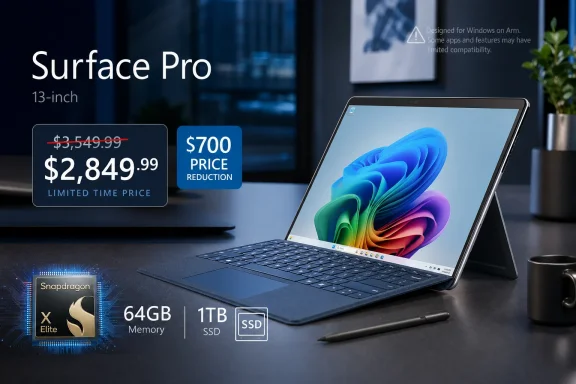 The $700 cut lands less than two months after launch
Microsoft introduced the 2026 13-inch Surface Pro at $1,499.99, with the Snapdragon X2 Plus, 16GB of RAM, 256GB SSD, and LCD display. The premium OLED models start with the Snapdragon X2 Elite, but the price climbs sharply once buyers move beyond 16GB of memory and 512GB of storage.The fully configured consumer model carries a $3,549.99 MSRP. Microsoft’s current $2,849.99 price is just under a 20 percent cut, and it is the largest nominal reduction in the lineup. The 32GB/1TB OLED variant is down from $2,749.99 to $2,199.99, while the 16GB/1TB OLED models are listed at $1,649.99, down $450.
That pricing ladder explains why the 64GB model is the one worth examining rather than simply celebrating. A $700 discount sounds dramatic because the original price was dramatic. Microsoft is asking $650 more for the jump from 32GB to 64GB while keeping the same Snapdragon X2 Elite processor, OLED panel, and 1TB storage. Memory capacity is the practical upgrade here; there is no faster processor tier, larger drive, cellular modem, or additional port capability bundled into the $2,849.99 configuration.
Microsoft’s Store labels the sale as a limited-time, supply-dependent promotion and reserves the right to change or withdraw it. There is no published end date for the direct price reduction, so prospective buyers should treat the listed price as current rather than a guaranteed August-long promotion.
The Surface Pro remains a tablet first — and the price excludes the essentials
The discounted device is still sold as the tablet alone. Microsoft includes a 39W Surface Connect power supply, but the Type Cover-style keyboard is optional, as is the Surface Slim Pen. That distinction is easy to miss when comparing the Surface Pro’s advertised price with conventional laptops.Microsoft’s current accessory choices include standard Surface Pro keyboards, keyboards with Slim Pen storage, and the detachable wireless Surface Pro Flex Keyboard. The Flex Keyboard is the accessory that makes the Surface Pro most credible as a laptop replacement, particularly because it can operate while detached from the screen. It also raises the real purchase total substantially, and a Slim Pen adds another charge for users who want the inking experience Microsoft uses to sell the form factor.
At $2,849.99 before accessories, the 64GB Surface Pro is already beyond the range where a buyer should accept a compromised desk setup. A keyboard is not an indulgence for this configuration; it is required equipment for the kind of local development, virtual-machine use, photography work, large spreadsheet models, and creative applications that can plausibly consume 64GB of RAM.
The hardware itself retains the familiar Surface Pro strengths. It weighs 1.97 pounds without a keyboard, offers two USB4 ports plus Surface Connect, has Wi-Fi 7, a 1440p ultrawide front camera, a 10MP rear camera, and the adjustable kickstand that still makes it more flexible than a clamshell notebook in tight spaces. The 13-inch 2,880 × 1,920 OLED panel supports a dynamic refresh rate of up to 120Hz. Microsoft also says the SSD is removable, although replacing it does not change the fact that memory is soldered and fixed at purchase.
For users who genuinely need a full Windows tablet with high memory capacity, those attributes remain unusually compelling. The problem is that this buyer group is narrow, and the machine’s processor architecture narrows it further.
Snapdragon X2 Elite performance does not remove Windows on Arm constraints
Microsoft positions the Snapdragon X2 Elite Surface Pro as a Copilot+ PC with an 80 TOPS Hexagon NPU and claims up to 53 percent higher graphics performance than the prior Surface Pro generation. Tom’s Hardware, reporting on the launch, confirmed the headline specifications: Snapdragon X2 Plus and X2 Elite options, up to 64GB of RAM, 1TB of storage, OLED or LCD panels, and Wi-Fi 7.Those are meaningful generational changes, especially for workloads that run natively on Arm64 Windows: Office, Microsoft’s own tools, modern browsers, many Adobe and Affinity applications, and a growing set of native utilities. More graphics performance also helps with timeline editing, image processing, high-resolution external displays, and GPU-accelerated UI work. Microsoft’s advertised battery figures are up to 15.5 hours of local video playback and 11.5 hours of active web browsing, though those measurements were conducted using preproduction 16GB systems rather than the 64GB model now on sale.
The purchase decision should still begin with software, not memory. Windows 11 on Arm can emulate many x86 and x64 applications, but emulation is not a substitute for native support when a workflow depends on low-level drivers, legacy peripherals, virtualization features, endpoint-security components, specialist plug-ins, or software that expects an x86 Windows environment. The risk rises in managed IT environments, where VPN clients, hardware-management utilities, printer and scanner drivers, security agents, and line-of-business software can determine whether a machine is deployable.
A 64GB configuration can make that mismatch more frustrating, not less. It has enough memory to invite heavy use — multiple development environments, containers, virtual machines, very large files — but any important application or driver that does not behave properly on Arm negates the benefit. IT teams should validate their image, VPN, EDR stack, management client, and peripheral drivers against this exact Snapdragon platform before treating the sale as a procurement opportunity.
Windows Central’s July coverage of the new Surface Pro described the Snapdragon X2 graphics gains as more useful for productivity and content work than gaming. That is the correct frame. This is an ultra-portable Windows productivity device with a strong display and a high-capacity memory option, not a mobile workstation with discrete graphics or a broad guarantee of legacy enterprise compatibility.
Microsoft’s own sale undercuts the original premium positioning
The larger story is how quickly the top-tier SKU has needed a visible price reset. Microsoft launched the 64GB/1TB OLED configuration at $3,549.99, an unusually high number for a consumer Surface Pro. PhoneArena’s launch coverage called the 2026 Surface Pro pricing difficult to justify, and it was not alone in emphasizing the widening gap between the device’s aspirational configuration pricing and comparable premium laptops.The $2,849.99 sale does not make the prior MSRP irrelevant. Retailers use list prices to establish discounts, but the June 16 launch price was Microsoft’s official price for a live product, not an inherited or obsolete reference number. A $700 reduction less than seven weeks later is evidence that the original ceiling was too high for the market Microsoft is trying to reach.
Microsoft has also discounted the rest of the 13-inch range. The entry LCD model is $1,199.99, $300 below its $1,499.99 MSRP, and the 16GB/512GB OLED X2 Elite model is $1,499.99, also $300 off. The best-balanced value in the family may therefore be the 16GB/1TB OLED configuration at $1,649.99 rather than the 64GB flagship: it retains the 12-core Elite processor, OLED display, and 1TB drive for $1,200 less.
The 64GB machine makes sense when memory is a documented requirement and its Arm compatibility has been tested. For most Windows enthusiasts and professionals, the $2,849.99 price is a warning to price the whole setup — keyboard, pen if needed, warranty coverage, docks, and software requirements — before assuming the largest advertised discount is the best Surface Pro deal.
References
- Primary source: PhoneArena
Published: 2026-08-05T07:30:02+00:00
Loading…
www.phonearena.com - Related coverage: phonearena.com
Microsoft's 12th Gen Surface Pro is here with a 13-inch screen and Snapdragon X2 processing power - PhoneArena
Raw power and battery life are without a doubt the key selling points of the latest (overpriced) Surface Pro tablet.www.phonearena.com - Related coverage: blogs.windows.com
Introducing the next Surface Pro and Surface Laptop, built for performance and flexibility
For more than 13 years, Surface has been shaped by the people who use it. Architects sketch buildings, developers train models, students build startups and field engineers solve problems that rarely make headlines. We didn't intend to design for onblogs.windows.com - Related coverage: learn.microsoft.com
Loading…
learn.microsoft.com - Related coverage: microsoft.com
Loading…
www.microsoft.com - Related coverage: support.microsoft.com
Loading…
support.microsoft.com - Related coverage: microsoft.com
Loading…
www.microsoft.com - Related coverage: blogs.windows.com
Introducing new Surface devices built for business and AI acceleration
Every IT leader and partner we work with is navigating the same challenges: AI is changing the demands of how teams work, security threats are growing more sophisticated and agents are changing investment decisions for the future. All under greater sblogs.windows.com - Related coverage: news.microsoft.com
- Related coverage: learn.microsoft.com
Surface supported operating systems - Surface | Microsoft Learn
Discover which versions of Windows are supported on Microsoft Surface devices to ensure compatibility and optimize your Surface experience.learn.microsoft.com - Related coverage: neowin.net
Loading…
www.neowin.net - Related coverage: cdn-dynmedia-1.microsoft.com
- Related coverage: cdn-dynmedia-1.microsoft.com
Loading…
cdn-dynmedia-1.microsoft.com - Related coverage: tomshardware.com
Microsoft debuts Surface Pro and Surface Laptop with new jade green color and Qualcomm Snapdragon X2 chips — refreshed devices start at $1,499 with 16GB of RAM | Tom's Hardware
The Laptop features Microsoft's new haptic touchpad.www.tomshardware.com - Related coverage: windowscentral.com
Surface Pro for Business (12th Edition) vs Surface Pro 11 | Windows Central
Microsoft's two-stage Surface Pro launch is confusing. Let me clear things up.www.windowscentral.com - Related coverage: windowscentral.com
Loading…
www.windowscentral.com - Related coverage: tomsguide.com
Latest Microsoft Surface devices are more expensive — but there’s some good news | Tom's Guide
The consumer versions of the Microsoft Surface Laptop 8 and Surface Pro 12 are now available for $600 and $500 more than 2024's models.www.tomsguide.com - Related coverage: pcgamer.com
Microsoft plans to launch a cheaper 8 GB Surface laptop later this year which won't meet the requirements of a Copilot+ PC | PC Gamer
How far we have fallen.www.pcgamer.com - Related coverage: newsbytesapp.com
Loading…
www.newsbytesapp.com - Related coverage: neowin.net
Microsoft announces 12th-gen Surface Pro with Snapdragon X2 processors - Neowin
The new Surface Pro is officially here. Powered by the Snapdragon X2 processor family, the tablet offers better performance and optional OLED displays, albeit at a notably higher price. www.neowin.net
- Related coverage: notebookcheck.net
Loading…
www.notebookcheck.net - Related coverage: gadgetsalvation.com
Loading…
www.gadgetsalvation.com - Related coverage: techmymoney.com
Loading…
techmymoney.com - Related coverage: comparos.in
Loading…
www.comparos.in - Related coverage: techradar.com
Loading…
www.techradar.com - Related coverage: offkeytikki.com
Loading…
offkeytikki.com - Related coverage: 9to5google.com
Loading…
9to5google.com - Related coverage: kayakcambria.com
Loading…
kayakcambria.com - Related coverage: bestbuy.ca
Loading…
www.bestbuy.ca - Related coverage: uk.insight.com
Loading…
uk.insight.com - Related coverage: solosezfaq.com
Loading…
solosezfaq.com
