
Taghash has introduced a WhatsApp-based AI agent intended to let venture-capital and private-equity teams query fund records and prepare operational work from a chat thread rather than from the company’s web dashboard. According to Entrackr, the agent can retrieve information across deals, portfolio companies, funds and limited partners, then surface follow-ups, identify potential warm introductions and draft reminder emails. Actions that would send or change something are supposed to wait for a user’s review and approval.
The significant part is not WhatsApp support by itself. Taghash had already published a WhatsApp bot in February 2025 that accepted forwarded files, voice notes, screenshots and messages, then asked users to associate the material with a deal or portfolio company. This new release, as described by Entrackr, changes the role of that chat channel from an ingestion tool into a conversational front end for the fund’s operating system.
That is a meaningful upgrade for firms that run relationship-heavy dealflow outside their CRM. It is also a riskier one: once a chat assistant can pull limited-partner, portfolio and fund context into a messaging interface—and prepare outbound communications—the controls around identity, data access, retention and approval history matter at least as much as the quality of its answers.
Taghash’s 2025 WhatsApp bot was deliberately narrow. A user could send an incoming document or note to the bot, choose the relevant record, confirm the association, and have that material stored in Taghash. It solved a common operational failure in venture firms: deal context arrives in WhatsApp, gets read on a phone, and never makes it into the system that other partners or operations staff can search.
The new agent is presented as the reverse flow. Rather than pushing a file into Taghash, a user can ask for information already held by the platform. Entrackr reports that the agent can answer questions concerning deals, portfolio companies, funds and LPs, find pending follow-ups, and locate common connections for investor introductions.
Taghash’s current product site supports the underlying premise. Its platform combines dealflow CRM, relationship management, portfolio tracking, fund management and LP management; it says these modules hold relationship history, meeting context, portfolio metrics, capital activity, investor records and reporting workflows. If the agent is working against those live records rather than a static export, the practical benefit is obvious: an investment professional can ask for the status of a deal or an LP relationship while travelling, in a meeting, or between calls without opening the full application.
But conversational access does not repair incomplete data. A WhatsApp agent can make a fund’s existing record system easier to interrogate; it cannot know that a partner failed to log a call, attached a deck to the wrong deal, or kept sensitive relationship information in a personal chat. The faster interface may make these omissions more visible, but it may also give them a more authoritative-sounding presentation.
For fund managers, this is the correct boundary. A drafted reminder about an investor document, a follow-up to a founder, or a suggested introduction can be useful. Sending one automatically could create a recordkeeping problem, expose a confidential relationship, contact the wrong person, or make an unauthorized representation on behalf of the firm.
The approval mechanism also has a less visible operational consequence: it should create an identifiable point of accountability. A proper implementation needs to record the original user prompt, the data consulted, the draft generated, the approver, the final content, the recipient and the time of dispatch. Without that audit trail, “human approval” becomes a reassuring phrase rather than a control that a compliance team can actually inspect.
Taghash says on its site that it supports role-based access controls across workspaces, teams, funds, deals, portfolio companies, LP records and reports. That matters here because a general partner, an investment associate, a fund administrator and an external service provider should not necessarily see the same LP records or possess the same authority to start an action. The company also says it is SOC 2 compliant, uses regular vulnerability assessments and penetration testing, and is designed to help SEBI-regulated fund teams align with India’s CSCRF requirements.
Those are useful claims about the platform, but they do not answer the WhatsApp-specific questions. Neither Taghash’s public product pages nor Entrackr’s report identifies the WhatsApp Business architecture in use, the agent’s model provider, data-retention terms, data-residency options, supported jurisdictions, available languages, administrative controls, or whether conversation content is retained within Taghash, Meta’s systems, an AI provider’s systems, or some combination of them.
For a product handling cap tables, capital calls, investor identities and fund-performance data, those omissions are material. Firms should treat the agent as a controlled channel for approved workflows, not as a place for users to paste unrestricted fund information until those boundaries are documented.
Taghash’s own site says its MCP capability enables AI tools to work with live fund data and workflow context involving deals, portfolio companies, LPs, funds and reporting. That is consistent with the model described by Entrackr: the WhatsApp agent is not merely a chatbot trained on generic fund-administration material; it appears intended to call into the customer’s Taghash data and workflows.
Still, there is an important distinction between supporting MCP and delivering a ready-made integration for every AI client. The earlier report said Taghash’s MCP server could connect with Claude, OpenAI and Microsoft Copilot. The current Taghash product page makes the broader statement that it enables “AI tools,” but does not publicly list those client products, deployment requirements or feature parity between them.
Windows administrators and Microsoft 365 teams should not infer that a WhatsApp agent automatically becomes a Microsoft Copilot connector. An MCP server may provide the technical path, but a production Copilot deployment still requires authentication, tenant-level controls, permission mapping, logging and a review of what data each tool call can expose. Taghash has not published a configuration guide or a public capability matrix for the WhatsApp agent, Copilot, OpenAI or Claude.
The company’s headless software framing therefore deserves a practical reading. It does not mean the underlying system of record disappears. It means Taghash is trying to make its data and workflows callable from surfaces where fund teams already work: email, LinkedIn, browser activity, AI tools and now a more capable WhatsApp interface. The database, permissions model and workflow engine remain the product’s center of gravity.
For Taghash customers, the agent’s most credible uses are narrow and routine:
Taghash says users can control role-based access within its platform. The open question is how faithfully those access restrictions, authentication requirements and revocation rules carry into WhatsApp. A permission model is only as effective as its least-controlled access point.
Taghash also has not publicly stated a price, launch geography, customer-availability schedule, supported WhatsApp account types, or whether the feature is an add-on, an enterprise-only capability or included with existing subscriptions. No second outlet had reported those terms at publication time.
The WhatsApp agent can reduce the mundane friction that causes investment and operations teams to work from memory, spreadsheets and disconnected message threads. But the launch’s real value depends on controls that have not yet been publicly documented: precise permissions, data-handling boundaries, complete action logs, administrator visibility and reliable approval workflows.
For fund managers, the immediate task is simple. Test the agent first with low-risk retrieval and draft-only workflows, verify the audit record behind every proposed action, and establish which records must never be surfaced through mobile messaging. The dashboard may be out of the loop; governance cannot be.
That is a meaningful upgrade for firms that run relationship-heavy dealflow outside their CRM. It is also a riskier one: once a chat assistant can pull limited-partner, portfolio and fund context into a messaging interface—and prepare outbound communications—the controls around identity, data access, retention and approval history matter at least as much as the quality of its answers.
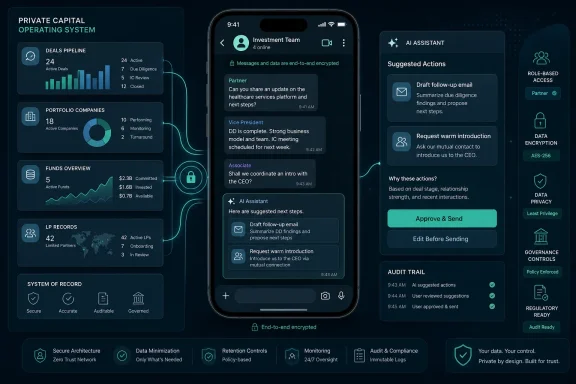 From filing documents to querying live fund data
Taghash’s 2025 WhatsApp bot was deliberately narrow. A user could send an incoming document or note to the bot, choose the relevant record, confirm the association, and have that material stored in Taghash. It solved a common operational failure in venture firms: deal context arrives in WhatsApp, gets read on a phone, and never makes it into the system that other partners or operations staff can search.The new agent is presented as the reverse flow. Rather than pushing a file into Taghash, a user can ask for information already held by the platform. Entrackr reports that the agent can answer questions concerning deals, portfolio companies, funds and LPs, find pending follow-ups, and locate common connections for investor introductions.
Taghash’s current product site supports the underlying premise. Its platform combines dealflow CRM, relationship management, portfolio tracking, fund management and LP management; it says these modules hold relationship history, meeting context, portfolio metrics, capital activity, investor records and reporting workflows. If the agent is working against those live records rather than a static export, the practical benefit is obvious: an investment professional can ask for the status of a deal or an LP relationship while travelling, in a meeting, or between calls without opening the full application.
But conversational access does not repair incomplete data. A WhatsApp agent can make a fund’s existing record system easier to interrogate; it cannot know that a partner failed to log a call, attached a deck to the wrong deal, or kept sensitive relationship information in a personal chat. The faster interface may make these omissions more visible, but it may also give them a more authoritative-sounding presentation.
The approval step is the essential safeguard
The most consequential detail in Entrackr’s reporting is that outgoing actions require review and approval before execution. That makes the agent an assisted-workflow tool rather than an autonomous operator—at least for actions such as sending reminder emails or initiating follow-ups.For fund managers, this is the correct boundary. A drafted reminder about an investor document, a follow-up to a founder, or a suggested introduction can be useful. Sending one automatically could create a recordkeeping problem, expose a confidential relationship, contact the wrong person, or make an unauthorized representation on behalf of the firm.
The approval mechanism also has a less visible operational consequence: it should create an identifiable point of accountability. A proper implementation needs to record the original user prompt, the data consulted, the draft generated, the approver, the final content, the recipient and the time of dispatch. Without that audit trail, “human approval” becomes a reassuring phrase rather than a control that a compliance team can actually inspect.
Taghash says on its site that it supports role-based access controls across workspaces, teams, funds, deals, portfolio companies, LP records and reports. That matters here because a general partner, an investment associate, a fund administrator and an external service provider should not necessarily see the same LP records or possess the same authority to start an action. The company also says it is SOC 2 compliant, uses regular vulnerability assessments and penetration testing, and is designed to help SEBI-regulated fund teams align with India’s CSCRF requirements.
Those are useful claims about the platform, but they do not answer the WhatsApp-specific questions. Neither Taghash’s public product pages nor Entrackr’s report identifies the WhatsApp Business architecture in use, the agent’s model provider, data-retention terms, data-residency options, supported jurisdictions, available languages, administrative controls, or whether conversation content is retained within Taghash, Meta’s systems, an AI provider’s systems, or some combination of them.
For a product handling cap tables, capital calls, investor identities and fund-performance data, those omissions are material. Firms should treat the agent as a controlled channel for approved workflows, not as a place for users to paste unrestricted fund information until those boundaries are documented.
Taghash MCP is the bridge to AI tools, not proof of interoperability
Entrackr describes the WhatsApp agent as an extension of Taghash MCP, which the company reportedly introduced in July 2025. MCP, or Model Context Protocol, is a standard for allowing an AI application to discover and call external tools and data services. Microsoft has made MCP support generally available in Copilot Studio, and Microsoft’s documentation describes it as a way for agents to access external information and actions through MCP servers.Taghash’s own site says its MCP capability enables AI tools to work with live fund data and workflow context involving deals, portfolio companies, LPs, funds and reporting. That is consistent with the model described by Entrackr: the WhatsApp agent is not merely a chatbot trained on generic fund-administration material; it appears intended to call into the customer’s Taghash data and workflows.
Still, there is an important distinction between supporting MCP and delivering a ready-made integration for every AI client. The earlier report said Taghash’s MCP server could connect with Claude, OpenAI and Microsoft Copilot. The current Taghash product page makes the broader statement that it enables “AI tools,” but does not publicly list those client products, deployment requirements or feature parity between them.
Windows administrators and Microsoft 365 teams should not infer that a WhatsApp agent automatically becomes a Microsoft Copilot connector. An MCP server may provide the technical path, but a production Copilot deployment still requires authentication, tenant-level controls, permission mapping, logging and a review of what data each tool call can expose. Taghash has not published a configuration guide or a public capability matrix for the WhatsApp agent, Copilot, OpenAI or Claude.
The company’s headless software framing therefore deserves a practical reading. It does not mean the underlying system of record disappears. It means Taghash is trying to make its data and workflows callable from surfaces where fund teams already work: email, LinkedIn, browser activity, AI tools and now a more capable WhatsApp interface. The database, permissions model and workflow engine remain the product’s center of gravity.
WhatsApp is convenient precisely where governance is hardest
The product is aimed at a real behavior rather than an imagined one. Fund teams communicate with founders, co-investors, advisers and sometimes prospective LPs through mobile messaging constantly. A task that requires opening a browser, finding the right CRM record, checking the latest notes, drafting a message and then logging the activity is often deferred. A chat interface reduces that friction.For Taghash customers, the agent’s most credible uses are narrow and routine:
- A deal team member can ask for overdue portfolio reporting follow-ups before a meeting and prepare reminders for review.
- An associate can search relationship records for internal connections to a prospective LP or founder.
- An operations colleague can retrieve fund or investor context while preparing a workflow, without manually moving between separate modules.
- A user can turn a WhatsApp prompt into a proposed action while leaving the final communication under human control.
Taghash says users can control role-based access within its platform. The open question is how faithfully those access restrictions, authentication requirements and revocation rules carry into WhatsApp. A permission model is only as effective as its least-controlled access point.
Taghash also has not publicly stated a price, launch geography, customer-availability schedule, supported WhatsApp account types, or whether the feature is an add-on, an enterprise-only capability or included with existing subscriptions. No second outlet had reported those terms at publication time.
The product will be judged on traceability, not chat fluency
Taghash is widening the scope of tools it has been building around private-capital operations. Its site now promotes fund formation, accounting, investor onboarding, compliance, bookkeeping, valuations and data-support services alongside the software platform. That creates a strong reason to make the interface faster: the company wants to be the place where fund data, operational tasks and service-led workflows meet.The WhatsApp agent can reduce the mundane friction that causes investment and operations teams to work from memory, spreadsheets and disconnected message threads. But the launch’s real value depends on controls that have not yet been publicly documented: precise permissions, data-handling boundaries, complete action logs, administrator visibility and reliable approval workflows.
For fund managers, the immediate task is simple. Test the agent first with low-risk retrieval and draft-only workflows, verify the audit record behind every proposed action, and establish which records must never be surfaced through mobile messaging. The dashboard may be out of the loop; governance cannot be.
References
- Primary source: Entrackr
Published: 2026-08-06T07:30:09.421265
Taghash launches WhatsApp AI agent for fund managers
Fund operations platform Taghash has launched a WhatsApp based AI agent that allows venture capital and private equity teams to access fund information. entrackr.com
- Related coverage: devblogs.microsoft.com
Build Smarter with the Microsoft 365 Agents Toolkit MCP Server - Microsoft 365 Developer Blog
As AI agents become central to how we build and interact with modern productivity apps, developers need tools that are flexible, standard-based, anddevblogs.microsoft.com - Related coverage: taghash.io
Taghash - Technology, Solutions & Services for Private Capital
Run dealflow, portfolio management, LP management, fund operations, reporting and compliance on one intelligent platform built for private capital teams.taghash.io - Related coverage: learn.microsoft.com
What Is the Azure MCP Server? - Azure MCP Server | Microsoft Learn
Learn about the Azure MCP Server, its features, and how it helps developers build and deploy apps to Azure. Discover benefits and get started today.learn.microsoft.com - Related coverage: learn.microsoft.com
Build a plugin for a declarative agent from an MCP server | Microsoft Learn
Learn how to use the Microsoft 365 Agents Toolkit to wrap your MCP server as a plugin in a declarative agent.learn.microsoft.com - Related coverage: techcommunity.microsoft.com
- Related coverage: moneycontrol.com
WhatsApp Business to introduce token-based pricing for Meta Business Agent from August 1
Meta also plans to reinstate charges for certain types of business messages as it seeks to accelerate WhatsApp Business growth.www.moneycontrol.com - Related coverage: taghash.io