
Tesla has reached 10 million electric vehicles manufactured, a major production milestone that arrived as TSLA shares rebounded 3.9% on Thursday, July 30, ending a six-session slide following the company’s second-quarter earnings report. Investor’s Business Daily first reported the pairing of the stock recovery and manufacturing landmark, though the bounce does little by itself to resolve the profitability concerns that drove the sell-off.
Tesla’s latest results showed the unusual split at the center of its 2026 story: vehicle volume and revenue are rising, while the cost of building its next businesses is pulling earnings and cash flow in the opposite direction.
Tesla delivered 480,126 vehicles in the second quarter, its highest quarterly total, according to its production and delivery filing with the SEC. The Model 3 and Model Y supplied 467,762 of those deliveries, keeping the company’s established mass-market models central to its scale.
Revenue reached $28.24 billion, up 26% year over year, but operating income fell 57% to about $398 million. Tesla’s non-GAAP earnings of $0.33 per share missed the roughly $0.51 expected by analysts, according to reporting from InsideEVs and electrive, and free cash flow turned negative by approximately $1.09 billion.
That is the immediate reason the 10-million-vehicle accomplishment has not automatically repaired investor sentiment. Cumulative output is evidence that Tesla has built a global manufacturing machine; quarterly margins determine how much financial room it has to fund the next stage.
Tesla is also reshaping its factory footprint around products that are not conventional passenger cars. Its Q2 update said Cybercab production has begun at Gigafactory Texas, while the Fremont lines previously used for Model S and Model X are being converted for first-generation Optimus humanoid-robot production.
For IT professionals, that pivot is more than a branding exercise. Tesla is tying vehicle manufacturing more tightly to AI infrastructure, robotics training data, custom silicon and factory automation — all capital-intensive systems that will need to prove they can scale beyond prototypes and internal deployments.
Tesla has said Cybercab engineering-validation vehicles are undergoing public-road testing and that early Optimus units will be used internally for training and software development. Those are meaningful operational steps, but they are not yet evidence of a large, profitable commercial robotics or autonomous-mobility business.
The stock’s July 30 recovery therefore reads as a pause after a sharp reassessment, not a verdict on Tesla’s new strategy. Its next results will need to show whether record Model 3 and Model Y volume can coexist with disciplined spending — and whether Cybercab and Optimus can move from costly factory programs into businesses that improve, rather than dilute, Tesla’s economics.
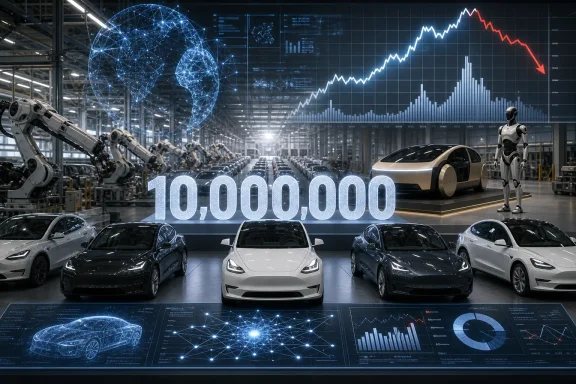 Record deliveries did not translate into a clean earnings win
Tesla delivered 480,126 vehicles in the second quarter, its highest quarterly total, according to its production and delivery filing with the SEC. The Model 3 and Model Y supplied 467,762 of those deliveries, keeping the company’s established mass-market models central to its scale.Revenue reached $28.24 billion, up 26% year over year, but operating income fell 57% to about $398 million. Tesla’s non-GAAP earnings of $0.33 per share missed the roughly $0.51 expected by analysts, according to reporting from InsideEVs and electrive, and free cash flow turned negative by approximately $1.09 billion.
That is the immediate reason the 10-million-vehicle accomplishment has not automatically repaired investor sentiment. Cumulative output is evidence that Tesla has built a global manufacturing machine; quarterly margins determine how much financial room it has to fund the next stage.
The 10-million mark reflects scale — and a changing factory agenda
The milestone spans Tesla’s evolution from the original Roadster and early Model S production to high-volume Model 3 and Model Y assembly in Fremont, Shanghai, Berlin and Texas. The company’s Q2 manufacturing total was 451,758 vehicles, lower than deliveries as Tesla drew down inventory during the quarter.Tesla is also reshaping its factory footprint around products that are not conventional passenger cars. Its Q2 update said Cybercab production has begun at Gigafactory Texas, while the Fremont lines previously used for Model S and Model X are being converted for first-generation Optimus humanoid-robot production.
For IT professionals, that pivot is more than a branding exercise. Tesla is tying vehicle manufacturing more tightly to AI infrastructure, robotics training data, custom silicon and factory automation — all capital-intensive systems that will need to prove they can scale beyond prototypes and internal deployments.
Spending on AI, Robotaxi and Optimus is now the central test
Tesla increased research-and-development spending 49% year over year to $2.37 billion in Q2, with spending directed toward AI, its Robotaxi network and Optimus. Capital expenditures climbed to about $5.8 billion as the company expanded manufacturing and supporting infrastructure.Tesla has said Cybercab engineering-validation vehicles are undergoing public-road testing and that early Optimus units will be used internally for training and software development. Those are meaningful operational steps, but they are not yet evidence of a large, profitable commercial robotics or autonomous-mobility business.
The stock’s July 30 recovery therefore reads as a pause after a sharp reassessment, not a verdict on Tesla’s new strategy. Its next results will need to show whether record Model 3 and Model Y volume can coexist with disciplined spending — and whether Cybercab and Optimus can move from costly factory programs into businesses that improve, rather than dilute, Tesla’s economics.
References
- Primary source: Investor's Business Daily
Published: 2026-07-30T16:10:10+00:00
Loading…
www.investors.com