
Texas A&M researchers have developed AI tools aimed at cutting dead ends from tuberculosis drug discovery, including a model that flags misleading screening hits before they consume months of laboratory work. News-Medical and Drug Target Review reported this week on the work from James Sacchettini’s lab, which combines molecular machine learning with a shared research-data platform used by the Tuberculosis Drug Accelerator.
The practical payoff is not an AI system that declares a new TB drug ready for use. It is a triage layer: software that helps researchers decide which of thousands of initial compounds are most likely to be worth expensive follow-up experiments.
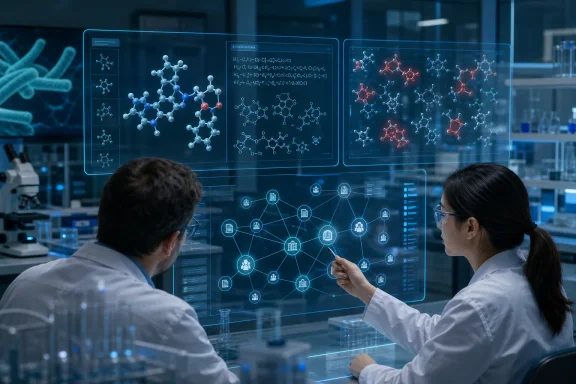
The centerpiece is CAGE-Fusion, short for Co-Attention Graph Embedding Fusion. Published in the Journal of Cheminformatics, the model evaluates both molecular graph structures and SMILES chemical-string representations, using a gated co-attention architecture to combine the two views.
Its job is to identify assay nuisance compounds—molecules that appear active in a screening test for reasons unrelated to useful target-specific drug activity. These can include compounds that aggregate, interfere with a chemical detection signal, react indiscriminately, or bind broadly to many targets.
According to Texas A&M’s account carried by News-Medical, the system ranks a nuisance compound above a clean compound as the more suspicious candidate about 94% of the time. The peer-reviewed paper reports a macro-averaged ROC-AUC of 0.94 on its nuisance-compound classification task, though that figure measures model discrimination on the study data rather than clinical efficacy or the chance of a compound becoming an approved medicine.
That distinction matters. AI can make an early screen less wasteful, but it cannot replace chemical validation, biological testing, toxicology, formulation work, or human trials.
The lab’s open-source DAIKON platform, introduced in 2023, tracks a drug target from gene-level work through medicinal chemistry. The Gates Foundation-supported Tuberculosis Drug Accelerator uses it across participating labs and companies. New AI features are being plugged into that environment rather than operating as a standalone chatbot or a disconnected prediction service.
Researchers can reportedly trace a molecule through prior projects, including failed paths, and query presentations and experiment records through a chat-style interface. For an enterprise IT audience, that resembles a familiar knowledge-management problem: the hard part is often not retaining documents, but connecting structured results, slide decks, molecular records, and institutional memory in a system that supports reliable retrieval.
CAGE-Fusion’s explainability component may also be important. Rather than returning only a risk score, the researchers say the model can highlight molecular regions contributing to its classification. That does not make it infallible, but it gives chemists a route to inspect and challenge a prediction rather than treating the model as a black box.
The next measure of success will be whether these tools consistently reduce wasted validation work inside real TB discovery programs. If they do, the value will not be a headline-grabbing AI-generated drug candidate, but a more disciplined pipeline that gets human researchers to credible candidates faster.
CAGE-Fusion Targets the False-Positive Problem
The centerpiece is CAGE-Fusion, short for Co-Attention Graph Embedding Fusion. Published in the Journal of Cheminformatics, the model evaluates both molecular graph structures and SMILES chemical-string representations, using a gated co-attention architecture to combine the two views.Its job is to identify assay nuisance compounds—molecules that appear active in a screening test for reasons unrelated to useful target-specific drug activity. These can include compounds that aggregate, interfere with a chemical detection signal, react indiscriminately, or bind broadly to many targets.
According to Texas A&M’s account carried by News-Medical, the system ranks a nuisance compound above a clean compound as the more suspicious candidate about 94% of the time. The peer-reviewed paper reports a macro-averaged ROC-AUC of 0.94 on its nuisance-compound classification task, though that figure measures model discrimination on the study data rather than clinical efficacy or the chance of a compound becoming an approved medicine.
That distinction matters. AI can make an early screen less wasteful, but it cannot replace chemical validation, biological testing, toxicology, formulation work, or human trials.
DAIKON Turns Fragmented Lab Records Into Searchable Evidence
The second part of the Texas A&M project is less flashy but arguably just as consequential for collaborative research: organizing years of drug-discovery information so scientists can actually retrieve it.The lab’s open-source DAIKON platform, introduced in 2023, tracks a drug target from gene-level work through medicinal chemistry. The Gates Foundation-supported Tuberculosis Drug Accelerator uses it across participating labs and companies. New AI features are being plugged into that environment rather than operating as a standalone chatbot or a disconnected prediction service.
Researchers can reportedly trace a molecule through prior projects, including failed paths, and query presentations and experiment records through a chat-style interface. For an enterprise IT audience, that resembles a familiar knowledge-management problem: the hard part is often not retaining documents, but connecting structured results, slide decks, molecular records, and institutional memory in a system that supports reliable retrieval.
Why TB Is a Particularly Suitable Test Case
Tuberculosis screening is slow and difficult. Mycobacterium tuberculosis has a waxy cell envelope that limits drug penetration, while its slow growth can turn experiments into months-long efforts. That makes every avoidable false positive unusually costly in time, laboratory capacity, and funding.CAGE-Fusion’s explainability component may also be important. Rather than returning only a risk score, the researchers say the model can highlight molecular regions contributing to its classification. That does not make it infallible, but it gives chemists a route to inspect and challenge a prediction rather than treating the model as a black box.
The next measure of success will be whether these tools consistently reduce wasted validation work inside real TB discovery programs. If they do, the value will not be a headline-grabbing AI-generated drug candidate, but a more disciplined pipeline that gets human researchers to credible candidates faster.
References
- Primary source: News-Medical
Published: 2026-07-30T17:01:00+00:00
Texas A&M researchers build AI tools for tuberculosis drug discovery
When researchers screen potential tuberculosis drugs, they often end up with too many options. Some look promising but later prove to be costly dead ends.www.news-medical.net - Independent coverage: Drug Target Review
Published: 2026-07-30T00:00:00+00:00
AI-powered tools speed tuberculosis drug discovery by filtering false leads and organising screening data | Drug Target Review
Researchers at Texas A&M have developed AI-driven platforms to help scientists navigate the bottlenecks of tuberculosis drug discovery, from eliminating nuisance compounds to unlocking years of archived research data.www.drugtargetreview.com - Related coverage: omnicuris.com