
As reported by iXBT Games and confirmed in replies from Rebel Wolves’ developer account on the official Dawnwalker subreddit, the chart targets 1080p at 30 FPS on minimum settings with a GeForce GTX 1060 or Radeon RX 580, 1080p at 60 FPS on medium with an RTX 2060 Super, Radeon RX 5700, or Intel Arc A750, and 2160p at 60 FPS on Ultra with an RTX 4070 Ti or Radeon RX 9070. Every tier calls for 16GB of RAM, 60GB of SSD storage, Windows 10, and DirectX 12.
The welcome headline is that a 4K-oriented target no longer carries the previously alarming GeForce RTX 5090 recommendation. The less welcome but more important detail is that Rebel Wolves has changed the measurement method. The April requirement sheet covered native-resolution targets with neither upscaling nor frame generation factored in; this final sheet describes an upscaled 4K output target.
Those are not interchangeable benchmarks.
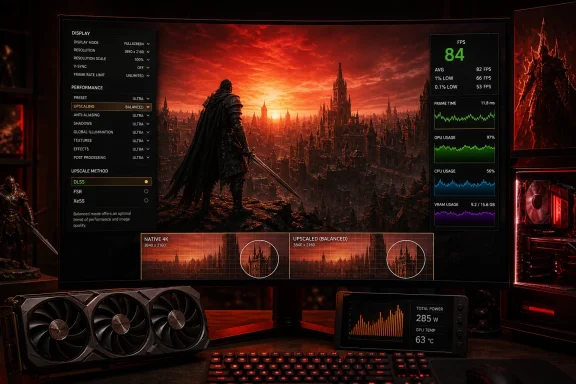 The RTX 5090 Requirement Has Not Been Directly Replaced
Wccftech’s report on Rebel Wolves’ April 28 PC-specification reveal documented the old top-line target: native 2160p at 60 FPS on Ultra required an RTX 5090, with no upscaler and no frame generation used in the measurements. The same chart called for an RTX 4080 or Radeon RX 7900 XTX for native 1440p at 60 FPS on Ultra.
The newly published final chart moves the 2160p, 60-FPS Ultra target to an RTX 4070 Ti or Radeon RX 9070, but the developer has since clarified that Balanced upscaling was active. In practical terms, the game is no longer rendering a full native 3840×2160 image before presenting a 4K output image. It is rendering fewer pixels internally and reconstructing the result through the selected upscaler.
Balanced mode is generally a reasonable compromise for 4K gaming, and it is substantially less aggressive than Performance or Ultra Performance modes. But it still changes the workload enough that the old native RTX 5090 target and the new RTX 4070 Ti/RX 9070 target cannot be read as a one-for-one optimization gain.
The strongest conclusion supported by the two charts is narrower: Rebel Wolves now expects an RTX 4070 Ti-class or Radeon RX 9070-class PC to reach its stated 4K/60 Ultra output target with Balanced upscaling enabled. It has not said that the same systems will reach native 4K at 60 FPS on Ultra.
That distinction should matter to anyone deciding whether to upgrade a GPU before launch. A game can look very good using Balanced DLSS, FSR, or XeSS at 4K, but image quality, motion clarity, and fine-detail reconstruction vary by upscaler, GPU architecture, and scene. The published specification is a starting point for buying decisions, not a native-performance guarantee.
The Final Chart Is More Useful at 1080p Than the Earlier One
The lower-end figures are the genuinely useful part of the revision, because they give owners of older cards a clearer view of whether the game should launch at all on their systems. A GTX 1060 or RX 580 paired with an Intel Core i5-11400F or Ryzen 7 2700X is now listed for 1080p at 30 FPS on the minimum preset, again with Balanced upscaling active.
That is a modest but meaningful baseline. The GTX 1060 and RX 580 remain common in older Windows gaming PCs, although their 6GB and 8GB memory configurations make them very different propositions in newer Unreal Engine 5 games. Rebel Wolves has not published a VRAM requirement beside this final chart, so a GTX 1060 3GB model should not be assumed to meet the same target merely because it shares the product name with the more capable 6GB version.
For 1080p at 60 FPS on medium, the listed GPUs move to the RTX 2060 Super, RX 5700, and Arc A750, joined by an Intel Core i7-11700K or Ryzen 7 5700X. That CPU step is notable. The processor recommendation is much newer and stronger than the minimum tier, suggesting that stable 60-FPS performance may depend on simulation, streaming, or dense open-world scenes rather than GPU throughput alone.
The chart does not state whether its 60-FPS readings are averages, lows, or sustained performance through demanding locations. It also does not identify the game build, driver versions, RAM speed, memory configuration, Windows version, or the exact graphic settings behind each broad preset. Those omissions are normal for a pre-release requirements table, but they limit what the numbers can prove.
A target of “60 FPS” says little about the experience if traversal stutter or poor one-percent lows remain. That is particularly relevant for open-world Unreal Engine 5 games, where shader compilation and asset streaming behavior can affect even high-end PCs independently of the average frame rate.
Frame Generation Is Still an Unanswered Variable
Rebel Wolves explicitly confirmed the Balanced upscaler preset after players questioned whether its requirements might use a more aggressive image-reconstruction mode. It has not, however, clearly stated in the final chart whether frame generation was disabled during testing.
That missing line matters. Traditional spatial or AI upscaling lowers render cost by starting from a lower internal resolution. Frame generation increases displayed frame rate by inserting generated frames between rendered ones. The two technologies can be used together, but they answer different questions: upscaling can reduce the cost of rendering each real frame, while frame generation can make motion appear smoother without raising the base game simulation and input-update rate to the same degree.
If the 60-FPS targets were measured without frame generation, Rebel Wolves should say so plainly. If they include frame generation, buyers need to know the underlying rendered frame rate and the hardware conditions. Nvidia’s frame-generation support is not available to every RTX owner, while AMD and Intel approaches have different compatibility and image-quality trade-offs.
Until that is clarified, readers should avoid assuming that a listed 60-FPS configuration means 60 traditionally rendered frames per second. The developer’s Balanced-mode confirmation is useful; a similarly direct statement on frame generation would complete the performance context.
Steam’s Current Requirements Do Not Match the New Performance Table
There is another complication for people using the Steam store page as their only compatibility check. Steam currently lists a minimum configuration matching the i5-11400F/Ryzen 7 2700X and GTX 1060/RX 580 baseline, but its recommended configuration names an RTX 4060, Radeon RX 7600 XT, or Intel Arc B580 instead of the RTX 2060 Super, RX 5700, and Arc A750 listed in the final performance chart.
Steam does not attach a resolution, frame-rate objective, preset, or upscaling mode to that recommended block. The store entry is therefore not a substitute for Rebel Wolves’ more detailed chart, but the mismatch is still significant. Players comparing components should use the final target table for the stated output goal and treat Steam’s generic “recommended” label as incomplete until the publisher reconciles the two listings.
The store page also lists a September 2 release date, while Rebel Wolves’ previous public announcements and PlayStation’s official coverage have identified September 3, 2026. That may reflect regional timing or storefront date handling, but Bandai Namco and Rebel Wolves have not publicly explained the one-day difference. Buyers planning preloads, launch-night sessions, or time off work should watch their regional Steam listing rather than rely on a single global date.
What PC Players Should Do Before September
The final requirements are a better purchase-planning tool than the April native-only chart, provided they are read for what they are: upscaled-output targets. Owners of GTX 1060-, RX 580-, RTX 2060 Super-, RX 5700-, and Arc A750-class cards now have an official baseline to compare against, but should set expectations around 30 FPS or 60 FPS with reconstruction enabled rather than native rendering.
Players shopping for a GPU specifically for The Blood of Dawnwalker should wait for launch-day technical testing before treating RTX 4070 Ti or RX 9070 ownership as a guarantee of clean 4K Ultra performance. Independent tests need to establish frame-time consistency, VRAM usage, CPU bottlenecks, shader-compilation behavior, image quality across DLSS, FSR, and XeSS, and whether frame generation is needed to meet the published targets.
Rebel Wolves has lowered the apparent hardware barrier to its September release. What it has actually done is define a different, more realistic 2026 PC-gaming baseline: 4K output at 60 FPS with Balanced upscaling is now the advertised Ultra target, while native 4K performance remains an unanswered question until the game is in players’ hands.
Update: Report Adds Missing 1440p Tier and Full GPU Alternatives (August 19, 2026)
DSOGaming’s breakdown of the final requirements reportedly fills in a 1440p target absent from the earlier table: 1440p at 60 FPS on High settings, with DLSS, FSR, or XeSS enabled, is listed for an RTX 4060, Radeon RX 7600 XT, or Intel Arc B580 alongside an Intel Core i7-11700K or Ryzen 7 5700X.
The report also names a GeForce GTX 1070 Ti as another supported option for the 1080p/60 FPS Medium target, alongside the RTX 2060 Super, RX 5700, and Arc A750. That is useful for owners of older Pascal hardware, although the target still assumes Balanced-style reconstruction rather than native rendering.
For the 4K/60 Ultra output target, the listed CPU requirement rises to an Intel Core i7-12700K or Ryzen 7 7800X3D. That strengthens the case that high-end performance expectations are not GPU-only: Rebel Wolves’ advertised upscaled 4K target appears to assume substantially newer CPU hardware than its 1080p and 1440p tiers.
Update: Full chart adds VRAM thresholds for every performance tier (August 19, 2026)
KitGuru’s reproduction of Rebel Wolves’ final requirements adds the VRAM guidance missing from the earlier breakdown: the 1080p/30 FPS Low target requires at least 6GB, while the 1080p/60 Medium and 1440p/60 High tiers each require 8GB or more. The advertised 4K/60 Ultra target calls for 12GB or more.
That clarification is particularly important for GTX 1060 owners. Only the 6GB version aligns with the published minimum; the 3GB GTX 1060 falls below Rebel Wolves’ stated memory floor despite sharing the same product name.
It also makes the 4K recommendation more concrete. An RTX 4070 Ti meets the listed 12GB threshold, but prospective buyers should still treat the target as Balanced-upscaled 4K output rather than evidence of native 4K/60 Ultra performance.