
OtterlyAI says it has become a supplier to The Ocean Cleanup and is providing the nonprofit complimentary access to an AI-search visibility platform that tracks how its work appears in ChatGPT, Microsoft Copilot, Google AI results, Perplexity, Gemini, and Claude. But the public record maintained by The Ocean Cleanup currently identifies MarchiteQ — not OtterlyAI — as its official AI-search supplier, raising a basic verification problem with the August 5 announcement carried by The Manila Times through GlobeNewswire.
The distinction is more than a branding technicality. The Ocean Cleanup’s own supplier directory explicitly says that claims of support are verified only when the organization appears on its partners, suppliers, or institutional-affiliations pages, or when it displays an Independent Supporter badge. OtterlyAI was not listed in the supplier roster reviewed August 6; MarchiteQ was.
OtterlyAI’s statement may describe a separate, complimentary software arrangement, or a tool being used by MarchiteQ in delivering its service. Neither company nor The Ocean Cleanup has publicly documented that relationship. Until one does, the evidence supports a narrower conclusion: an AI-search visibility service is being supplied to The Ocean Cleanup through MarchiteQ, while OtterlyAI has announced that it is supplying its platform directly. Those are not automatically the same thing.
The Ocean Cleanup’s official Suppliers page includes a list of named companies providing goods or services to support its operations. The listed suppliers range from logistics and maritime-service firms to software providers including Dropbox, Dataiku, Dassault Systèmes, and DCS Computing. Its AI-search-related entry is MarchiteQ.
The page also features a statement from Rick Tousseyn, MarchiteQ’s co-founder, describing work intended to help The Ocean Cleanup’s “story, science, and impact” reach people across AI-search platforms. That description closely matches the benefit OtterlyAI described in its own August 5 release: monitoring how an organization is mentioned, which sources are cited, and where AI-generated answers may fail to represent its work accurately.
MarchiteQ is a separate AI marketing agency, founded in 2026, that describes its work in terms of generative-engine optimization, paid advertising, data architecture, and automation. OtterlyAI, meanwhile, is an Austrian AI-search monitoring and optimization vendor founded in 2024 by Thomas Peham, Klaus M. Schremser, and Josef Trauner. The companies operate in adjacent markets, but their public company descriptions identify different founders, structures, and services.
There is one apparent connection in the broader search-marketing world: Tousseyn’s public professional profile identifies him as an SEO and generative-engine-optimization strategist for The Ocean Cleanup, a role dating back to 2025. That may explain why MarchiteQ’s supplier profile speaks so specifically about AI visibility. It does not, however, establish that OtterlyAI itself is a formal supplier or that the two companies are acting as a single provider.
The Ocean Cleanup has not issued a press release announcing OtterlyAI as a supplier, and OtterlyAI does not appear in the nonprofit’s public supplier list. No independent outlet has reported the terms, timing, or structure of a direct OtterlyAI relationship. The announcement therefore deserves to be read as OtterlyAI’s own claim about its support, rather than as a jointly confirmed partnership announcement.
That does not mean every supplier arrangement is paid in cash. The Ocean Cleanup also accepts in-kind support, and OtterlyAI says the platform access is complimentary. But a public supplier designation is still more consequential than a one-off donation or a marketing pledge: it signals that the organization has vetted and listed the provider as part of its operational support network.
OtterlyAI’s wording — “has become a supplier” — would normally make its absence from that network notable. The nonprofit’s site does not merely omit a list of minor contributors; it specifically tells visitors that organizations not shown on its verified-support pages should not be treated as affiliated.
That is the central gap in the announcement. OtterlyAI may have provided access to its software. It may even have an agreement awaiting publication. But the nonprofit’s own verification mechanism has not yet caught up, or does not confirm the claim. For companies working in AI visibility and reputation management, that is an awkward mismatch: the product being donated is designed to measure accurate representation in AI results, while the provider’s own relationship status is unclear in the recipient’s primary record.
The August 5 announcement says The Ocean Cleanup can monitor references to cleanup projects, research, and river Interceptor deployments. In practical terms, the organization could test prompts such as those asking who is removing plastic from the Great Pacific Garbage Patch, which technologies intercept river waste, or whether a particular cleanup project is operating in Los Angeles, Mumbai, Jakarta, or the Philippines.
That can be useful operational intelligence. AI answers are probabilistic, change with source availability and model updates, and can vary by country, prompt phrasing, account state, and the time a query is run. A monitoring platform can expose a bad or missing answer; it cannot directly force ChatGPT, Copilot, Gemini, Claude, Perplexity, or Google to change it.
The public announcement offers no baseline results, no list of monitored prompts, no geography or language coverage, no sampling frequency, and no indication of which outputs will be assessed manually. It also does not say whether The Ocean Cleanup will publish any findings, correct factual errors through source-page updates, or use the data solely for communications and fundraising work.
That missing detail matters for Windows and IT readers because “visibility” can sound more deterministic than it is. A dashboard that records whether Microsoft Copilot cited an Ocean Cleanup page this week is a measurement tool. It is not an administrative control over Copilot’s retrieval, ranking, citations, model behavior, or future responses.
OtterlyAI’s own April materials described support for six surfaces: ChatGPT, Perplexity, Google AI Overviews, Google AI Mode, Gemini, and Microsoft Copilot. The new release adds Claude. That may reflect a product expansion, but OtterlyAI has not separately published technical detail on Claude monitoring, such as query cadence, region coverage, citation capture, or how it normalizes the different answer formats across services.
Those figures are not necessarily incompatible. “More than 52 million” could include 57 million kilograms, and cleanup totals naturally change as projects operate. But both statements use June 2026 as their reference point, and OtterlyAI did not identify the source or cut-off date for its more precise total.
The Ocean Cleanup’s milestones page separately records that it crossed 50 million kilograms in March 2026. That confirms the general scale of the organization’s progress, but it does not independently substantiate the 57 million-kilogram number in the OtterlyAI announcement. A five-million-kilogram difference is too large to treat as a harmless rounding change when the release presents it as a current impact statistic.
The same caution applies to the broader marketing narrative. The Ocean Cleanup is a substantial international nonprofit with real river and ocean operations, about 200 staff, and projects across multiple countries. Its June agreement with the Philippine government and its ongoing Interceptor deployments are independently documented. The existence of that mission does not validate every supplier claim made around it.
But the August 5 release contains more promotional certainty than public documentation. It frames OtterlyAI as an official supplier while The Ocean Cleanup’s own supplier register names MarchiteQ for the same AI-search visibility role. It claims coverage of Claude beyond the engine list in OtterlyAI’s earlier public product material. It uses a cleanup total more specific than the nonprofit’s own June public figure without identifying its source.
The immediate consequence is simple: treat OtterlyAI’s support as an announced complimentary platform arrangement, not as a confirmed formal supplier relationship, until The Ocean Cleanup adds OtterlyAI to its verified-support records or the parties explain how OtterlyAI, MarchiteQ, and the service delivery are connected.
OtterlyAI’s statement may describe a separate, complimentary software arrangement, or a tool being used by MarchiteQ in delivering its service. Neither company nor The Ocean Cleanup has publicly documented that relationship. Until one does, the evidence supports a narrower conclusion: an AI-search visibility service is being supplied to The Ocean Cleanup through MarchiteQ, while OtterlyAI has announced that it is supplying its platform directly. Those are not automatically the same thing.
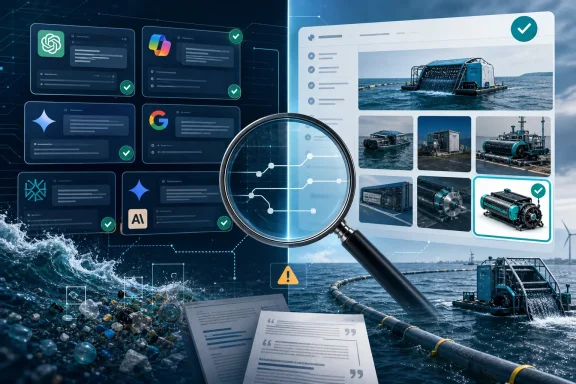 The Ocean Cleanup’s supplier page points to a different company
The Ocean Cleanup’s official Suppliers page includes a list of named companies providing goods or services to support its operations. The listed suppliers range from logistics and maritime-service firms to software providers including Dropbox, Dataiku, Dassault Systèmes, and DCS Computing. Its AI-search-related entry is MarchiteQ.The page also features a statement from Rick Tousseyn, MarchiteQ’s co-founder, describing work intended to help The Ocean Cleanup’s “story, science, and impact” reach people across AI-search platforms. That description closely matches the benefit OtterlyAI described in its own August 5 release: monitoring how an organization is mentioned, which sources are cited, and where AI-generated answers may fail to represent its work accurately.
MarchiteQ is a separate AI marketing agency, founded in 2026, that describes its work in terms of generative-engine optimization, paid advertising, data architecture, and automation. OtterlyAI, meanwhile, is an Austrian AI-search monitoring and optimization vendor founded in 2024 by Thomas Peham, Klaus M. Schremser, and Josef Trauner. The companies operate in adjacent markets, but their public company descriptions identify different founders, structures, and services.
There is one apparent connection in the broader search-marketing world: Tousseyn’s public professional profile identifies him as an SEO and generative-engine-optimization strategist for The Ocean Cleanup, a role dating back to 2025. That may explain why MarchiteQ’s supplier profile speaks so specifically about AI visibility. It does not, however, establish that OtterlyAI itself is a formal supplier or that the two companies are acting as a single provider.
The Ocean Cleanup has not issued a press release announcing OtterlyAI as a supplier, and OtterlyAI does not appear in the nonprofit’s public supplier list. No independent outlet has reported the terms, timing, or structure of a direct OtterlyAI relationship. The announcement therefore deserves to be read as OtterlyAI’s own claim about its support, rather than as a jointly confirmed partnership announcement.
“Supplier” has a specific meaning in The Ocean Cleanup’s own program
The language used in the announcement is unusually important because The Ocean Cleanup operates a formal supplier program. Its supplier materials describe companies offering products or services that help deploy cleanup systems and manage operations globally. The organization publishes purchase and invoicing guidance for suppliers, including purchase-order requirements and typical payment timing.That does not mean every supplier arrangement is paid in cash. The Ocean Cleanup also accepts in-kind support, and OtterlyAI says the platform access is complimentary. But a public supplier designation is still more consequential than a one-off donation or a marketing pledge: it signals that the organization has vetted and listed the provider as part of its operational support network.
OtterlyAI’s wording — “has become a supplier” — would normally make its absence from that network notable. The nonprofit’s site does not merely omit a list of minor contributors; it specifically tells visitors that organizations not shown on its verified-support pages should not be treated as affiliated.
That is the central gap in the announcement. OtterlyAI may have provided access to its software. It may even have an agreement awaiting publication. But the nonprofit’s own verification mechanism has not yet caught up, or does not confirm the claim. For companies working in AI visibility and reputation management, that is an awkward mismatch: the product being donated is designed to measure accurate representation in AI results, while the provider’s own relationship status is unclear in the recipient’s primary record.
What OtterlyAI says it will measure — and what remains undisclosed
OtterlyAI’s established product proposition is straightforward. Its platform sends tracked prompts through selected AI-search services and reports whether a brand appears in the answers, whether competitors appear, and which web sources are cited. It packages those results into indicators such as brand coverage, share of voice, citation visibility, and a broader Brand Visibility Index.The August 5 announcement says The Ocean Cleanup can monitor references to cleanup projects, research, and river Interceptor deployments. In practical terms, the organization could test prompts such as those asking who is removing plastic from the Great Pacific Garbage Patch, which technologies intercept river waste, or whether a particular cleanup project is operating in Los Angeles, Mumbai, Jakarta, or the Philippines.
That can be useful operational intelligence. AI answers are probabilistic, change with source availability and model updates, and can vary by country, prompt phrasing, account state, and the time a query is run. A monitoring platform can expose a bad or missing answer; it cannot directly force ChatGPT, Copilot, Gemini, Claude, Perplexity, or Google to change it.
The public announcement offers no baseline results, no list of monitored prompts, no geography or language coverage, no sampling frequency, and no indication of which outputs will be assessed manually. It also does not say whether The Ocean Cleanup will publish any findings, correct factual errors through source-page updates, or use the data solely for communications and fundraising work.
That missing detail matters for Windows and IT readers because “visibility” can sound more deterministic than it is. A dashboard that records whether Microsoft Copilot cited an Ocean Cleanup page this week is a measurement tool. It is not an administrative control over Copilot’s retrieval, ranking, citations, model behavior, or future responses.
OtterlyAI’s own April materials described support for six surfaces: ChatGPT, Perplexity, Google AI Overviews, Google AI Mode, Gemini, and Microsoft Copilot. The new release adds Claude. That may reflect a product expansion, but OtterlyAI has not separately published technical detail on Claude monitoring, such as query cadence, region coverage, citation capture, or how it normalizes the different answer formats across services.
The cleanup total cited in the release is not backed by the nonprofit’s June record
The OtterlyAI release says The Ocean Cleanup had collected more than 57 million kilograms of trash from aquatic ecosystems “as of June 2026.” The Ocean Cleanup’s own June 4 announcement of its Philippine government partnership used a different figure: more than 52 million kilograms.Those figures are not necessarily incompatible. “More than 52 million” could include 57 million kilograms, and cleanup totals naturally change as projects operate. But both statements use June 2026 as their reference point, and OtterlyAI did not identify the source or cut-off date for its more precise total.
The Ocean Cleanup’s milestones page separately records that it crossed 50 million kilograms in March 2026. That confirms the general scale of the organization’s progress, but it does not independently substantiate the 57 million-kilogram number in the OtterlyAI announcement. A five-million-kilogram difference is too large to treat as a harmless rounding change when the release presents it as a current impact statistic.
The same caution applies to the broader marketing narrative. The Ocean Cleanup is a substantial international nonprofit with real river and ocean operations, about 200 staff, and projects across multiple countries. Its June agreement with the Philippine government and its ongoing Interceptor deployments are independently documented. The existence of that mission does not validate every supplier claim made around it.
The useful outcome depends on a public clarification
There is a reasonable service behind the announcement. Charities and public-interest organizations have a real interest in knowing whether AI assistants accurately describe their work, cite primary sources, and distinguish them from imitators, critics, or unrelated cleanup efforts. The Ocean Cleanup in particular depends on public credibility to attract funding, volunteers, institutional partners, and political support for projects that must operate in specific rivers and coastal jurisdictions.But the August 5 release contains more promotional certainty than public documentation. It frames OtterlyAI as an official supplier while The Ocean Cleanup’s own supplier register names MarchiteQ for the same AI-search visibility role. It claims coverage of Claude beyond the engine list in OtterlyAI’s earlier public product material. It uses a cleanup total more specific than the nonprofit’s own June public figure without identifying its source.
The immediate consequence is simple: treat OtterlyAI’s support as an announced complimentary platform arrangement, not as a confirmed formal supplier relationship, until The Ocean Cleanup adds OtterlyAI to its verified-support records or the parties explain how OtterlyAI, MarchiteQ, and the service delivery are connected.
References
- Primary source: The Manila Times
Published: 2026-08-05T14:04:05+00:00
Loading…
www.manilatimes.net - Related coverage: theoceancleanup.com
Loading…
theoceancleanup.com - Related coverage: oceanicsociety.org
Loading…
www.oceanicsociety.org - Related coverage: oceanicsociety.org
Loading…
www.oceanicsociety.org - Related coverage: linkedin.com
Loading…
www.linkedin.com - Related coverage: gmanetwork.com
Loading…
www.gmanetwork.com - Related coverage: apps1.unep.org
Loading…
apps1.unep.org - Related coverage: static.ocean.org
Loading…
static.ocean.org - Related coverage: europeansearchawards.com
OtterlyAI Named Finalist for Best AI Search Software Solution at the 2026 European Search Awards - European Search Awards
OtterlyAI, 2026 European Search Awards finalist. Monitor brand visibility across ChatGPT, Perplexity, and AI Overviews.europeansearchawards.com - Related coverage: globenewswire.com
OtterlyAI Wins European Search Awards 2026, Cementing Its
Bootstrapped platform surpasses +30,000 active users and beats ten finalists to claim top prize in one of the search industry's most competitive new...www.globenewswire.com - Related coverage: globenewswire.com
Loading…
www.globenewswire.com - Related coverage: theoceancleanup.com
Loading…
theoceancleanup.com - Related coverage: linkedin.com
Loading…
www.linkedin.com - Related coverage: otterly.ai
Loading…
otterly.ai