
Frogwares released The Sinking City 2 on August 18 for PC, PlayStation 5, and Xbox Series X|S. On Steam, the early user response is positive—85% of 811 posted reviews were favorable when checked on August 24—but the game’s official PC targets explain why prospective buyers should look beyond the familiar Resident Evil comparisons. This is a Windows 11-only Unreal Engine 5 game that asks for an SSD, 16GB of memory, and an 8GB graphics card merely to aim for 1080p at 30 frames per second on Low settings.
That makes the central story here more concrete than a reviewer finding a horror game unexpectedly enjoyable. The Sinking City 2 is Frogwares’ attempt to turn a studio known for investigations into a survival-horror developer, and the result is a promising genre pivot whose PC requirements are closer to current high-end releases than its $50 price suggests.
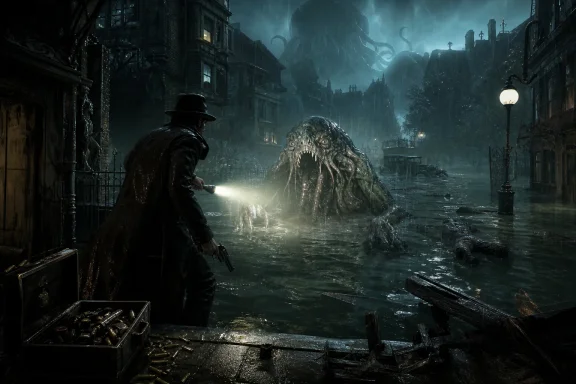 A sequel that leaves Oakmont behind
Tom’s Guide correctly identifies the game as a standalone story. Players take control of occult adventurer Calvin Rafferty after a ritual leaves his partner, Faye Bennett, trapped in a coma-like state connected to the Dreamlands. The setting has also changed: the first game’s flooded Oakmont gives way to Arkham, another 1920s city overwhelmed by supernatural water and creatures.
Frogwares confirmed before launch that it deliberately avoided bringing back original protagonist Charles Reed or tying the new story to a particular ending from the first game. In its Unreal Engine interview, the studio said that decision was meant to make the sequel accessible to newcomers and free it from the original’s branching narrative baggage. On that count, the game seems to deliver: PC Gamer describes the prior game’s plot references as largely Easter eggs, while GamesRadar says the sequel mechanically shares very little with its predecessor.
For anyone who skipped the 2019 release, that is good news. There is no homework requirement. For players who bought into The Sinking City because they liked piecing together cases, interviewing suspects, and navigating a city built around deduction, it is a much more consequential change. Frogwares has kept investigation in the game, but has demoted it from the main structure to optional material that can yield supplies, upgrades, shortcuts, lore, and alternate routes.
The studio’s own explanation is unusually candid. Frogwares said it wanted to broaden its audience and secure its future beyond the detective-game niche that it has occupied for decades. That business rationale is visible in the design: this sequel pursues the established language of modern survival horror—safe rooms, inventory constraints, ammo conservation, locked routes, puzzle-gated progression, weak points, and enemies that can turn encounters into resource drains.
Resident Evil comparisons are accurate, with a catch
The “Resident Evil itch” in Tom’s Guide’s headline is not marketing shorthand invented by one reviewer. GamesRadar, PC Gamer, and Frogwares itself all draw the connection. PC Gamer found the game close to Resident Evil in its puzzle locks, reanimating enemies, inventory grid, and safe-room storage. GamesRadar similarly points to maps, item boxes, crafting choices, and tense backtracking as the systems that make the comparison stick.
The important distinction is that Frogwares has not simply dressed a detective game in Resident Evil imagery. It has built its campaign around familiar survival-horror decisions: whether to spend ammunition, whether to make health items instead of bullets, whether an optional side path is worth the danger, and whether an encounter is better avoided than fought. That direction gives the game an immediate clarity the original sometimes lacked.
It also means the sequel has less room for the freeform investigation that defined the first game. PC Gamer’s review is the sharpest expression of that tradeoff: it argues that Calvin looks like a detective and still has a “mind palace,” but that the system primarily functions as a way to connect clues into codes and puzzle solutions rather than solve cases. GamesRadar reaches a friendlier conclusion, saying the investigations remain a worthwhile side activity, but also tells fans of detective games to temper their expectations.
So the Resident Evil comparison should be treated as purchasing advice rather than praise alone. If the appeal is a modern, lower-budget survival-horror campaign with an unusual Lovecraftian setting, The Sinking City 2 appears to be a credible option. If the appeal is Frogwares’ older model of suspect-driven cases and open-ended deduction, the sequel is a deliberate departure.
The PC specifications are the real caveat
Frogwares’ Steam listing makes the technical cost of that new direction plain. The minimum configuration requires a Core i7-8700K or Ryzen 5 3600X, 16GB of RAM, a GeForce GTX 1070 or Radeon RX 5700 with 8GB of VRAM, DirectX 12, 70GB of available SSD storage, and Windows 11. The listed performance target is 1080p at 30fps on Low settings, using TSR or comparable upscaling technology.
The recommended specification is more striking. Frogwares calls for a Core i5-14600K or Ryzen 5 7600X, 32GB of RAM, and either an RTX 4070 Ti or Radeon RX 7900 XT with 12GB of VRAM. Even that configuration is only targeting 1440p at 60fps on Medium settings, again with TSR or a similar reconstruction technique in use.
Those figures put the game’s visual ambition in context. Unreal Engine 5 is being used for the rain-soaked streets, water, fog, dense interiors, and more detailed character work that Tom’s Guide praised. Frogwares said its transition from Unreal Engine 4 was planned from pre-production and that it used the move to refactor old internal tools and build around newer UE5 systems. The studio also highlighted MetaHuman and MetaHuman Animator as tools intended to improve facial performances, an area it acknowledged had drawn criticism in its earlier games.
Yet the official requirements also undercut any assumption that the game is lightweight because it comes from an independent studio. A PC that was considered comfortably midrange only a few years ago can technically run it, but Frogwares is setting expectations at 30fps and Low settings. Players running older GTX 10-series, RTX 20-series, or Radeon 5000-series hardware should regard the minimum line as a floor for entry, not a promise of the visual experience shown in trailers.
Reviews agree on the atmosphere, less so on the rough edges
Tom’s Guide reports stiff cutscene animations, some repeated environments and textures, and gunplay that can feel clumsy when dodging. Those observations are broadly corroborated, though the severity varies by review. GamingBoulevard cites performance drops and visual problems alongside praise for the atmosphere, while Hey Poor Player found that Unreal Engine 5’s image could look muddy and blurred on PlayStation 5, with frame drops and stutters in its testing.
The available PC evidence is less uniform. Hooked Gamers reports no technical issues or graphical glitches during its PC playthrough, while PC Gamer reviewed on a Windows 11 machine with an Intel Core i9, 32GB of RAM, and an RTX 4060. PC Gamer’s larger criticism was structural: it appreciated the tighter survival-horror design, but felt that the campaign moved through Arkham too quickly and ended abruptly after roughly 15 hours.
GamesRadar had the opposite reaction to the condensed structure. Its reviewer completed a first run in just under 10 hours and praised the tight progression, effective safe-room tension, and the way the game mines classic survival-horror systems without merely copying them. Both accounts agree on the basic point: the first game’s open-world sprawl is gone. Whether that feels like focus or lost potential will depend heavily on why a player liked Frogwares in the first place.
What PC players should expect before buying
The Steam version includes single-player support, Steam Cloud, achievements, trading cards, and Family Sharing. It also requires acceptance of a third-party EULA. The standard edition is $49.99, with Deluxe and Premium editions also listed, plus separate downloadable content including the Arkham Field Kit, The Holloway Manor, and the original soundtrack.
The practical recommendation is straightforward:
- Players with a Windows 10 installation should verify their upgrade path before buying, because Frogwares lists Windows 11 x64 as the only supported operating system.
- Players with 16GB of RAM and an 8GB GPU should expect to use low settings and upscaling if they are working from the official minimum target.
- Players seeking a 1440p, 60fps experience should take Frogwares’ recommended RTX 4070 Ti or RX 7900 XT guidance seriously rather than assuming the game’s $50 price or semi-linear structure means modest demands.
- Returning fans should buy for survival horror, not for a continuation of the first game’s detective-first format.
The Sinking City 2 has given Frogwares a stronger mechanical foundation than the original’s uneven combat and sprawling investigation structure. Its flooded Arkham appears to have landed because it makes exploration, scavenging, and dread serve the same purpose. On PC, though, the price of that reinvention is clear: a horror game built for contemporary hardware, with official performance targets that leave little ambiguity about how far older systems will stretch.