
Lenovo’s ThinkPad X9-15p Gen 1 Aura Edition is a substantially different machine from the ThinkPad X9-15 it resembles: it moves from Intel’s Lunar Lake platform to Panther Lake H-class silicon, grows the battery from 80Wh to 88Wh, replaces the short M.2 2242 SSD bay with a full-length M.2 2280 PCIe 5.0 slot, and adds the cooling hardware needed to run a much higher sustained power envelope. Notebookcheck’s teardown-style comparison makes the key point clear: the “p” suffix is not cosmetic. Lenovo reused the X9’s exterior footprint while rebuilding the internal layout around performance.
That is useful news for Windows users shopping the premium 15-inch class, but it also changes who this ThinkPad is for. The original X9-15 was built around Lunar Lake’s low-power design and long unplugged runtime. The X9-15p keeps the same 15.3-inch OLED-first formula, yet its revised internals put it closer to a portable workstation for developers, analysts, photographers, and users who want a large Windows laptop without moving to a thicker discrete-GPU system.
Lenovo’s own product documentation confirms the broad redesign, while independent reviews fill in the practical consequence: the company has traded roughly 130 grams of weight for a chassis that can support significantly stronger CPU and integrated-GPU performance without shrinking the battery or reducing storage flexibility.
The ThinkPad X9-15p retains the X9-15’s 339.5 mm by 228.5 mm footprint and its thin, aluminum-clad form. Lenovo’s specifications list a maximum thickness of 17.9 mm for the newer model, compared with 17.71 mm for the original X9-15. In other words, the enclosure remains visually almost unchanged, but it is not literally dimension-for-dimension identical.
The critical change is at the rear of the laptop, where the raised Engine Hub section gives Lenovo room for a far larger cooling system. Notebookcheck reports that the X9-15p’s fans are about twice the size of those in the older design and connected by a wider copper heat pipe. That is an engineering response to a very different processor class, not a minor refinement to fan acoustics.
The original model used Intel Core Ultra 200V-series Lunar Lake chips, prioritizing low power consumption and battery life. The X9-15p’s official specification sheet lists Core Ultra 5 338H and Core Ultra X7 358H or 368H processors from Intel’s Series 3 generation, paired with Arc B370 or B390 integrated graphics. These are H-class designs with more CPU cores and a considerably more capable iGPU, particularly in the X7 configurations.
Lenovo announced the X9-15p at CES 2026 as a 45W-class machine, which explains why it could not simply retain the earlier X9-15’s compact thermal arrangement. A faster processor in the old cooling system would have produced a laptop that looked premium in a product listing but lost performance during long builds, exports, local AI work, or sustained spreadsheet and data-analysis workloads. The redesign is Lenovo’s attempt to avoid that familiar thin-laptop failure mode.
Independent testing points in the same direction. MyFixGuide’s review of an X7-based model recorded multi-core Cinebench results around 20,000 points in Cinebench R23 and observed the system settling around 50W under an extended CPU stress test. Those figures should not be read as universal across all retail configurations, but they support the broader conclusion: Lenovo built the X9-15p to sustain H-series performance, rather than merely offer a higher-tier processor on paper.
The result is unusually favorable on paper. The original ThinkPad X9-15 has an 80Wh battery; the X9-15p has an 88Wh pack, a 10% capacity increase, despite the new cooling hardware. Lenovo attributes that to a denser battery construction, and its own specifications list the 88Wh battery alongside the larger thermal system and 100W USB-C charging support.
That battery increase is more important than it first appears. Moving from Lunar Lake to a higher-power Panther Lake H platform ordinarily puts endurance at risk. Lenovo’s answer was not to preserve the original battery and accept reduced runtime, but to increase capacity while redesigning the whole internal floor plan. Notebookcheck’s review reports slightly longer battery life from the newer system, though readers should treat that as a configuration-specific result rather than a guarantee that every touch OLED and X7 configuration will outlast every older X9-15.
Lenovo’s published estimates make the direction of travel plausible but are not directly comparable enough to settle the matter by themselves. The company claims up to 23.6 hours in MobileMark 30 for a favorable X9-15p configuration, versus up to 21.18 hours for a favorable original X9-15 configuration. Those figures use different processors, display choices, and test configurations, so they are useful as a ceiling, not a buying decision.
The practical win is that the X9-15p does not force a simple performance-versus-battery choice. For a Windows user whose day includes browser work, Teams calls, Office apps, and intermittent heavier work, an 88Wh battery provides meaningful margin. Under a continuous compile, GPU load, or video export, Panther Lake will consume that reserve faster than Lunar Lake did. Lenovo has increased the buffer; it has not suspended the physics of higher sustained power.
Both systems officially top out at 2TB in Lenovo’s own catalog, so this is not an official capacity increase today. But M.2 2280 is the mainstream SSD size: it offers buyers and IT departments a much broader selection of drives, more performance tiers, and generally better replacement availability than the short 2242 format. That matters after the warranty period, when a storage upgrade or replacement becomes the owner’s responsibility.
Neowin’s long-term coverage of the earlier X9-15 showed precisely why the older format was limiting. Its reviewer upgraded to a 2TB Corsair M600 M.2 2242 SSD, but the pool of drives that physically fit was far narrower than the familiar 2280 market. Lenovo has removed that constraint from the X9-15p, even though it still provides only one drive bay and the memory remains soldered.
The PCIe 5.0 label also needs context. The new slot can support a faster SSD, but not every installed drive will be Gen 5. Lenovo’s own specifications list a 1TB PCIe 4.0 option alongside the faster PCIe 5.0 offerings. Users should therefore verify the exact machine type and SSD specification before assuming that every X9-15p delivers Gen 5 storage performance.
This is also where the laptop’s limitation becomes clearest for enterprise deployment. The X9-15p can be configured with up to 64GB of LPDDR5X-9600 memory, double the original model’s 32GB maximum, but all memory is soldered to the system board. Buyers planning to run local virtual machines, large Power BI models, software-development environments, or local AI tools should order the capacity they expect to need for the life of the machine.
Those additions are not merely a checklist. The SD reader and standard M.2 2280 SSD format directly address creators and field users handling removable media. The third Thunderbolt 4 port improves desk use, where charging, a dock, an external SSD, and a second peripheral can otherwise compete for scarce ports. The 100W USB-C adapter also gives the system more charging headroom than the original model’s 65W-class arrangement.
Lenovo’s decision to expose larger, user-facing speaker grilles reinforces the same strategy. This is still a business laptop, with optional Intel vPro support and Windows 11 Pro configurations, but it is no longer designed solely around the old corporate-ultrabook formula. The company is aiming at users who split their time between managed Windows environments and workloads traditionally pushed toward MacBook Pro hardware or larger creator laptops.
There is one cost: weight. Notebookcheck puts the original X9-15 at roughly 1.4 kg and the newer X9-15p at 1.53 kg in its tested form, while Lenovo lists the X9-15p as starting at 1.5 kg. That increase is real, but it is only about 9% in exchange for a larger battery, bigger fans, more ports, a full-size SSD slot, higher memory ceiling, and a more powerful processor platform.
But the internal redesign changes the recommendation for anyone who expects to use a 15-inch Windows laptop as a primary work machine. The X9-15p addresses the original model’s most durable compromises: the constrained 2242 SSD format, 32GB memory ceiling, limited port selection, and low-power platform. It does so without giving up the thin chassis or reducing battery capacity.
Lenovo has effectively used the same external shell to create two distinct product categories. The ThinkPad X9-15 is a large, lightweight premium ultraportable. The ThinkPad X9-15p is a sustained-performance laptop in ultraportable clothing—and the 130-gram penalty is the price of making that claim credible.
Lenovo’s own product documentation confirms the broad redesign, while independent reviews fill in the practical consequence: the company has traded roughly 130 grams of weight for a chassis that can support significantly stronger CPU and integrated-GPU performance without shrinking the battery or reducing storage flexibility.
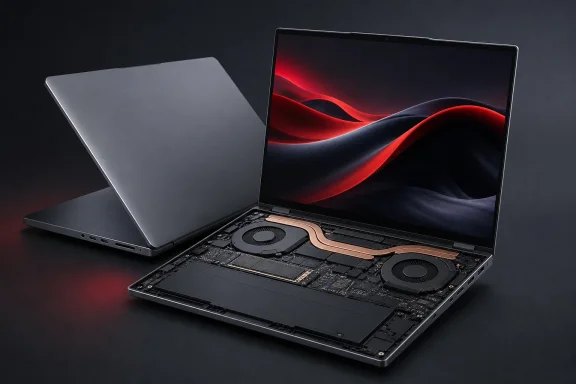 The chassis stayed familiar, but the thermal design did not
The ThinkPad X9-15p retains the X9-15’s 339.5 mm by 228.5 mm footprint and its thin, aluminum-clad form. Lenovo’s specifications list a maximum thickness of 17.9 mm for the newer model, compared with 17.71 mm for the original X9-15. In other words, the enclosure remains visually almost unchanged, but it is not literally dimension-for-dimension identical.The critical change is at the rear of the laptop, where the raised Engine Hub section gives Lenovo room for a far larger cooling system. Notebookcheck reports that the X9-15p’s fans are about twice the size of those in the older design and connected by a wider copper heat pipe. That is an engineering response to a very different processor class, not a minor refinement to fan acoustics.
The original model used Intel Core Ultra 200V-series Lunar Lake chips, prioritizing low power consumption and battery life. The X9-15p’s official specification sheet lists Core Ultra 5 338H and Core Ultra X7 358H or 368H processors from Intel’s Series 3 generation, paired with Arc B370 or B390 integrated graphics. These are H-class designs with more CPU cores and a considerably more capable iGPU, particularly in the X7 configurations.
Lenovo announced the X9-15p at CES 2026 as a 45W-class machine, which explains why it could not simply retain the earlier X9-15’s compact thermal arrangement. A faster processor in the old cooling system would have produced a laptop that looked premium in a product listing but lost performance during long builds, exports, local AI work, or sustained spreadsheet and data-analysis workloads. The redesign is Lenovo’s attempt to avoid that familiar thin-laptop failure mode.
Independent testing points in the same direction. MyFixGuide’s review of an X7-based model recorded multi-core Cinebench results around 20,000 points in Cinebench R23 and observed the system settling around 50W under an extended CPU stress test. Those figures should not be read as universal across all retail configurations, but they support the broader conclusion: Lenovo built the X9-15p to sustain H-series performance, rather than merely offer a higher-tier processor on paper.
Lenovo found room by changing the battery and motherboard
The most revealing part of Notebookcheck’s examination is where the additional thermal volume came from. Lenovo did not make the X9-15p materially wider or deeper. Instead, it used a more space-efficient battery design and narrowed the motherboard while extending it lengthwise, freeing the chassis area required for larger fans.The result is unusually favorable on paper. The original ThinkPad X9-15 has an 80Wh battery; the X9-15p has an 88Wh pack, a 10% capacity increase, despite the new cooling hardware. Lenovo attributes that to a denser battery construction, and its own specifications list the 88Wh battery alongside the larger thermal system and 100W USB-C charging support.
That battery increase is more important than it first appears. Moving from Lunar Lake to a higher-power Panther Lake H platform ordinarily puts endurance at risk. Lenovo’s answer was not to preserve the original battery and accept reduced runtime, but to increase capacity while redesigning the whole internal floor plan. Notebookcheck’s review reports slightly longer battery life from the newer system, though readers should treat that as a configuration-specific result rather than a guarantee that every touch OLED and X7 configuration will outlast every older X9-15.
Lenovo’s published estimates make the direction of travel plausible but are not directly comparable enough to settle the matter by themselves. The company claims up to 23.6 hours in MobileMark 30 for a favorable X9-15p configuration, versus up to 21.18 hours for a favorable original X9-15 configuration. Those figures use different processors, display choices, and test configurations, so they are useful as a ceiling, not a buying decision.
The practical win is that the X9-15p does not force a simple performance-versus-battery choice. For a Windows user whose day includes browser work, Teams calls, Office apps, and intermittent heavier work, an 88Wh battery provides meaningful margin. Under a continuous compile, GPU load, or video export, Panther Lake will consume that reserve faster than Lunar Lake did. Lenovo has increased the buffer; it has not suspended the physics of higher sustained power.
The storage change is more consequential than the processor upgrade for some buyers
The shift from M.2 2242 to M.2 2280 storage is one of the X9-15p’s most practical improvements. Lenovo’s current Product Specifications Reference confirms that the new model has a single M.2 2280 PCIe 5.0 x4 slot, with PCIe 5.0 SSD options offered at 1TB and 2TB. The original X9-15 has one M.2 2242 PCIe 4.0 x4 slot.Both systems officially top out at 2TB in Lenovo’s own catalog, so this is not an official capacity increase today. But M.2 2280 is the mainstream SSD size: it offers buyers and IT departments a much broader selection of drives, more performance tiers, and generally better replacement availability than the short 2242 format. That matters after the warranty period, when a storage upgrade or replacement becomes the owner’s responsibility.
Neowin’s long-term coverage of the earlier X9-15 showed precisely why the older format was limiting. Its reviewer upgraded to a 2TB Corsair M600 M.2 2242 SSD, but the pool of drives that physically fit was far narrower than the familiar 2280 market. Lenovo has removed that constraint from the X9-15p, even though it still provides only one drive bay and the memory remains soldered.
The PCIe 5.0 label also needs context. The new slot can support a faster SSD, but not every installed drive will be Gen 5. Lenovo’s own specifications list a 1TB PCIe 4.0 option alongside the faster PCIe 5.0 offerings. Users should therefore verify the exact machine type and SSD specification before assuming that every X9-15p delivers Gen 5 storage performance.
This is also where the laptop’s limitation becomes clearest for enterprise deployment. The X9-15p can be configured with up to 64GB of LPDDR5X-9600 memory, double the original model’s 32GB maximum, but all memory is soldered to the system board. Buyers planning to run local virtual machines, large Power BI models, software-development environments, or local AI tools should order the capacity they expect to need for the life of the machine.
The added ports show Lenovo’s new target buyer
Lenovo also used the redesign to correct several omissions from the first X9-15. The X9-15p has three Thunderbolt 4 ports rather than two, a full-size SD card reader, HDMI 2.1, USB-A, and a 3.5 mm headset jack. It moves to a six-speaker system and a 10MP webcam, up from the older X9-15’s four speakers and 8MP camera.Those additions are not merely a checklist. The SD reader and standard M.2 2280 SSD format directly address creators and field users handling removable media. The third Thunderbolt 4 port improves desk use, where charging, a dock, an external SSD, and a second peripheral can otherwise compete for scarce ports. The 100W USB-C adapter also gives the system more charging headroom than the original model’s 65W-class arrangement.
Lenovo’s decision to expose larger, user-facing speaker grilles reinforces the same strategy. This is still a business laptop, with optional Intel vPro support and Windows 11 Pro configurations, but it is no longer designed solely around the old corporate-ultrabook formula. The company is aiming at users who split their time between managed Windows environments and workloads traditionally pushed toward MacBook Pro hardware or larger creator laptops.
There is one cost: weight. Notebookcheck puts the original X9-15 at roughly 1.4 kg and the newer X9-15p at 1.53 kg in its tested form, while Lenovo lists the X9-15p as starting at 1.5 kg. That increase is real, but it is only about 9% in exchange for a larger battery, bigger fans, more ports, a full-size SSD slot, higher memory ceiling, and a more powerful processor platform.
The “p” model is the X9-15 buyers should wait for when performance matters
The X9-15p does not make the original ThinkPad X9-15 obsolete for everyone. The older model remains the more sensible choice for buyers whose priority is the lowest possible weight and the quiet, highly efficient behavior associated with Lunar Lake. It also retains the same large OLED canvas and premium X9 design language.But the internal redesign changes the recommendation for anyone who expects to use a 15-inch Windows laptop as a primary work machine. The X9-15p addresses the original model’s most durable compromises: the constrained 2242 SSD format, 32GB memory ceiling, limited port selection, and low-power platform. It does so without giving up the thin chassis or reducing battery capacity.
Lenovo has effectively used the same external shell to create two distinct product categories. The ThinkPad X9-15 is a large, lightweight premium ultraportable. The ThinkPad X9-15p is a sustained-performance laptop in ultraportable clothing—and the 130-gram penalty is the price of making that claim credible.
References
- Primary source: Notebookcheck
Published: August 6, 2026 at 9:33 AM UTC
Loading…
www.notebookcheck.net - Related coverage: support.lenovo.com
Loading…
support.lenovo.com - Related coverage: psref.lenovo.com
Loading…
psref.lenovo.com - Related coverage: support.lenovo.com
Loading…
support.lenovo.com - Related coverage: psref.lenovo.com
Loading…
psref.lenovo.com - Related coverage: lenovo.com
Loading…
www.lenovo.com - Related coverage: techtoday.lenovo.com
Loading…
techtoday.lenovo.com - Related coverage: psref.gtm.lenovo.com
Loading…
psref.gtm.lenovo.com - Related coverage: notebookcheck.net
Loading…
www.notebookcheck.net - Related coverage: lenovo.com
Loading…
www.lenovo.com - Related coverage: psreftest.lenovo.com
Loading…
psreftest.lenovo.com - Related coverage: news.lenovo.com
Loading…
news.lenovo.com - Related coverage: download.lenovo.com
Loading…
download.lenovo.com - Related coverage: ultrabookreview.com
Loading…
www.ultrabookreview.com - Related coverage: download.lenovo.com
Loading…
download.lenovo.com - Related coverage: neowin.net
Loading…
www.neowin.net - Related coverage: buy-a-charger.co.uk
Loading…
www.buy-a-charger.co.uk - Related coverage: community.bestlaptop.deals
Loading…
community.bestlaptop.deals - Related coverage: laptopmag.com
Loading…
www.laptopmag.com - Related coverage: techradar.com
Loading…
www.techradar.com - Related coverage: laptopmag.com
Loading…
www.laptopmag.com - Related coverage: myfixguide.com
Loading…
www.myfixguide.com - Related coverage: laptopdecision.com
Loading…
www.laptopdecision.com - Related coverage: nanoreview.info
Loading…
nanoreview.info - Related coverage: exceldisc.com
Loading…
exceldisc.com - Related coverage: exceldisc.com
Loading…
exceldisc.com - Related coverage: nanoreview.net
Loading…
nanoreview.net - Related coverage: notebookcheck.com
Loading…
www.notebookcheck.com