
The practical consequence is significant but narrower than the headline suggests. Triton is an experimental stack for Windows 11 on ARM64 guests, using a UTM-maintained QEMU branch and custom graphics components; it is not a driver that an administrator can install in an ordinary Windows QEMU VM and expect to work with stock QEMU or current UTM releases. The project itself warns that its available drivers are “very unstable” and should not be installed in a VM that matters.
That warning is more important than the AI angle. Triton demonstrates that Windows guests can finally use the part of the Direct3D 11 driver architecture that Windows itself expects, potentially fixing limits that have kept QEMU graphics acceleration far behind GPU passthrough, Hyper-V, VMware, and Parallels. It does not yet establish a safe, packaged route for production Windows virtual desktops or gaming VMs.
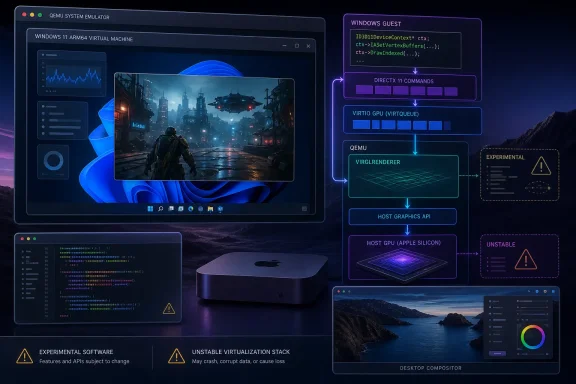 Triton moves below the DLL-replacement layer
Previous efforts such as Neptune and DXVK could make selected Windows games render in a QEMU guest by placing replacement
d3d11.dlland
dxgi.dllfiles next to an application executable. That approach does demonstrate Direct3D translation, but it is application-specific: each program needs the files, compatibility differs from one title to another, and anti-cheat or integrity systems can detect the replacement of core graphics components.
Triton takes a different path. Rather than impersonating the public DirectX API consumed by applications, it implements the DirectX Device Driver Interface, or DDI, that Windows’ own Direct3D runtime uses to communicate with a display driver. Microsoft’s D3D11 driver documentation describes this model clearly: the runtime loads a user-mode driver DLL, calls its
OpenAdapterentry point, and exchanges tables of callbacks and device functions with the driver.
That matters for the Windows desktop as much as for games. The UTM team says the DLL-replacement route leaves the Desktop Window Manager seeing an application’s output as an image, forcing CPU copies for compositing. A real DDI path can participate in the normal DXGI and DWM model, where applications, back buffers, compositor surfaces, synchronization objects, and final display scanout are managed as graphics resources rather than a copied frame.
In the announced design, the Windows Direct3D runtime makes DDI calls into Triton. Triton converts those driver-facing operations back into Direct3D 11 and DXGI API calls, which Neptune serializes across the VirtIO GPU interface. QEMU passes those commands into virglrenderer, which hands them to a host-side renderer. On Linux, that renderer can be DXVK over Vulkan; on macOS, the project uses either DXMT or a native wrapper around Apple’s D3DMetal framework.
It is an unusual inversion, but a sensible one. Instead of creating an entirely new DDI command protocol for QEMU, Triton reuses the Neptune transport already built to move Direct3D API commands. The cost is complexity at the guest-driver boundary; the benefit is avoiding a second bespoke graphics protocol and a separate host-side DDI interpreter.
The working demos do not amount to a general release
UTM’s technical post shows Windows 11 ARM64 running a 64-bit version of Crash Bandicoot N. Sane Trilogy on macOS through QEMU, along with a Fire Strike result and a Windows desktop compositing demonstration. Those are meaningful milestones. A game rendering through the Windows runtime and DWM without a per-game DLL override is precisely the test that this architecture needs to pass.
But the published material does not include a broad compatibility list, measured frame-rate comparisons, frame-time data, GPU-utilization figures, or a repeatable benchmark suite comparing Triton against GPU passthrough, software rendering, VirGL, DXVK-in-the-guest, or Parallels. The project’s own development account acknowledges why that omission matters: a graphics driver can render a frame correctly while dropping alternate frames, rendering specific elements incorrectly, or running well below hardware capability.
For now, readers should treat “DirectX 11 support” as a statement about API plumbing and demonstrated workloads, not a guarantee that the large and fragmented D3D11 software catalog works. A QEMU graphics driver has to survive edge cases in shaders, texture sharing, synchronization, presentation modes, multi-window applications, different feature-level assumptions, and the interaction between the guest driver, VirtIO device, host renderer, and host GPU driver.
The macOS route adds another layer of qualification. UTM’s instructions identify the D3DMetal backend as the default, but it runs as x86_64 code under Rosetta on Apple Silicon because Apple’s D3DMetal framework is x86_64-only. DXMT has a native ARM64 option, but the UTM team says the broader Vulkan-over-MoltenVK route remains unstable and needs more compatibility work. That does not make the result less impressive; it makes clear that the demonstrated stack is a development environment, not an appliance.
The deployment path is deliberately unfriendly
The current instructions require users to compile or obtain a special graphics stack: branches of QEMU and virglrenderer maintained by UTM, Neptune-enabled components, the Windows guest driver package, and host-side rendering libraries. On macOS, the documented setup calls for Xcode tooling, Meson, Ninja,
pkg-config, an LLVM 15 installation, ANGLE built from UTM’s WebKit fork, and either DXMT or D3DMetal-related pieces. The resulting QEMU command line explicitly exposes the Neptune capability to the guest.
The guest requirement is also specific. UTM says Triton currently needs a Windows ARM64 guest, and its documented boot path uses UTM-only
virtio-ramfb-glhardware to provide a usable display before the accelerated driver has been installed. The instructions say a vanilla-QEMU port can use a basic RAM framebuffer initially and switch to
virtio-gpu-gl-pcilater, but that is a porting note, not evidence of a supported upstream configuration.
This is the gap behind the announcement. There are prebuilt signed driver packages for testing, but signed does not mean production-certified or suitable for a normal corporate Windows image. Microsoft’s driver guidance distinguishes development test signing from release signing, and warns that test-signed drivers are for development and testing rather than production deployment. UTM’s own warning goes further: do not put these drivers into a VM that users care about.
For Windows enthusiasts, that still makes Triton worth watching. For IT administrators, it means the appropriate response is to isolate it in a disposable VM, snapshot before installation, and avoid treating it as an alternative to supported virtual GPU products or PCIe GPU passthrough.
AI accelerated the work, but the project’s own record shows human validation did the hard part
The AI contribution is real, and osy has unusually detailed records rather than a vague claim that a model “built a driver.” The companion UTM post says the Triton bring-up spanned 40 active days, 208 sessions, 51,900 API turns, 67.4 million generated output tokens, 18.3 billion prompt-cache reads, and an estimated API cost of $14,760 using June 2026 pricing.
The reported workflow was not a one-prompt creation. It included studying VirtualBox’s D3D11 virtualization design, mapping DDI functions against Microsoft documentation, comparing behavior against known-working implementations, building Windows ARM64 automation, debugging through WinDbg, and checking rendered output in separate test VMs. The project’s description of AI’s role is more credible than the usual autonomous-coding narrative because it identifies failure modes: hallucinated components were discarded, implementations were cross-checked, and visual and performance regressions required dedicated validation tools.
There is, however, a small but revealing inconsistency in the published attribution. The primary Triton architecture post is labeled as jointly authored by osy and
claude-opus-4-8; the bring-up post carries the label
claude-opus-5while its subtitle says “Three weeks of maxing out Fable.” Anthropic identifies Claude Fable 5 and Opus 4.8 as distinct models, but UTM does not provide a clean model-by-model accounting of which one produced which implementation or review. The reasonable conclusion is that several Claude variants participated across the project, not that a single named model authored Triton.
That distinction deserves attention because graphics-driver work is unusually resistant to superficial code generation. The work touches a Windows user-mode driver, kernel-mode interfaces, Direct3D bytecode, DXGI presentation, VirtIO transport, QEMU, virglrenderer, host translation layers, and real GPU synchronization. Generating plausible C or C++ is not the same as proving correctness across those boundaries.
The next milestone is packaging, compatibility, and upstream acceptance
Triton’s most important achievement is architectural: it replaces the fragile “drop a custom DLL beside a game” workaround with the driver integration point Windows uses by design. If the approach matures, it could make accelerated Windows-on-ARM guests far more useful on Apple Silicon Macs and potentially on Linux QEMU hosts without requiring a dedicated GPU passed through to every VM.
The harder work begins after the demo. Triton needs a public compatibility and regression-testing record, reproducible performance numbers, a safer distribution path, and a route from UTM-maintained branches into broadly consumable QEMU and graphics packages. Until those pieces arrive, its immediate value is as a promising research-grade driver stack—and as proof that QEMU’s Windows graphics ceiling is no longer fixed at basic display output.
References
- Primary source: Phoronix
Published: August 8, 2026 at 11:10 AM UTC
Loading…
www.phoronix.com - Related coverage: blog.getutm.app
Loading…
blog.getutm.app - Related coverage: freshports.org
Loading…
www.freshports.org - Related coverage: qemu-stsquad.readthedocs.io
Loading…
qemu-stsquad.readthedocs.io - Related coverage: learn.microsoft.com
Loading…
learn.microsoft.com - Related coverage: learn.microsoft.com
Loading…
learn.microsoft.com