
Warren Pandiscia filed Pandiscia v. Twitch Interactive, Inc. and Amazon.com, Inc. in the U.S. District Court for the Northern District of California on Thursday, August 20. The federal docket confirms the complaint, proposed summonses, and a jury demand were filed that day. Courthouse News first reported that Pandiscia, a Connecticut-based streamer, is seeking to represent creators whose Twitch material was allegedly copied to develop Amazon AI models without consent or compensation.
The timing is significant. Twitch added an account-level control on August 12 allowing channel owners to stop Amazon from using their material in future training of generative AI models. But the switch arrived enabled by default, and its language covers a much wider set of material than a streamer’s broadcast archive: streams, VODs, clips, stream chats, channel images, and channel text can all be eligible.
For creators, developers, and anyone using Twitch as a public-facing production platform, the lawsuit does not change the setting today. It does, however, expose the gap between what Twitch’s new opt-out can prevent going forward and what users may believe it does about content already collected, processed, or used.
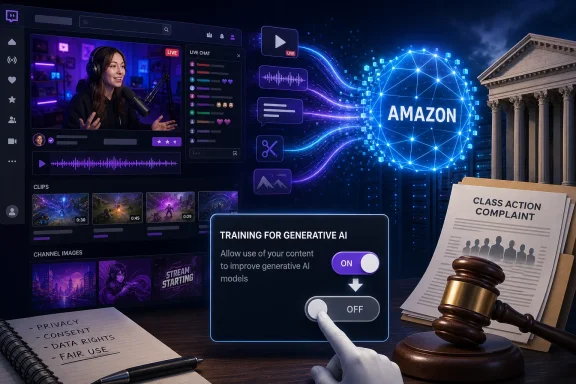 The lawsuit challenges past use, not merely Twitch’s new toggle
The submitted reporting correctly identifies the central allegation: Pandiscia says Amazon and Twitch used creator footage to train generative AI rather than obtaining licenses or affirmative permission. Those are allegations, not findings. Amazon and Twitch have not yet filed a response in the case, and a complaint alone does not establish that a model was trained on any particular streamer’s content.
But calling this simply a dispute over an unpopular opt-out setting misses the harder issue. Twitch’s own support material says disabling the setting means a creator’s channel material will not be used in future training of an Amazon model designed to generate or synthesize text, audio, images, or video. That wording does not promise that prior training data will be deleted, that models trained before the switch will be retrained, or that past copies can be identified and removed.
That is the distinction creators should pay attention to. An opt-out can change the intake pipeline; it does not automatically unwind a dataset or model already built. The complaint’s reported claim that creators cannot recover material allegedly used in training is therefore aimed at the technical reality of model development as much as the question of payment.
Ars Technica reported that Amazon had been using Twitch content for AI development before this month’s control appeared. During Twitch’s public discussion of the policy, Chief Product Officer Mike Minton also said he could not say what Amazon had used for model training. That lack of a clear historical accounting is likely to become more important than the switch’s current default state.
Twitch’s terms give Amazon and Twitch a substantial defense
The case will not be decided by a broad ethical argument about whether creators should have been asked. Twitch’s April 13, 2026 Terms of Service grant Twitch a worldwide, irrevocable, sublicensable, nonexclusive, royalty-free right to use, reproduce, modify, adapt, create derivative works from, distribute, perform, and display user content, subject to the agreement’s terms and applicable law.
That is a sweeping license. It also expressly includes a creator’s name, identity, likeness, and voice submitted with user content. The terms say Twitch can exercise those rights in connection with monetizing its services, and the monetized-streamer agreement permits sharing certain personal information with parent company Amazon and its subsidiaries for specified program tools.
Amazon and Twitch will have room to argue that creators accepted a license broad enough to support the challenged use, particularly if the company can tie model training to operating, improving, or monetizing Twitch and Amazon services. They may also argue that the new setting is an added user control, not an admission that past conduct lacked permission.
Yet the terms do not explicitly say, in the language surfaced by Twitch’s legal page, “we may train generative AI models on your content.” That omission does not make the plaintiff right. It does mean the dispute is less straightforward than the source reports’ framing of “no license” suggests. The legal fight is likely to focus on whether conventional platform-license language, written to support hosting, distribution, promotion, and service operations, clearly encompasses training a parent company’s generative models.
The answer could turn on the exact contract versions accepted by individual creators, the timing and wording of privacy disclosures, the relationship between Twitch and Amazon, and the specific models and uses at issue. It may also turn on claims beyond contract law. Courthouse News reported that the complaint alleges implied-contract and state unfair-competition theories alongside the basic copying allegation.
Amazon’s default setting makes consent the practical issue
The policy that triggered the backlash is unusually direct. Twitch’s account settings label the control “Training for Generative AI” and say it allows channel content to train generative AI models at Amazon. Turning it off removes a channel from future training for models that generate or synthesize media.
Twitch’s explanation is also explicit about the potential uses. It says a creator’s audio could help refine speech-to-text models, improving captions on Twitch and across Amazon. That is a plausible product use, and it shows why video platforms are valuable AI-data reservoirs: a Twitch channel can bundle long-form video, spoken language, viewer conversation, gameplay, demonstrations, captions, images, and written metadata in one continuous record.
The problem is not that every AI-assisted function is covered by the toggle. Twitch says opting out of generative-model training does not disable all AI or machine-learning uses on the service. AutoMod, recommendations, captions, safety systems, and other AI-supported functions may still process channel content under separate rules. This is a meaningful distinction, but it is easy to lose when creators see a single “AI training” switch and assume it controls every automated use of their material.
The policy has another complication for viewers and collaborators. Twitch says that if someone posts in another streamer’s chat, the channel owner’s preference governs whether that chat can be used for generative-AI training. A creator who opts out can control material on their own channel, but cannot independently control comments they made in a channel whose owner remains opted in. For people who routinely appear as guests, moderators, co-streamers, or chat participants, ownership of the channel is not the same as control over all of their contributions.
The CPO’s comment may matter beyond public relations
Mike Minton’s explanation for the default drew the most attention because it plainly described the expected outcome of an opt-in design: Twitch expected few, if any, creators to volunteer their content. TechCrunch, Forbes, and several other outlets independently reported Minton’s statement during the official Twitch livestream.
That comment is not a legal admission that Twitch lacked contractual authority. It is, however, a clear acknowledgement that the company viewed affirmative participation as commercially unattractive. In a case centered on consent, disclosure, and the scope of a platform agreement, that could become a useful fact for the plaintiff’s lawyers.
It also explains the policy choice in business terms. An opt-in training pool has better affirmative consent but can be too small, too skewed, or too inconsistent to support large-scale data work. An opt-out default produces a larger corpus and reduces administrative friction, while shifting the burden to creators to discover a setting and understand what it covers.
That calculation may be common in digital services, but generative AI changes its stakes. Content is no longer used only to host a stream, serve recommendations, enforce moderation rules, or measure advertising performance. The input can contribute to a model that produces new output elsewhere in Amazon’s business. Creators who treat their voice, performance style, gameplay commentary, art process, or programming demonstrations as part of their professional identity have a legitimate reason to see that as a different category of use.
What Twitch users should do now
The immediate practical action is straightforward: Twitch users who do not want their own channel material used in future Amazon generative-AI training should open Settings, select Security and Privacy, find Training for Generative AI, and turn the control off.
They should also avoid treating that change as a complete privacy reset. Twitch’s documentation says the control does not opt a channel out of all AI-supported features, and it does not make claims about content used before the setting was changed. Users who have contracts with sponsors, publishers, game studios, clients, or employers should check whether their Twitch broadcasts contain third-party material that could create separate obligations.
For IT teams and independent developers who livestream product demos, code reviews, incident response, training sessions, or customer-facing workshops, the policy is a governance issue rather than just a creator-rights debate. A public stream can include proprietary screens, customer conversations, API keys exposed by mistake, internal architecture details, or employee likenesses. The first defense remains operational: do not put confidential material on a public channel. The second is administrative: ensure the account’s data-use controls match the organization’s policy.
Pandiscia’s case is only three days old, and the docket currently shows the complaint and proposed summonses rather than a ruling on the merits. The immediate consequence is more modest but more useful: Twitch has now made future generative-AI training an explicit account decision, while the lawsuit tests whether its previous contractual language was enough to cover the same use.