
TypeScript 7.0 is now shipping as version 7.0.2 on npm, replacing the JavaScript-hosted compiler with a native Go implementation that Microsoft says cuts full-build times by roughly 8x to 12x. The important correction to the August 4 report is timing: Microsoft announced general availability on July 8, 2026, and the current npm package confirms that 7.0.2 has been available since mid-July. This is an established release, not a fresh August launch.
The headline performance result is real enough to warrant attention from teams with large TypeScript projects, especially Windows developers using Visual Studio Code, Visual Studio, GitHub Actions, Azure DevOps, or self-hosted CI runners. But TypeScript 7 is also a transition release with a major operational limitation: it ships without the familiar programmatic compiler API. For many projects, the migration is therefore not a simple
Microsoft detailed the release in its TypeScript blog, while InfoWorld independently reported on the Go port’s build and editor-performance implications during the release-candidate period. The TypeScript team’s own benchmark figures put a full VS Code build at 10.6 seconds under TypeScript 7, compared with 125.7 seconds under TypeScript 6.0; Sentry dropped from 139.8 seconds to 15.7 seconds, and Playwright from 12.8 seconds to 1.47 seconds. Those are vendor-run results on selected large repositories, so they should be treated as evidence of the upside rather than a promise that every application will become ten times faster.
TypeScript 7 remains TypeScript: it checks types and emits JavaScript in the same role as previous releases. What changed is the implementation underneath. Microsoft ported the compiler and language-service code to Go, keeping the existing structure and type-checking logic as closely aligned as possible rather than using the milestone to redesign TypeScript semantics.
That choice explains why the performance gains are concentrated in the work developers repeatedly wait on: parsing large projects, checking types, emitting output, watching files, and answering editor requests such as completions, diagnostics, and Find All References. The native implementation can use shared-memory parallelism in ways that the prior JavaScript implementation could not.
Microsoft says TypeScript 7 uses less aggregate memory across its published build tests as well. Its figures show reductions ranging from 6% for Sentry to 26% for Bluesky. The performance case is therefore broader than a shorter command-line
The company also reports that TypeScript 7’s language server reduced failing commands by more than 80% and crashes by more than 60% compared with TypeScript 6.0. Those are Microsoft telemetry claims, not independently reproducible public benchmarks, but the VS Code team’s own account of its migration supports the core conclusion: the native compiler has already been exercised against a large, complex Windows-friendly development workload rather than only against synthetic test projects.
For small projects, the payoff will be less dramatic. A type check that already completes in a second or two is unlikely to transform a developer’s day. The primary beneficiaries are monorepos, repositories with extensive project references, codebases where the TypeScript server has been slow to load, and CI systems where type checking sits on the critical path before tests or packaging.
TypeScript 7 adopts the configuration defaults introduced in 6.0.
The defaults can produce failures that look unrelated to a compiler rewrite. A repository whose
Several older targets and resolution modes are gone entirely:
That includes an important slice of the broader TypeScript tooling world. Microsoft specifically names typescript-eslint as an example, and also says that workflows based on Vue, MDX, Astro, Svelte, and embedded TypeScript tooling are likely to remain on TypeScript 6 for now. Angular users can use TypeScript 7 for fast command-line project checks while retaining TypeScript 6 for editor-oriented template tooling.
This puts many teams into an awkward but manageable dual-version deployment. Microsoft’s prescribed bridge is the
That approach is practical, but it is not a transparent upgrade. Build owners must know which jobs call the compiler as a command-line tool and which invoke it through an API. A pipeline might successfully compile with TypeScript 7 while linting, framework checks, code generation, or editor extensions continue to depend on TypeScript 6. Treating the two versions as interchangeable will make support incidents harder to diagnose.
The immediate rollout path is clear: test TypeScript 7 in command-line checking and build jobs first, retain TypeScript 6 where API-dependent tools require it, and make the boundary explicit in package manifests and CI scripts. Do not replace a single
More workers can improve results on a high-core desktop or a powerful self-hosted Windows build server. Microsoft’s own tests show VS Code completing in 7.51 seconds with eight checker workers, versus 10.6 seconds at the default setting of four. The tradeoff is increased CPU and memory pressure, because each worker may duplicate some shared type-analysis work.
For CI administrators, this turns TypeScript performance into a capacity-planning issue. A setting that speeds a developer workstation could hurt a busy hosted runner by competing with tests, bundlers, containers, or simultaneous jobs. Microsoft explicitly notes that lower-core, lower-memory runners may benefit from
The Go port also includes a Go adaptation of Parcel’s file-watching implementation. Microsoft says this improves resource use in
That discrepancy does not invalidate the release; npm is the actual installation channel Microsoft directs developers to use. It does, however, mean release automation and internal documentation should not treat the GitHub Releases label as the authoritative indicator of the deployed TypeScript version. The npm package version and a project’s lock file are the records that matter for a real rollout.
TypeScript 7 delivers the speed improvement Microsoft has pursued since announcing the native port, but the practical adoption milestone is TypeScript 7.1. Until the API arrives, organizations can gain faster
npm install upgrade.Microsoft detailed the release in its TypeScript blog, while InfoWorld independently reported on the Go port’s build and editor-performance implications during the release-candidate period. The TypeScript team’s own benchmark figures put a full VS Code build at 10.6 seconds under TypeScript 7, compared with 125.7 seconds under TypeScript 6.0; Sentry dropped from 139.8 seconds to 15.7 seconds, and Playwright from 12.8 seconds to 1.47 seconds. Those are vendor-run results on selected large repositories, so they should be treated as evidence of the upside rather than a promise that every application will become ten times faster.
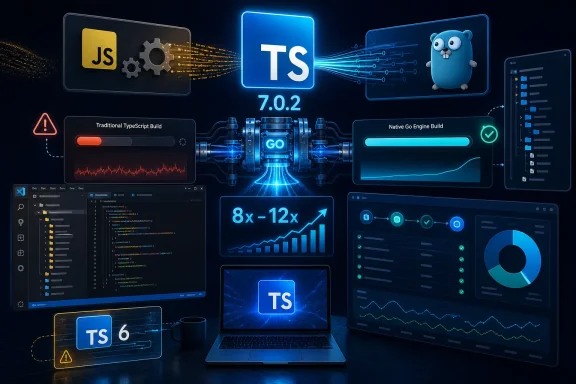 Go replaces the JavaScript compiler, not the TypeScript language
TypeScript 7 remains TypeScript: it checks types and emits JavaScript in the same role as previous releases. What changed is the implementation underneath. Microsoft ported the compiler and language-service code to Go, keeping the existing structure and type-checking logic as closely aligned as possible rather than using the milestone to redesign TypeScript semantics.That choice explains why the performance gains are concentrated in the work developers repeatedly wait on: parsing large projects, checking types, emitting output, watching files, and answering editor requests such as completions, diagnostics, and Find All References. The native implementation can use shared-memory parallelism in ways that the prior JavaScript implementation could not.
Microsoft says TypeScript 7 uses less aggregate memory across its published build tests as well. Its figures show reductions ranging from 6% for Sentry to 26% for Bluesky. The performance case is therefore broader than a shorter command-line
tsc run: a language server that loads a large workspace faster can affect how quickly Visual Studio Code populates errors, navigation, and IntelliSense after a checkout or branch switch.The company also reports that TypeScript 7’s language server reduced failing commands by more than 80% and crashes by more than 60% compared with TypeScript 6.0. Those are Microsoft telemetry claims, not independently reproducible public benchmarks, but the VS Code team’s own account of its migration supports the core conclusion: the native compiler has already been exercised against a large, complex Windows-friendly development workload rather than only against synthetic test projects.
For small projects, the payoff will be less dramatic. A type check that already completes in a second or two is unlikely to transform a developer’s day. The primary beneficiaries are monorepos, repositories with extensive project references, codebases where the TypeScript server has been slow to load, and CI systems where type checking sits on the critical path before tests or packaging.
TypeScript 6.0 was the warning; TypeScript 7 makes it enforceable
The release is compatible with TypeScript 6.0’s intended behavior, but it also turns TypeScript 6 deprecations into hard errors. That is the part organizations should audit before changing the version in a shared lock file.TypeScript 7 adopts the configuration defaults introduced in 6.0.
strict is enabled by default, module defaults to esnext, stableTypeOrdering is mandatory, rootDir defaults to the project directory, and types defaults to an empty array instead of automatically including installed global type packages. A project that relies on ambient declarations from packages such as Node.js, Jest, Mocha, or Cypress may need explicit entries in compilerOptions.types.The defaults can produce failures that look unrelated to a compiler rewrite. A repository whose
tsconfig.json lives above a src directory may emit files into an unexpected layout unless it explicitly sets rootDir. A test configuration that previously picked up @types/jest or @types/node by implication can lose those names until the packages are listed. These are predictable migration changes, but they can be disruptive in older repositories where the compiler configuration has accumulated over several years.Several older targets and resolution modes are gone entirely:
- TypeScript 7 no longer supports
target: es5,downlevelIteration,moduleResolution: nodeornode10, ormoduleResolution: classic. - The AMD, UMD, SystemJS, and
nonemodule modes are no longer accepted. baseUrlis removed; path mappings must be adjusted to work relative to the project root.esModuleInteropandallowSyntheticDefaultImportscannot be disabled.- Command-line file builds in a directory containing a
tsconfig.jsonnow require an explicit--ignoreConfigflag.
The missing compiler API keeps TypeScript 6 in the toolchain
The material limitation in TypeScript 7.0 is that it does not provide a stable programmatic API. Microsoft expects a new, different API in TypeScript 7.1, but the current release cannot fully replace TypeScript 6 for tools that import and drive the compiler programmatically.That includes an important slice of the broader TypeScript tooling world. Microsoft specifically names typescript-eslint as an example, and also says that workflows based on Vue, MDX, Astro, Svelte, and embedded TypeScript tooling are likely to remain on TypeScript 6 for now. Angular users can use TypeScript 7 for fast command-line project checks while retaining TypeScript 6 for editor-oriented template tooling.
This puts many teams into an awkward but manageable dual-version deployment. Microsoft’s prescribed bridge is the
@typescript/typescript6 compatibility package, which provides the TypeScript 6 API and a tsc6 executable while TypeScript 7 owns the normal tsc command. npm aliases can then allow a dependency expecting typescript to resolve to the 6.0 compatibility package while build scripts invoke the 7.0 compiler.That approach is practical, but it is not a transparent upgrade. Build owners must know which jobs call the compiler as a command-line tool and which invoke it through an API. A pipeline might successfully compile with TypeScript 7 while linting, framework checks, code generation, or editor extensions continue to depend on TypeScript 6. Treating the two versions as interchangeable will make support incidents harder to diagnose.
The immediate rollout path is clear: test TypeScript 7 in command-line checking and build jobs first, retain TypeScript 6 where API-dependent tools require it, and make the boundary explicit in package manifests and CI scripts. Do not replace a single
typescript dependency blindly in a monorepo with framework plugins and custom build tooling.
Parallelism is tunable, and CI runners need a deliberate setting
TypeScript 7 parallelizes parsing, checking, emitting, and project-reference builds. It defaults to four type-checker workers, and Microsoft provides experimental--checkers and --builders controls for teams that want to tune work distribution. A --singleThreaded option exists for constrained environments and debugging.More workers can improve results on a high-core desktop or a powerful self-hosted Windows build server. Microsoft’s own tests show VS Code completing in 7.51 seconds with eight checker workers, versus 10.6 seconds at the default setting of four. The tradeoff is increased CPU and memory pressure, because each worker may duplicate some shared type-analysis work.
For CI administrators, this turns TypeScript performance into a capacity-planning issue. A setting that speeds a developer workstation could hurt a busy hosted runner by competing with tests, bundlers, containers, or simultaneous jobs. Microsoft explicitly notes that lower-core, lower-memory runners may benefit from
--checkers 1. Teams that care about reproducibility should also pin a checker count across developer and CI environments, since rare order-dependent behaviors can surface when the degree of parallelism changes.The Go port also includes a Go adaptation of Parcel’s file-watching implementation. Microsoft says this improves resource use in
--watch mode across platforms, a meaningful change for Windows developers who keep large workspaces open all day. It should reduce a class of friction that build-time benchmarks do not capture: idle language-server and file-watcher activity competing with the rest of a workstation.The release record itself is inconsistent
There is one avoidable documentation problem in the official record. Microsoft’s TypeScript blog and npm registry clearly establish that TypeScript 7.0 is generally available and that 7.0.2 is the current package version. Yet the GitHub Releases page for the TypeScript repository still presents TypeScript 6.0.3 as its “Latest” release.That discrepancy does not invalidate the release; npm is the actual installation channel Microsoft directs developers to use. It does, however, mean release automation and internal documentation should not treat the GitHub Releases label as the authoritative indicator of the deployed TypeScript version. The npm package version and a project’s lock file are the records that matter for a real rollout.
TypeScript 7 delivers the speed improvement Microsoft has pursued since announcing the native port, but the practical adoption milestone is TypeScript 7.1. Until the API arrives, organizations can gain faster
tsc builds and a quicker Windows editor experience while still carrying TypeScript 6 for parts of their toolchain.
References
- Primary source: i-programmer.info
Published: 2026-08-04T17:50:27.053706
Loading…
www.i-programmer.info - Related coverage: github.com
Loading…
github.com - Related coverage: typescriptlang.org
Loading…
www.typescriptlang.org - Related coverage: github.com
Loading…
github.com - Related coverage: devblogs.microsoft.com
Loading…
devblogs.microsoft.com - Related coverage: typescriptlang.org
Loading…
www.typescriptlang.org - Related coverage: jasminedesign.com
Loading…
www.jasminedesign.com - Related coverage: devblogs.microsoft.com
Loading…
devblogs.microsoft.com - Related coverage: techtimes.com
Loading…
www.techtimes.com - Related coverage: typescript.news
Loading…
typescript.news - Related coverage: bruno.digital
Loading…
bruno.digital - Related coverage: web-standards.dev
Loading…
web-standards.dev - Related coverage: infoworld.com
Loading…
www.infoworld.com - Related coverage: infoworld.com
Loading…
www.infoworld.com - Related coverage: linuxiac.com
Loading…
linuxiac.com - Related coverage: doccompiler.ai
Loading…
doccompiler.ai - Related coverage: data.vrc-ta-hub.com
Loading…
data.vrc-ta-hub.com - Related coverage: npmjs.com
Loading…
www.npmjs.com - Related coverage: npmjs.com
Loading…
www.npmjs.com