
UC Santa Barbara’s Nanofabrication Facility is using a one-week Cleanroom Bootcamp and IEEE-backed micro-credentials to turn cleanroom access into a more direct route into semiconductor jobs, a model aimed at students, career changers and community-college learners who might otherwise never train on fabrication equipment.
As detailed by UCSB ECE, the program grew from repeated concerns among Santa Barbara-area semiconductor companies: entry-level candidates often lacked practical experience in cleanroom protocols and core manufacturing processes. Demis D. John, process group manager at the UCSB Nanofabrication Facility, worked with Santa Barbara City College and regional workforce partners to make UCSB’s facility available as a training environment rather than expecting every college to build its own costly cleanroom.
The bootcamp, supported by a National Science Foundation Advanced Technological Education grant awarded in 2021, covers cleanroom operations alongside foundational process work such as photolithography, deposition, etching and metrology. Its premise is straightforward: semiconductor employers need people who understand the discipline, safety requirements and workflow of a fab environment before their first day on the job.
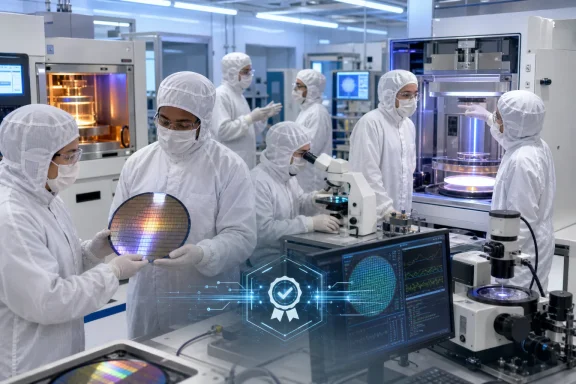
The larger change is not simply the training week but the attempt to standardize what it proves. UCSB, the University of Southern California and the CA DREAMS Microelectronics Hub developed modular IEEE Micro-Credentials that validate individual skills rather than merely recording attendance.
IEEE describes its micro-credentials as assessment-based and stackable, allowing learners to build a shareable record of demonstrated competencies. IEEE Spectrum has reported that UCSB opened its cleanroom training to external learners in 2021, including community-college students and people changing careers, at a time when many university cleanrooms remained inaccessible to those outside four-year degree programs.
According to UCSB ECE, 42 participants had earned the credentials since IEEE approved them for the bootcamp in August 2024. That matters because the program’s target roles do not always demand a conventional engineering degree, but they do demand evidence that a candidate can work effectively in a controlled manufacturing environment.
The model has already drawn educators and lab staff looking to recreate the course. USC Nanofabrication Lab operations engineer Joey Vo told UCSB ECE that his institution joined to study how the training could be adapted for its own users.
For Windows and IT professionals watching U.S. semiconductor expansion, the practical takeaway is that workforce pipelines increasingly resemble technical certification ecosystems: short, skills-specific and portable. A degree remains valuable, but an employer hiring for a cleanroom technician or a junior process-support role may now have a clearer way to identify candidates who have handled the fundamentals.
UCSB’s next test is scale. A one-week bootcamp can introduce a small cohort to fabrication work; a nationwide network of programs using comparable IEEE credentials could make that experience easier for employers to recognize across regions.
The bootcamp, supported by a National Science Foundation Advanced Technological Education grant awarded in 2021, covers cleanroom operations alongside foundational process work such as photolithography, deposition, etching and metrology. Its premise is straightforward: semiconductor employers need people who understand the discipline, safety requirements and workflow of a fab environment before their first day on the job.
Credentials Turn a Short Course Into a Hiring Signal
The larger change is not simply the training week but the attempt to standardize what it proves. UCSB, the University of Southern California and the CA DREAMS Microelectronics Hub developed modular IEEE Micro-Credentials that validate individual skills rather than merely recording attendance.IEEE describes its micro-credentials as assessment-based and stackable, allowing learners to build a shareable record of demonstrated competencies. IEEE Spectrum has reported that UCSB opened its cleanroom training to external learners in 2021, including community-college students and people changing careers, at a time when many university cleanrooms remained inaccessible to those outside four-year degree programs.
According to UCSB ECE, 42 participants had earned the credentials since IEEE approved them for the bootcamp in August 2024. That matters because the program’s target roles do not always demand a conventional engineering degree, but they do demand evidence that a candidate can work effectively in a controlled manufacturing environment.
The Facility Is the Expensive Part
The bootcamp’s train-the-trainer model is its potentially more durable contribution. A community college can teach supporting theory and career preparation, but building and operating a semiconductor-capable cleanroom is a far higher bar. UCSB’s approach lets partner institutions use an existing research facility, then take course structure, assessments and credentialing practices back to their own programs.The model has already drawn educators and lab staff looking to recreate the course. USC Nanofabrication Lab operations engineer Joey Vo told UCSB ECE that his institution joined to study how the training could be adapted for its own users.
For Windows and IT professionals watching U.S. semiconductor expansion, the practical takeaway is that workforce pipelines increasingly resemble technical certification ecosystems: short, skills-specific and portable. A degree remains valuable, but an employer hiring for a cleanroom technician or a junior process-support role may now have a clearer way to identify candidates who have handled the fundamentals.
UCSB’s next test is scale. A one-week bootcamp can introduce a small cohort to fabrication work; a nationwide network of programs using comparable IEEE credentials could make that experience easier for employers to recognize across regions.
References
- Primary source: UCSB ECE
Published: Fri, 31 Jul 2026 17:07:26 GMT
Nanofab – Cleanroom Bootcamp | Electrical and Computer Engineering | UC Santa Barbara
ECE’s Demis D. John, Nanofab Group Manager leads the UCSB’s Cleanroom Bootcamp that gives students, educators, and professionals hands-on training and industry-recognized credential for growing semiconductor workforce.
www.ece.ucsb.edu
- Related coverage: entrepreneurship.ieee.org
UNESCO-IEEE Entrepreneurship Bootcamp for Early-Career Engineers - IEEE Entrepreneurship
Photo: Participants at the UNESCO-IEEE Entrepreneurship Conduct Workshop 2023 in Panama City, Panama UNESCO-IEEE Entrepreneurship Bootcamp for Early-Career Engineers 09 – 13 September 2024 Location: Luanda, Angola United Nations Educational, Scientific and Cultural Organization (UNESCO), in...
entrepreneurship.ieee.org