
The inquiry appears to focus on the difference between an introductory subscription price and the amount charged at renewal. That matters to Microsoft 365 Personal and Family customers who may have signed up through discounted offers, then continued on an automatically renewing plan without fully understanding the later price.
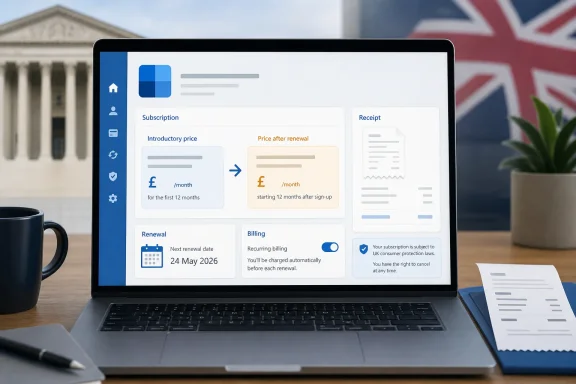 Renewal pricing is the central issue
MLex reported that the regulator believes Microsoft 365 renewals may have misled consumers. Perspective Media likewise described an investigation into whether Microsoft misled customers over subscription costs. An investigation is not a finding of wrongdoing, and neither report establishes that Microsoft has breached consumer law.
Still, auto-renewal pricing has become a sharper enforcement priority in the UK. Competition and Markets Authority guidance says businesses must present key contractual information clearly and bring renewal terms to customers’ attention in time for them to cancel. The regulator’s consumer-protection guidance also warns that technically accurate information can be misleading when its overall presentation causes consumers to make a different purchasing decision.
What Microsoft 365 subscribers should check
For individual Microsoft 365 accounts, the practical question is simple: whether the next renewal date, billing frequency and full renewal price match what the customer expects.
Subscribers can review those details from their Microsoft account’s Services & subscriptions page, where they can check the recurring-billing status and turn it off before the renewal date. Turning off recurring billing normally preserves access through the already-paid subscription period rather than immediately ending the service.
The case could pressure Microsoft to make renewal-price disclosures and cancellation choices more prominent for UK consumer plans. For IT administrators, it is a reminder that this is principally a consumer-subscription issue—not necessarily a change to Microsoft 365 commercial agreements—but organisations that reimburse employee home subscriptions may still want to clarify who is responsible for renewal charges.
Update: CMA probe now linked to Copilot-related plan and price changes (July 29, 2026)
New reporting by PYMNTS, citing Reuters, says the Competition and Markets Authority’s investigation specifically examines changes made after Microsoft integrated Copilot AI features into Microsoft 365 Personal and Family subscriptions.
The CMA will assess whether subscribers received enough information about their available plan choices, price differences and renewal terms before deciding whether to continue. Microsoft said it is reviewing the concerns and will cooperate with the investigation.
This focus means the inquiry is not limited to generic auto-renewal disclosures: it also concerns whether AI-driven feature and pricing changes were presented clearly enough for consumers to make an informed choice. UK subscribers who saw their Microsoft 365 options or renewal price change after Copilot’s inclusion should review their current plan and recurring-billing settings carefully.
Update: CMA formal probe highlights Microsoft 365 “Classic” plan choices (July 30, 2026)
As reported by Windows Report, the CMA’s formal investigation will examine whether Microsoft clearly presented lower-cost “Classic” options to existing Microsoft 365 Personal and Family subscribers before their renewals.
The report says Microsoft introduced Copilot-inclusive consumer plans in January 2025, with affected customers moved to the higher-priced versions when their existing term ended unless they actively selected another option. Existing subscribers could instead choose temporary Copilot-free Classic plans: Microsoft 365 Personal Classic at £59.99 annually versus £84.99 for the AI-enabled plan, and Family Classic at £79.99 versus £104.99.
That adds a more specific question for the regulator: not only whether renewal notices were clear, but whether customers were given adequate time and prominence to compare the cheaper non-AI alternatives before being charged. The CMA has not reached a conclusion, but it can impose penalties of up to 10% of global annual turnover for consumer-law infringements.
