
Valve’s Steam Machine is not trying to replace a high-end desktop PC; it is a SteamOS-first living-room companion for players who want their existing PC library on the television without turning the entertainment center into a Windows gaming rig. That distinction matters more than the familiar debate over whether its hardware can match a custom-built PC at the same price.
As argued in a recent NoobFeed opinion piece, the appeal is less about chasing native 4K Ultra settings than moving the Steam Deck experience to a larger display with substantially more headroom. Valve has positioned the compact system at more than six times the Steam Deck’s performance, but that figure should be read as an architectural comparison—not a promise of sixfold frame rates in every game.
For Steam Deck owners, the Steam Machine fills a clear gap. The handheld remains excellent for portable play, but docked mode asks its low-power APU to drive a TV-resolution image in games that increasingly strain the hardware.
The Machine is designed around the same library, interface, controller-forward navigation, Proton compatibility layer, and suspend-and-resume expectations, while offering enough performance for higher settings and higher output resolutions. That makes it less a conventional desktop replacement than a fixed, couch-friendly extension of the Deck ecosystem.
The practical goal is simple: play Spider-Man, Halo, older PC games, and emulated titles from the sofa without shifting to a desk, managing a Windows desktop, or maintaining a large tower PC beside the TV.
That does not make every FSR implementation good. Image quality, latency, and artifacts still vary by game, display size, and chosen performance mode. But dismissing the Steam Machine because it uses upscaling misunderstands its target: a compact PC designed to offer acceptable living-room performance, not a hardware showcase intended to brute-force every new release at native 4K.
For technically minded buyers, the important question is not whether the output is “native.” It is whether a given game looks and runs well enough at normal couch-viewing distance on the intended TV.
A Steam library built over years travels with the device. SteamOS provides a game-focused interface, while desktop access allows owners to install tools, configure controllers, run alternative software, and use emulators. That flexibility makes the hardware useful for more than newly released AAA games—and means older titles and retro systems can be a meaningful part of its value.
The same applies to online multiplayer. PC games do not impose a universal platform subscription simply for online access, although individual games may still have their own accounts, services, or recurring costs.
NoobFeed is right that value is personal, especially for someone with hundreds of Steam games already purchased. But Valve cannot rely only on library goodwill. A premium price puts pressure on compatibility, performance consistency, storage, support, and the overall polish of SteamOS on a television.
That is why the Steam Machine should not be judged as a universal console recommendation. It is a specialized answer for players who value a small, quiet, open PC that behaves more like an appliance than a project. For that audience, the real comparison is not against a desktop benchmark chart—it is against the friction of bringing PC gaming into the living room.
The report also identifies microSD compatibility as an additional storage-expansion option. That gives owners a simpler way to add capacity or move smaller game installs without immediately replacing internal storage or attaching an external drive.
These features do not change the machine’s price or SteamOS compatibility constraints, but they make its living-room proposition more tangible: easier setup, fewer peripherals, and more flexible storage for users treating it as a dedicated couch-gaming system.
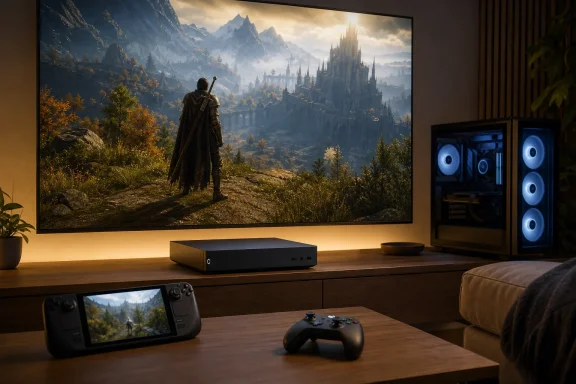 The Steam Deck’s docked-mode successor
For Steam Deck owners, the Steam Machine fills a clear gap. The handheld remains excellent for portable play, but docked mode asks its low-power APU to drive a TV-resolution image in games that increasingly strain the hardware.The Machine is designed around the same library, interface, controller-forward navigation, Proton compatibility layer, and suspend-and-resume expectations, while offering enough performance for higher settings and higher output resolutions. That makes it less a conventional desktop replacement than a fixed, couch-friendly extension of the Deck ecosystem.
The practical goal is simple: play Spider-Man, Halo, older PC games, and emulated titles from the sofa without shifting to a desk, managing a Windows desktop, or maintaining a large tower PC beside the TV.
Upscaling is a trade-off, not a disqualifier
FSR upscaling has become a flashpoint in Steam Machine criticism, particularly around Valve’s 4K and ray-tracing messaging. But the underlying premise is hardly unique to Valve’s box. Modern console games frequently use dynamic resolution, reconstruction techniques, and upscalers to reach their performance targets.That does not make every FSR implementation good. Image quality, latency, and artifacts still vary by game, display size, and chosen performance mode. But dismissing the Steam Machine because it uses upscaling misunderstands its target: a compact PC designed to offer acceptable living-room performance, not a hardware showcase intended to brute-force every new release at native 4K.
For technically minded buyers, the important question is not whether the output is “native.” It is whether a given game looks and runs well enough at normal couch-viewing distance on the intended TV.
Openness is the feature consoles cannot easily copy
The strongest argument for the Steam Machine is not its raw specification sheet. It is the combination of console-like convenience with PC ownership.A Steam library built over years travels with the device. SteamOS provides a game-focused interface, while desktop access allows owners to install tools, configure controllers, run alternative software, and use emulators. That flexibility makes the hardware useful for more than newly released AAA games—and means older titles and retro systems can be a meaningful part of its value.
The same applies to online multiplayer. PC games do not impose a universal platform subscription simply for online access, although individual games may still have their own accounts, services, or recurring costs.
The $1,049 problem is real
The Steam Machine’s starting price of $1,049 for the 512GB model changes the argument considerably. At that level, buyers can reasonably compare it with self-built small-form-factor PCs, prebuilt desktops, consoles, or simply keeping a Steam Deck docked.NoobFeed is right that value is personal, especially for someone with hundreds of Steam games already purchased. But Valve cannot rely only on library goodwill. A premium price puts pressure on compatibility, performance consistency, storage, support, and the overall polish of SteamOS on a television.
That is why the Steam Machine should not be judged as a universal console recommendation. It is a specialized answer for players who value a small, quiet, open PC that behaves more like an appliance than a project. For that audience, the real comparison is not against a desktop benchmark chart—it is against the friction of bringing PC gaming into the living room.
Update: HDMI-CEC and microSD support add living-room convenience (August 1, 2026)
Geeky Gadgets reports that Valve’s Steam Machine includes HDMI-CEC support, allowing compatible TVs to manage basic power and input behavior through the television remote. In practice, that could reduce the number of controllers or remotes needed to start a session, reinforcing the device’s appliance-like role beneath a TV rather than its identity as a conventional desktop PC.The report also identifies microSD compatibility as an additional storage-expansion option. That gives owners a simpler way to add capacity or move smaller game installs without immediately replacing internal storage or attaching an external drive.
These features do not change the machine’s price or SteamOS compatibility constraints, but they make its living-room proposition more tangible: easier setup, fewer peripherals, and more flexible storage for users treating it as a dedicated couch-gaming system.
References
- Primary source: NoobFeed
Published: 2026-07-30T18:00:00+00:00
Loading…
www.noobfeed.com - Related coverage: pcgamer.com
Loading…
www.pcgamer.com - Related coverage: tomshardware.com
Loading…
www.tomshardware.com - Related coverage: gamesradar.com
Loading…
www.gamesradar.com - Related coverage: techradar.com
Loading…
www.techradar.com - Related coverage: pcworld.com
Valve's new Steam Machine is '6x more powerful than the Steam Deck' | PCWorld
Think of it like a tiny living room PC version of the Steam Deck, with all the boosts that entails.www.pcworld.com - Primary source: Geeky Gadgets
Published: 2026-07-31T11:17:00+00:00