
Victory Giant Technology is committing at least 3 billion yuan, or about US$444 million, to a proposed AI-focused PCB manufacturing site in Huizhou, Guangdong, a move that shows how far the supply-chain buildout around AI servers has reached beyond GPUs and memory. But the reported connection to Nvidia’s Kyber rack program is far less settled than the investment itself: the new facility has no announced production date, no disclosed output target, and no customer contract attached to it.
The South China Morning Post reported that Victory Giant acquired a 100,000-square-metre industrial plot for an “AI high-end electronic circuit smart manufacturing” project. The local land-disposal terms reportedly require at least 3 billion yuan of investment, including 2 billion yuan in fixed assets, while the land itself sold for 66.5 million yuan. The newspaper also reported, citing a person familiar with the matter, that the company is negotiating new orders with major US firms and that its supply pipeline for Nvidia’s next-generation Kyber rack was progressing smoothly.
Those are materially different kinds of evidence. The land agreement is a concrete capital commitment. The US-customer negotiations and Kyber supply status are single-source claims that Victory Giant has not confirmed publicly. The company did not respond to the South China Morning Post before publication, and its own public filings do not name Nvidia as a customer or identify the Huizhou plot as a Kyber-specific project.
For Windows enthusiasts, enterprise buyers, and datacenter operators, the practical takeaway is that PCB capacity is becoming a gating factor for AI infrastructure, not a commodity footnote underneath the accelerator. Yet a new factory site does not solve the most difficult board-manufacturing problem today: reliably producing the extremely large, dense, high-speed interconnects required by rack-scale systems.
Victory Giant is not a small supplier making generic desktop motherboards. The Huizhou-based company is listed in Shenzhen as 300476 and, since April 21, 2026, in Hong Kong as VGT under stock code 2476. Its Hong Kong listing raised more than HK$20 billion, providing fresh capital just as the PCB industry shifts toward high-layer-count, high-density boards for AI compute trays, networking gear, accelerator modules, and storage systems.
In its 2025 annual report, Victory Giant said revenue rose 79.77% year over year to 19.292 billion yuan, while net profit attributable to shareholders rose 273.52% to 4.312 billion yuan. The company attributed the growth to large-scale production of higher-value AI computing, data-center, and high-performance-computing boards, alongside a customer mix increasingly tilted toward higher-complexity products.
Its disclosed capabilities illustrate why AI hardware manufacturers are looking beyond the traditional names in PC and server-board fabrication. Victory Giant says it can produce PCB designs with more than 100 layers, 10-step 30-layer HDI boards, and 16-layer arbitrary-interconnect HDI boards, while it is developing a 14-step 36-layer HDI process. HDI, or high-density interconnect, uses fine traces, microvias, and closely packed layers to route far more electrical connections in a constrained space.
That matters because modern AI systems are not simply graphics cards bolted into a standard chassis. A server-grade accelerator tray must move enormous volumes of data between GPUs, CPUs, memory, NICs, switches, and storage. The board underneath those parts has to preserve signal integrity across increasingly rapid links, manage high current and heat, and meet demanding yield requirements. A defect on a complex, large-format multilayer board can turn into a costly assembly failure late in the production chain.
The proposed Huizhou facility therefore reads as a capacity-and-process investment directed at the higher end of PCB production. The disclosed minimum fixed-asset commitment is roughly 30 times the reported land price, which is a reminder that the property transaction is the smallest part of the project. The expensive work is the clean production environment, laser drilling, imaging, plating, lamination, inspection, automation, wastewater treatment, and the specialized equipment needed to maintain acceptable yields.
That official roadmap makes the alleged Victory Giant supply relationship strategically plausible. It does not confirm it.
More importantly, it arrives amid reporting that the Kyber program itself has hit a board-manufacturing obstacle. In July, Tom’s Hardware, reporting on analysis from SemiAnalysis, said Nvidia’s Kyber NVL144 rack may have slipped into 2028 because its large PCB midplane remains difficult to manufacture at production scale. Nvidia responded to Tom’s Hardware only that its “roadmap is intact,” without confirming the original schedule, the reported delay, or the status of the board.
The reported complication is not a conventional server PCB issue. Kyber is designed around a rigid orthogonal backplane or midplane that replaces a huge amount of rack cabling with a board-based interconnect. Nvidia has presented the architectural benefit as a way to reduce cabling and speed assembly, but the technical tradeoff is severe: the board must carry extremely fast signals, handle power-delivery demands, and remain manufacturable at large physical dimensions and high layer counts.
This is where the factory announcement changes meaning. A 3 billion-yuan AI PCB facility is evidence that Victory Giant expects durable demand for advanced boards across AI computing. It is not evidence that the Kyber midplane problem has been solved, or even that the new Huizhou site will build that component.
The difference matters for anyone trying to read the AI supply chain as an early indicator of Nvidia platform timing. Capacity expansion can support existing Blackwell-class products, Rubin systems using more familiar rack layouts, custom ASIC servers, high-speed switching, optical modules, and many other workloads. It cannot be treated as confirmation that a difficult next-generation rack design has cleared qualification.
What the filing does not do is name Nvidia, disclose revenue tied to Nvidia programs, identify US companies in active negotiations, or spell out how much of its future output is contractually committed. That omission is normal for component manufacturers operating under customer confidentiality agreements, but it limits what can be concluded from supply-chain reporting.
The annual report also describes a “China + N” manufacturing approach, with production expansion in Thailand, Vietnam, and Malaysia as well as China. That strategy is commercially significant. US and multinational system makers increasingly want manufacturing options outside a single jurisdiction, particularly for products that will be integrated into servers and networking systems sold internationally. The Huizhou project strengthens the company’s domestic technical-production base; it does not eliminate the reason for its Southeast Asian buildout.
Victory Giant already has a US subsidiary, VGTPCB Inc., according to its annual report, but that alone does not establish the scale or status of any new US order pipeline. Nor does an AI PCB supplier’s relationship with a US customer mean its boards are necessarily part of a finished system shipped into China. The flow of PCBs, components, accelerators, and completed AI servers is governed by different commercial arrangements and, in some cases, different export-control requirements.
The key missing disclosures are straightforward:
The company’s own 2025 report makes clear that it is investing heavily in both technical capability and international capacity. It reported 778 million yuan in research and development spending for 2025, up 72.88% from the prior year, and listed 87 active R&D projects spanning AI computer boards, high-end intelligent-server computing boards, autonomous-driving systems, and robotics control hardware.
That helps explain why PCB makers are receiving investor attention once reserved for accelerator designers and memory suppliers. The value is migrating into physical interconnect: the boards and substrates that make denser compute, faster networking, and rack-scale integration possible.
Victory Giant’s Huizhou commitment is a credible signal that it expects the AI infrastructure spending cycle to persist. For now, however, the public record supports a broader conclusion than the headline suggests: the company is building capacity for high-end AI electronics, while the claimed Nvidia Kyber opportunity remains unconfirmed and sits beside unresolved reporting about Kyber’s manufacturability. The first meaningful milestone will be a disclosed construction schedule, customer qualification, or production-capacity figure—not the land purchase itself.
Those are materially different kinds of evidence. The land agreement is a concrete capital commitment. The US-customer negotiations and Kyber supply status are single-source claims that Victory Giant has not confirmed publicly. The company did not respond to the South China Morning Post before publication, and its own public filings do not name Nvidia as a customer or identify the Huizhou plot as a Kyber-specific project.
For Windows enthusiasts, enterprise buyers, and datacenter operators, the practical takeaway is that PCB capacity is becoming a gating factor for AI infrastructure, not a commodity footnote underneath the accelerator. Yet a new factory site does not solve the most difficult board-manufacturing problem today: reliably producing the extremely large, dense, high-speed interconnects required by rack-scale systems.
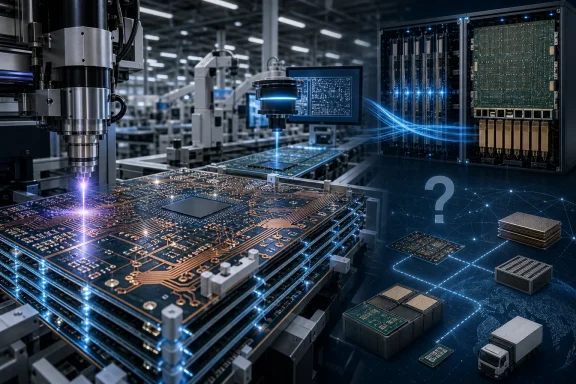 The Huizhou commitment is larger than a routine factory expansion
Victory Giant is not a small supplier making generic desktop motherboards. The Huizhou-based company is listed in Shenzhen as 300476 and, since April 21, 2026, in Hong Kong as VGT under stock code 2476. Its Hong Kong listing raised more than HK$20 billion, providing fresh capital just as the PCB industry shifts toward high-layer-count, high-density boards for AI compute trays, networking gear, accelerator modules, and storage systems.In its 2025 annual report, Victory Giant said revenue rose 79.77% year over year to 19.292 billion yuan, while net profit attributable to shareholders rose 273.52% to 4.312 billion yuan. The company attributed the growth to large-scale production of higher-value AI computing, data-center, and high-performance-computing boards, alongside a customer mix increasingly tilted toward higher-complexity products.
Its disclosed capabilities illustrate why AI hardware manufacturers are looking beyond the traditional names in PC and server-board fabrication. Victory Giant says it can produce PCB designs with more than 100 layers, 10-step 30-layer HDI boards, and 16-layer arbitrary-interconnect HDI boards, while it is developing a 14-step 36-layer HDI process. HDI, or high-density interconnect, uses fine traces, microvias, and closely packed layers to route far more electrical connections in a constrained space.
That matters because modern AI systems are not simply graphics cards bolted into a standard chassis. A server-grade accelerator tray must move enormous volumes of data between GPUs, CPUs, memory, NICs, switches, and storage. The board underneath those parts has to preserve signal integrity across increasingly rapid links, manage high current and heat, and meet demanding yield requirements. A defect on a complex, large-format multilayer board can turn into a costly assembly failure late in the production chain.
The proposed Huizhou facility therefore reads as a capacity-and-process investment directed at the higher end of PCB production. The disclosed minimum fixed-asset commitment is roughly 30 times the reported land price, which is a reminder that the property transaction is the smallest part of the project. The expensive work is the clean production environment, laser drilling, imaging, plating, lamination, inspection, automation, wastewater treatment, and the specialized equipment needed to maintain acceptable yields.
Kyber is precisely where PCB manufacturing has become difficult
The timing of the Kyber claim deserves closer scrutiny. Nvidia’s own Vera Rubin platform material describes Kyber as its next-generation MGX rack architecture, intended to house 144 GPUs in an NVL144 configuration and scale into larger NVL1152 systems. Nvidia says Kyber will debut with Vera Rubin Ultra, alongside NVL72, NVL144, and NVL576 choices for the scale-up domain.That official roadmap makes the alleged Victory Giant supply relationship strategically plausible. It does not confirm it.
More importantly, it arrives amid reporting that the Kyber program itself has hit a board-manufacturing obstacle. In July, Tom’s Hardware, reporting on analysis from SemiAnalysis, said Nvidia’s Kyber NVL144 rack may have slipped into 2028 because its large PCB midplane remains difficult to manufacture at production scale. Nvidia responded to Tom’s Hardware only that its “roadmap is intact,” without confirming the original schedule, the reported delay, or the status of the board.
The reported complication is not a conventional server PCB issue. Kyber is designed around a rigid orthogonal backplane or midplane that replaces a huge amount of rack cabling with a board-based interconnect. Nvidia has presented the architectural benefit as a way to reduce cabling and speed assembly, but the technical tradeoff is severe: the board must carry extremely fast signals, handle power-delivery demands, and remain manufacturable at large physical dimensions and high layer counts.
This is where the factory announcement changes meaning. A 3 billion-yuan AI PCB facility is evidence that Victory Giant expects durable demand for advanced boards across AI computing. It is not evidence that the Kyber midplane problem has been solved, or even that the new Huizhou site will build that component.
The difference matters for anyone trying to read the AI supply chain as an early indicator of Nvidia platform timing. Capacity expansion can support existing Blackwell-class products, Rubin systems using more familiar rack layouts, custom ASIC servers, high-speed switching, optical modules, and many other workloads. It cannot be treated as confirmation that a difficult next-generation rack design has cleared qualification.
Victory Giant’s public record supports the broader AI bet, not the customer names
Victory Giant’s annual report supports the company’s broad positioning as a supplier of high-end AI and data-center boards. It says the company is expanding in AI computing cards, data-center UBB boards, and switching products, and describes its market position in those categories as globally leading. It also says it has multiple high-end products in mass production and has become a core partner to numerous domestic and international technology customers.What the filing does not do is name Nvidia, disclose revenue tied to Nvidia programs, identify US companies in active negotiations, or spell out how much of its future output is contractually committed. That omission is normal for component manufacturers operating under customer confidentiality agreements, but it limits what can be concluded from supply-chain reporting.
The annual report also describes a “China + N” manufacturing approach, with production expansion in Thailand, Vietnam, and Malaysia as well as China. That strategy is commercially significant. US and multinational system makers increasingly want manufacturing options outside a single jurisdiction, particularly for products that will be integrated into servers and networking systems sold internationally. The Huizhou project strengthens the company’s domestic technical-production base; it does not eliminate the reason for its Southeast Asian buildout.
Victory Giant already has a US subsidiary, VGTPCB Inc., according to its annual report, but that alone does not establish the scale or status of any new US order pipeline. Nor does an AI PCB supplier’s relationship with a US customer mean its boards are necessarily part of a finished system shipped into China. The flow of PCBs, components, accelerators, and completed AI servers is governed by different commercial arrangements and, in some cases, different export-control requirements.
The key missing disclosures are straightforward:
- Victory Giant has not publicly identified the Huizhou project’s first production date or its annual board-output capacity.
- It has not said whether the project is intended for AI accelerator trays, switch boards, optical networking, GPU modules, server motherboards, or Kyber’s specialized midplane.
- It has not publicly named the major US firms reportedly negotiating orders.
- Nvidia has not confirmed Victory Giant as a Kyber supplier or clarified the claimed Kyber schedule.
The capacity race may create a new bottleneck of its own
Victory Giant is expanding into a market where demand alone is no longer enough to guarantee success. Advanced PCB manufacturing depends on materials, process control, engineering know-how, customer qualification, and yield. A factory can be funded and built, yet take much longer to produce a board that passes a hyperscaler or GPU vendor’s reliability and signal-integrity requirements at volume.The company’s own 2025 report makes clear that it is investing heavily in both technical capability and international capacity. It reported 778 million yuan in research and development spending for 2025, up 72.88% from the prior year, and listed 87 active R&D projects spanning AI computer boards, high-end intelligent-server computing boards, autonomous-driving systems, and robotics control hardware.
That helps explain why PCB makers are receiving investor attention once reserved for accelerator designers and memory suppliers. The value is migrating into physical interconnect: the boards and substrates that make denser compute, faster networking, and rack-scale integration possible.
Victory Giant’s Huizhou commitment is a credible signal that it expects the AI infrastructure spending cycle to persist. For now, however, the public record supports a broader conclusion than the headline suggests: the company is building capacity for high-end AI electronics, while the claimed Nvidia Kyber opportunity remains unconfirmed and sits beside unresolved reporting about Kyber’s manufacturability. The first meaningful milestone will be a disclosed construction schedule, customer qualification, or production-capacity figure—not the land purchase itself.
References
- Primary source: South China Morning Post
Published: 2026-08-06T10:30:05+00:00
Loading…
amp.scmp.com - Related coverage: chnpcb.com
Loading…
www.chnpcb.com - Related coverage: techxplore.com
Loading…
techxplore.com - Related coverage: tomshardware.com
Nvidia's Huang vows to deliver 'giant amounts' of Vera Rubin — company says that 'our roadmap is intact' | Tom's Hardware
But what about Vera Rubin Ultra?www.tomshardware.com - Related coverage: forbes.com
Loading…
www.forbes.com - Related coverage: minichart.com.sg
Loading…
www.minichart.com.sg - Related coverage: marketscreener.com
Loading…
www.marketscreener.com