
Volkswagen Group is positioning generative AI as a core engineering capability rather than a productivity add-on, using it to test infotainment software, manage requirements, analyze complex development data, and reduce the friction that slows a vehicle from concept to series production. The company’s stated ambition is stark: bring vehicle development time below 36 months, roughly 25% faster than its present baseline, while retaining the traceability, validation discipline, and human accountability that automotive development demands. Volkswagen’s own account of the strategy makes clear that this is not a speculative lab project. It is an attempt to reshape how a global automaker builds software-defined vehicles.
For Windows users and enterprise IT leaders, the story matters because it shows where the next phase of Microsoft Copilot, Azure OpenAI, and industrial application lifecycle management may lead. Generative AI is becoming less about producing a polished email or summarizing a meeting, and more about operating inside systems that hold requirements, test evidence, software versions, safety-relevant decisions, and decades of product knowledge.
That is an enormous opportunity. It is also precisely the environment in which a casually deployed chatbot can do the most harm.
Volkswagen says it now has more than 1,200 AI applications active across the Group, with hundreds more being developed or nearing deployment. Those applications span vehicle development, production, cybersecurity, supply-chain operations, administrative work, and internal knowledge exchange. The Group’s AI overview frames the objective in unusually broad terms: AI should be used throughout the automotive value chain wherever it can increase speed, quality, or efficiency.
The exact public number is worth handling carefully. In a separate interview, Volkswagen’s Head of Group Research and Development, Werner Tietz, said there were over 1,400 applications across the Group, while the wider corporate AI page says over 1,200. That interview provides the higher figure. The discrepancy does not undermine the larger point—Volkswagen is clearly operating at substantial scale—but it does illustrate a basic AI-programme governance lesson: enterprises need a consistent definition of what qualifies as an “active AI application.”
Volkswagen also reports that more than 100 AI-based processes entered productive use in its Technical Development organization during 2025. Volkswagen’s development interview says these processes are deployed in development, testing, simulation, and validation—areas that are both labor-intensive and deeply interdependent.
This distinction is crucial. A standard enterprise AI deployment can generate value by helping staff write documents faster. An automotive engineering AI deployment has to improve the flow of verified work between many systems and teams:
That complexity changes the threshold for useful AI.
In office work, a bad AI summary can waste time or create an embarrassing error. In vehicle development, a poor AI-generated requirement could omit an edge case, misunderstand a system dependency, or introduce ambiguity into a chain of decisions that ultimately affects a customer-facing product. The output may look articulate and complete while still being unsuitable for engineering approval.
Volkswagen’s approach recognizes that reality. Tietz describes AI as integrated into the work of development rather than treated as a separate experiment, extending from early design through simulation and software testing. Volkswagen’s interview with Tietz emphasizes that engineers remain responsible for the systems they create.
That is the correct starting point for industrial generative AI. The most valuable implementations are unlikely to be the most theatrical. They will be the tools that remove repeatable, low-value friction while leaving decisions, approvals, and accountability with qualified people.
Testing a digital interface may sound modest compared with autonomous-driving software or battery management. Yet infotainment testing is a useful example because it exposes a widespread engineering problem: capable specialists can lose enormous amounts of time repeating predictable interactions, documenting routine results, and reconciling those results across tools.
Automation has long helped with test execution. The AI dimension is more interesting when it improves test selection, interpretation, documentation, and feedback loops around those tests. If GHOST can produce consistent evidence while freeing engineers to investigate unusual behavior, improve coverage, and focus on difficult edge cases, it moves beyond a simple macro recorder.
Volkswagen’s claim of “no documentation errors” should be understood as a statement about the tool’s defined testing process rather than a universal quality guarantee for all infotainment development. The company’s interview does not publish a defect-rate comparison, testing coverage figure, or independently audited measurement. Still, the workflow is exactly where AI-assisted automation can offer credible value: it turns repeated manual evidence collection into a structured, consistent process.
The opportunity is not to eliminate the tester. It is to make the tester’s time more valuable.
A mature AI-assisted testing workflow should allow engineers to:
The Group uses PTC Codebeamer, an application lifecycle management platform designed to help teams define, review, validate, and trace requirements and tests across hardware and software. Microsoft’s customer account says Volkswagen is integrating Microsoft Copilot and Microsoft Cloud for Manufacturing technologies into Codebeamer, with generative AI capabilities powered by Azure OpenAI.
This is where the Microsoft connection becomes particularly relevant to enterprise Windows environments. Copilot is not being presented as a detached consumer-style assistant. It is being applied inside a governed engineering environment that already holds business context, requirements, standards, workflow states, and traceability relationships.
Robert Kattner, Head of Volkswagen Group IT Engineering, said that a Copilot within Codebeamer can help create new requirements specifications and test cases using Volkswagen’s specific data and business context. Microsoft’s published case study also says the deployment is intended to improve search, analysis, and content generation inside the ALM platform, while helping teams bring references out of legacy IT systems.
A requirement has to be precise enough for a team to implement, testable enough for a validation organization to verify, traceable enough for audit and change control, and intelligible enough for different disciplines to interpret consistently. At a global automaker, those requirements may span suppliers, brands, regions, hardware platforms, software components, and many years of maintenance.
AI can assist with some of the hardest parts of this work:
That distinction matters. Volkswagen’s deployment may eventually produce comparable, better, or lower results depending on data quality, process maturity, integration depth, and the degree to which engineers trust and use the system. Enterprise buyers should resist converting a platform vendor’s possible savings range into an internal business case without task-level measurement.
That is a stronger model than letting engineers paste confidential requirements into a generic AI interface and manually copy the output back into a disconnected system. The latter may create short-term convenience, but it also creates fragmented provenance, inconsistent access controls, and an unclear record of how a requirement changed.
An engineering copilot should be able to answer a simple but vital question: What source material informed this proposed output?
If the answer is unavailable, the output may still be useful as an informal starting point. It should not be treated as trusted engineering evidence.
That framing should remain intact. Volkswagen has provided persuasive evidence that AI is in practical use at scale, including concrete applications in technical development. It has not publicly released the detailed, independent, programme-level data needed to demonstrate that its 25% vehicle-development acceleration has already been achieved across its portfolio.
This is not a weakness unique to Volkswagen. Large industrial AI programmes often produce early proof in individual processes before a full product-development system shows a measurable aggregate gain. A reduction in documentation effort is real, but it will not necessarily reduce the overall launch timeline if data handoffs, supplier delays, physical prototypes, approval structures, or platform architecture remain slow.
That is the key caveat behind every industrial AI productivity forecast. An AI assistant cannot compensate for:
The sub-36-month target is therefore best seen as a measure of Volkswagen’s wider transformation. AI may be a powerful accelerator, but it is not the engine by itself.
That phrase is better than the more common rhetoric around replacing knowledge workers. It acknowledges that AI can enhance capacity without pretending that responsibility can be outsourced to a model.
Volkswagen’s wider AI policy also says that, in sensitive personnel matters, a human makes the final decision. The Group’s AI page presents this as part of an approach based on ethical standards and European regulation. The principle should be even stricter in product engineering: human judgment must remain visible at the points where a decision affects safety, compliance, release readiness, or customer impact.
A strong governance model should include:
For many enterprises, that may mean connecting Azure OpenAI-based capabilities to:
For WindowsForum readers, the broader takeaway is that Windows productivity AI is expanding beyond Microsoft 365-style assistance. The most consequential deployments may happen quietly in specialized enterprise applications: systems used by engineers, analysts, designers, quality teams, and operations staff who need an AI assistant that understands a controlled workflow rather than merely a text box.
The strongest evidence is not the number of AI applications alone. It is the integration of AI into workflows where repeatability, context, review, and traceability already matter. GHOST demonstrates how automation can reduce testing and documentation friction. The Codebeamer work with PTC and Microsoft illustrates how Copilot can support requirements and test workflows inside an application lifecycle management platform rather than outside it.
The limits are equally clear. Volkswagen’s sub-36-month, 25%-faster development target remains an ambition, not a published achieved result. The company has not publicly quantified the programme’s full impact on defects, headcount capacity, programme cost, or time to market across every brand and vehicle line.
But that does not diminish the strategic value of its approach. Volkswagen is treating generative AI as part of a broader engineering-system transformation: one that combines modern lifecycle management, software-defined vehicle development, repeatable testing, secure data access, skills investment, and human responsibility.
That is the model industrial enterprises should follow. Use AI to accelerate engineering work, not to evade engineering accountability.
For Windows users and enterprise IT leaders, the story matters because it shows where the next phase of Microsoft Copilot, Azure OpenAI, and industrial application lifecycle management may lead. Generative AI is becoming less about producing a polished email or summarizing a meeting, and more about operating inside systems that hold requirements, test evidence, software versions, safety-relevant decisions, and decades of product knowledge.
That is an enormous opportunity. It is also precisely the environment in which a casually deployed chatbot can do the most harm.
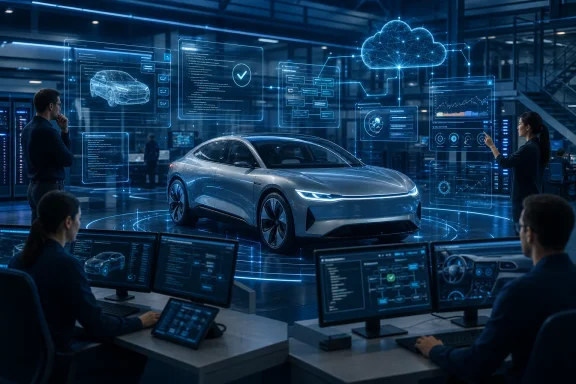 Overview: Volkswagen’s AI Plan Is About Engineering Flow, Not Just AI Assistants
Volkswagen says it now has more than 1,200 AI applications active across the Group, with hundreds more being developed or nearing deployment. Those applications span vehicle development, production, cybersecurity, supply-chain operations, administrative work, and internal knowledge exchange. The Group’s AI overview frames the objective in unusually broad terms: AI should be used throughout the automotive value chain wherever it can increase speed, quality, or efficiency.The exact public number is worth handling carefully. In a separate interview, Volkswagen’s Head of Group Research and Development, Werner Tietz, said there were over 1,400 applications across the Group, while the wider corporate AI page says over 1,200. That interview provides the higher figure. The discrepancy does not undermine the larger point—Volkswagen is clearly operating at substantial scale—but it does illustrate a basic AI-programme governance lesson: enterprises need a consistent definition of what qualifies as an “active AI application.”
Volkswagen also reports that more than 100 AI-based processes entered productive use in its Technical Development organization during 2025. Volkswagen’s development interview says these processes are deployed in development, testing, simulation, and validation—areas that are both labor-intensive and deeply interdependent.
This distinction is crucial. A standard enterprise AI deployment can generate value by helping staff write documents faster. An automotive engineering AI deployment has to improve the flow of verified work between many systems and teams:
- Product requirements and engineering specifications
- Hardware and software interfaces
- Simulation and physical testing
- Supplier documentation and component data
- Security controls and compliance evidence
- Defect management, approvals, and release records
- Post-sale software maintenance and over-the-air updates
Why Automotive Engineering Is a Harder Test for Generative AI
Modern cars are mechanical products, but they are also networks of software, electronics, sensors, controllers, cloud-connected services, user interfaces, and data-processing systems. Volkswagen and Microsoft describe this shift in practical terms: the manufacturer’s engineering teams must define, validate, and trace requirements and tests across both hardware and software, including software estates that can run to millions of lines of code. Microsoft’s Volkswagen customer story explains why application lifecycle management has become central to automotive development.That complexity changes the threshold for useful AI.
In office work, a bad AI summary can waste time or create an embarrassing error. In vehicle development, a poor AI-generated requirement could omit an edge case, misunderstand a system dependency, or introduce ambiguity into a chain of decisions that ultimately affects a customer-facing product. The output may look articulate and complete while still being unsuitable for engineering approval.
Volkswagen’s approach recognizes that reality. Tietz describes AI as integrated into the work of development rather than treated as a separate experiment, extending from early design through simulation and software testing. Volkswagen’s interview with Tietz emphasizes that engineers remain responsible for the systems they create.
That is the correct starting point for industrial generative AI. The most valuable implementations are unlikely to be the most theatrical. They will be the tools that remove repeatable, low-value friction while leaving decisions, approvals, and accountability with qualified people.
The productivity model is different
A traditional “AI productivity” dashboard might focus on:- Active users
- Prompts submitted
- Documents drafted
- Time spent in a copilot application
- Licenses assigned
- Requirement-to-release cycle time
- Test execution and documentation time
- Defect escape rates
- Rework caused by incomplete or inconsistent requirements
- Release readiness
- Validation throughput
- Traceability completeness
- Time required to investigate and resolve failures
GHOST: The Most Concrete Example of AI in Volkswagen’s Development Workflow
Volkswagen’s clearest public example is a proprietary system called GHOST, used to automatically test infotainment software functions, including touch interactions. The company says the tool effectively presses buttons like a human tester and produces reproducible test runs, eliminates documentation errors in that workflow, and supports faster release cycles. Volkswagen’s description of GHOST is deliberately straightforward, but the implications are significant.Testing a digital interface may sound modest compared with autonomous-driving software or battery management. Yet infotainment testing is a useful example because it exposes a widespread engineering problem: capable specialists can lose enormous amounts of time repeating predictable interactions, documenting routine results, and reconciling those results across tools.
Automation has long helped with test execution. The AI dimension is more interesting when it improves test selection, interpretation, documentation, and feedback loops around those tests. If GHOST can produce consistent evidence while freeing engineers to investigate unusual behavior, improve coverage, and focus on difficult edge cases, it moves beyond a simple macro recorder.
Reproducibility is the real industrial benefit
The phrase “reproducible testing” deserves more attention than the headline-grabbing idea of AI pressing a virtual button. In engineering, reproducibility enables comparison. It helps teams determine whether a fault is new, whether a software change caused a regression, and whether a fix actually works across a repeatable set of conditions.Volkswagen’s claim of “no documentation errors” should be understood as a statement about the tool’s defined testing process rather than a universal quality guarantee for all infotainment development. The company’s interview does not publish a defect-rate comparison, testing coverage figure, or independently audited measurement. Still, the workflow is exactly where AI-assisted automation can offer credible value: it turns repeated manual evidence collection into a structured, consistent process.
The opportunity is not to eliminate the tester. It is to make the tester’s time more valuable.
A mature AI-assisted testing workflow should allow engineers to:
- Define the test intent and acceptance criteria.
- Run a repeatable set of interactions or system conditions.
- Collect evidence automatically.
- Identify deviations from expected behavior.
- Escalate unclear or safety-relevant results for human investigation.
- Preserve the final approval, rationale, and software version in the engineering record.
Codebeamer, Microsoft Copilot, and the Fight Against Requirements Chaos
Volkswagen’s partnership with PTC and Microsoft may be even more strategically important than the GHOST example because it places AI within the system that organizes development knowledge.The Group uses PTC Codebeamer, an application lifecycle management platform designed to help teams define, review, validate, and trace requirements and tests across hardware and software. Microsoft’s customer account says Volkswagen is integrating Microsoft Copilot and Microsoft Cloud for Manufacturing technologies into Codebeamer, with generative AI capabilities powered by Azure OpenAI.
This is where the Microsoft connection becomes particularly relevant to enterprise Windows environments. Copilot is not being presented as a detached consumer-style assistant. It is being applied inside a governed engineering environment that already holds business context, requirements, standards, workflow states, and traceability relationships.
Robert Kattner, Head of Volkswagen Group IT Engineering, said that a Copilot within Codebeamer can help create new requirements specifications and test cases using Volkswagen’s specific data and business context. Microsoft’s published case study also says the deployment is intended to improve search, analysis, and content generation inside the ALM platform, while helping teams bring references out of legacy IT systems.
Why requirements are fertile ground for AI
Requirements work is often underestimated because it is neither glamorous nor visibly technical in the way that CAD modeling or software coding can be. In reality, requirements are where ambiguity becomes expensive.A requirement has to be precise enough for a team to implement, testable enough for a validation organization to verify, traceable enough for audit and change control, and intelligible enough for different disciplines to interpret consistently. At a global automaker, those requirements may span suppliers, brands, regions, hardware platforms, software components, and many years of maintenance.
AI can assist with some of the hardest parts of this work:
- Finding duplicate or conflicting requirements
- Identifying missing links between requirements and tests
- Converting legacy material into a structured format
- Drafting test cases based on approved requirements
- Locating relevant historical decisions
- Summarizing a change request and its likely dependencies
- Helping teams search across dense engineering records
That distinction matters. Volkswagen’s deployment may eventually produce comparable, better, or lower results depending on data quality, process maturity, integration depth, and the degree to which engineers trust and use the system. Enterprise buyers should resist converting a platform vendor’s possible savings range into an internal business case without task-level measurement.
AI belongs within the engineering system of record
The best part of Volkswagen’s Codebeamer approach is not simply that it uses Microsoft Copilot. It is the decision to place assistance inside a platform where requirements, reviews, tests, and release workflows already live.That is a stronger model than letting engineers paste confidential requirements into a generic AI interface and manually copy the output back into a disconnected system. The latter may create short-term convenience, but it also creates fragmented provenance, inconsistent access controls, and an unclear record of how a requirement changed.
An engineering copilot should be able to answer a simple but vital question: What source material informed this proposed output?
If the answer is unavailable, the output may still be useful as an informal starting point. It should not be treated as trusted engineering evidence.
The Sub-36-Month Target: Ambitious, Plausible, and Not Yet Proven
Volkswagen’s headline ambition is to reduce its development time to under 36 months, which it says would be around 25% faster than its current level. Tietz’s interview presents that figure as an ambition rather than a completed transformation.That framing should remain intact. Volkswagen has provided persuasive evidence that AI is in practical use at scale, including concrete applications in technical development. It has not publicly released the detailed, independent, programme-level data needed to demonstrate that its 25% vehicle-development acceleration has already been achieved across its portfolio.
This is not a weakness unique to Volkswagen. Large industrial AI programmes often produce early proof in individual processes before a full product-development system shows a measurable aggregate gain. A reduction in documentation effort is real, but it will not necessarily reduce the overall launch timeline if data handoffs, supplier delays, physical prototypes, approval structures, or platform architecture remain slow.
AI is only one part of the operating model
Volkswagen itself points to a broader development shift. The company says software, electronics, vehicle development, and IT are increasingly being developed together rather than sequentially, allowing innovations to be validated earlier and moved into series production faster. Volkswagen’s development strategy interview connects the AI programme to end-to-end integration rather than treating it as a standalone technology upgrade.That is the key caveat behind every industrial AI productivity forecast. An AI assistant cannot compensate for:
- Incompatible data models
- Fragmented product lifecycle systems
- Unclear ownership of requirements
- Weak supplier collaboration
- Poor configuration management
- Incomplete test coverage
- Legacy documentation that lacks context
- Slow governance and approval pathways
The sub-36-month target is therefore best seen as a measure of Volkswagen’s wider transformation. AI may be a powerful accelerator, but it is not the engine by itself.
Human Accountability Is the Differentiator
Volkswagen’s public language on human oversight is unusually direct. Tietz says AI does not replace engineers; engineers continue to develop ideas and remain responsible for systems, while AI takes on repetitive tasks and expands what those professionals can accomplish. Volkswagen’s interview calls this model the “AI-accelerated engineer.”That phrase is better than the more common rhetoric around replacing knowledge workers. It acknowledges that AI can enhance capacity without pretending that responsibility can be outsourced to a model.
Volkswagen’s wider AI policy also says that, in sensitive personnel matters, a human makes the final decision. The Group’s AI page presents this as part of an approach based on ethical standards and European regulation. The principle should be even stricter in product engineering: human judgment must remain visible at the points where a decision affects safety, compliance, release readiness, or customer impact.
The risks that do not disappear with better models
Even a sophisticated generative AI system can:- Produce an answer that is fluent but incomplete
- Infer a relationship that does not exist in the product data
- Repeat an error present in legacy documentation
- Miss a critical exception condition
- Surface restricted intellectual property to the wrong user
- Create false confidence because its output sounds authoritative
- Encourage teams to accept a draft without sufficient review
A strong governance model should include:
- Source grounding: AI-generated output should point to relevant approved records where possible.
- Role-based access: Engineers, suppliers, and contractors should only access data appropriate to their responsibilities.
- Human review gates: AI output must be reviewed before it changes a controlled requirement, test, or release decision.
- Version control: Teams need a clear record of the source data, output, reviewer, and final approved revision.
- Evaluation and monitoring: Models need ongoing testing for accuracy, relevance, bias, data leakage, and failure patterns.
- Task-specific measurement: Productivity should be measured against real engineering outcomes, not only user satisfaction or chat volume.
What Volkswagen’s Strategy Means for Microsoft and Windows-Centered Enterprises
Volkswagen’s engineering programme offers an instructive model for organizations already invested in Microsoft’s stack. The central lesson is not “buy more Copilot licenses.” It is to integrate AI with the systems of record where work is governed.For many enterprises, that may mean connecting Azure OpenAI-based capabilities to:
- Application lifecycle management platforms
- Product lifecycle management systems
- Engineering document repositories
- Service-management platforms
- Manufacturing execution systems
- Quality-management databases
- Secure Windows workstations and identity controls
- Teams-based collaboration environments with appropriate retention policies
For WindowsForum readers, the broader takeaway is that Windows productivity AI is expanding beyond Microsoft 365-style assistance. The most consequential deployments may happen quietly in specialized enterprise applications: systems used by engineers, analysts, designers, quality teams, and operations staff who need an AI assistant that understands a controlled workflow rather than merely a text box.
Verdict: Volkswagen Has a Credible Industrial AI Blueprint
Volkswagen has moved beyond the phase where companies announce generic AI ambitions and demonstrate a few chat-based experiments. Its public examples show AI applied to meaningful engineering work: software testing, requirements management, technical documentation, analysis, validation, and development coordination.The strongest evidence is not the number of AI applications alone. It is the integration of AI into workflows where repeatability, context, review, and traceability already matter. GHOST demonstrates how automation can reduce testing and documentation friction. The Codebeamer work with PTC and Microsoft illustrates how Copilot can support requirements and test workflows inside an application lifecycle management platform rather than outside it.
The limits are equally clear. Volkswagen’s sub-36-month, 25%-faster development target remains an ambition, not a published achieved result. The company has not publicly quantified the programme’s full impact on defects, headcount capacity, programme cost, or time to market across every brand and vehicle line.
But that does not diminish the strategic value of its approach. Volkswagen is treating generative AI as part of a broader engineering-system transformation: one that combines modern lifecycle management, software-defined vehicle development, repeatable testing, secure data access, skills investment, and human responsibility.
That is the model industrial enterprises should follow. Use AI to accelerate engineering work, not to evade engineering accountability.
References
- Primary source: UC Today
Published: 2026-07-27T10:40:27+00:00
Volkswagen’s AI Plan to Build Cars Faster - UC Today
Volkswagen is using AI to accelerate vehicle engineering. Can GenAI cut development time without compromising safety, quality or control?www.uctoday.com
