

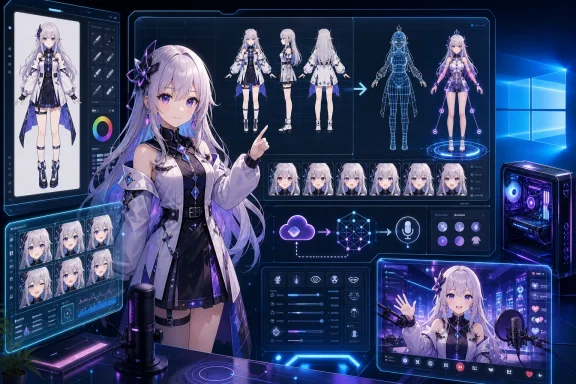
The release was reported on August 31, 2026, with direct downloads available from the product website. It supports 64-bit Windows 10 and Windows 11, alongside macOS 14 Sonoma or later on both Apple Silicon and Intel hardware. That makes it relevant to creators who want an approachable route into avatar production without beginning in a conventional 3D modeling package.
But prospective users should treat it as a newly released, cloud-connected creative service—not as a fully local character-creation utility, and not yet as a proven replacement for an established avatar-production workflow.
What the app says it can make from one illustration
The advertised workflow is unusually broad. A user supplies one character image; the software generates front, side, and back views; and those views are converted into a 3D character with automatic rigging. The service also offers an expression set that includes six lip-sync mouth shapes. Background-image and character-video generation are separately metered options.
That scope matters because the traditional alternative involves several distinct disciplines. A creator may need to commission or draw turnaround art, model a mesh, build or repair topology, weight the rig, set up facial expressions, and then configure the model for use in their streaming software. Compressing much of that process into one app could lower the entry barrier substantially for hobbyists, artists testing an original design, or smaller creators working without a 3D specialist.
The key limitation is that the dossier contains no independent hands-on validation of output quality. There is no verified benchmark for how faithfully the model preserves a supplied illustration, how cleanly its rig behaves, how convincing the lip sync is, or how reliably it handles difficult designs such as layered hair, elaborate costumes, asymmetrical accessories, unusual proportions, or detailed shading.
That is not a minor caveat. “Generated” and “production-ready” are different thresholds. A model can be impressive in a promotional example while still requiring cleanup before it can sustain close-up streaming, animation, or commercial branding. Creators with strict visual requirements should assume that results need review and should avoid committing a launch schedule or commissioning strategy until they have tested their own artwork.
A Windows app with a meaningful initial setup cost
The Windows requirement is 64-bit Windows 10 or Windows 11. The stated prerequisites also include an internet connection, at least 5 GB of free storage, and an approximately 1.5 GB AI-data download on first launch.
That first download is a useful clue to the product’s hybrid design. Some AI-powered functionality is installed locally, rather than every task being carried out remotely. Yet it also means the app is not a small, self-contained utility that can be casually installed on a nearly full laptop or expected to function fully offline.
The service requires users to sign in with a Google account to use generation features. For a creator, that means account access, cloud-service availability, and point purchases are part of the workflow, not optional details. Users should consider whether a Google-account-linked service is appropriate for the identity they use for their channel or creative business.
The official site also warns that a recently released build may trigger Windows or macOS security or reputation prompts. Such a prompt is not, by itself, evidence that an application is malicious; reputation systems commonly flag less-established downloads. However, the available material includes no independent code-signing verification, malware scan, checksum, or binary-integrity record for the direct-download installer.
The sensible Windows precaution is therefore straightforward: download only from the official product site, scrutinize any security dialog rather than bypassing it automatically, and avoid installing an executable redistributed through social media, file-hosting links, or unofficial mirrors. That advice is especially important for a tool likely to be installed by creators who also keep valuable streaming credentials, artwork, editing projects, and payment accounts on the same PC.
Local microphone analysis is not the same as local AI generation
The product’s privacy design needs a careful reading because its two main data paths are very different.
For streaming-related voice handling, the privacy policy says microphone audio remains on the user’s device. Speech recognition used by streaming features, along with decisions about which expression or video to use, are processed by AI running locally. The policy says neither microphone audio nor the derived speech text is sent to the operator or a third party.
For a streamer concerned about live speech, that is a consequential assurance. It suggests that spoken commentary and the on-device transcription derived from it are not being uploaded merely to drive avatar behavior. This can be particularly valuable for creators who discuss private material off-air, share a household workspace, or want to limit cloud exposure of voice data.
It would be a mistake, however, to turn that narrow assurance into a claim that the entire app works locally or that all creative data stays on the PC. The same privacy policy states that generation input data and output are sent to external generative-AI services to carry out generation.
The services named for those tasks are OpenAI for image generation and editing, Tripo AI for image-to-3D generation, Meshy for rigging and idle motion, and BytePlus for character-video generation. In practical terms, the illustration and other data supplied for a generation request, as well as the resulting output, are part of a cloud-processing workflow.
That distinction should shape what users upload. Do not assume that a locally processed microphone feature makes a supplied character image local too. Before submitting an illustration, consider whether it includes commissioned art, client material, unreleased designs, recognizable personal imagery, or third-party intellectual property. The reviewed terms say that whether external providers may use inputs or outputs for training depends on the operator’s contracts with those providers, but the exact contractual training-data terms are not disclosed in the material available here.
For creators, the practical rule is simple: local speech handling may reduce one category of exposure, but it does not eliminate the need to make an informed cloud-upload decision for generation work.
The real price is measured in points
The basic download and basic streaming functions are free, but generative functions use paid points. The listed point costs are:
- 800 points for 3D character generation.
- 200 points for an expression set, including six mouth shapes.
- 60 points for a background image.
- 85 points per second for generated video.
The published Japanese pricing lists 600 points for ¥630 and a 2,000-point Standard Pack for ¥2,080, including Japanese consumption tax. A first 3D model plus an expression set therefore uses 1,000 points before backgrounds or video are considered. At the stated rate, a 10-second generated video would use 850 points.
This model has advantages for someone who only needs occasional generations. It can avoid a recurring subscription for a casual experiment. But it also makes repeated iteration a budget concern. If a design needs several tries, or if a creator generates multiple versions while refining a channel identity, point consumption can rise more quickly than the headline cost of one 3D character suggests.
Two purchase terms are especially important. Points expire 180 days after they are granted, and ordinary cancellation or refunds are not available. The terms do provide for points to be returned automatically when a generation fails because of the provider’s system. That is narrower than a general satisfaction guarantee: a result that is technically produced but creatively disappointing is not necessarily a failed generation.
The useful purchasing strategy is to begin with the smallest project that can answer the core question: does this service produce a usable avatar from your art style? Avoid acquiring a large point balance merely because it appears more economical per point if there is no near-term production plan before the six-month expiry window.
Availability, taxation, payment methods, and checkout behavior may also vary by location. The available commercial notice indicates that non-Japanese checkout is converted to local currency and includes applicable VAT or GST, but identical purchasing conditions in every country were not independently verified.
Commercial use is permitted, but risk does not disappear
The terms allow users to use generated output commercially or non-commercially, and to sell or redistribute it, subject to the service’s conditions. This is a meaningful permission for streamers seeking to monetize a channel, use an avatar in promotional material, or distribute a project based on an original character.
Yet the same terms place important boundaries around that permission. Users must have the necessary rights to their input material. The operator also does not guarantee that an output is unique, non-infringing, or necessarily protected by copyright.
Those disclaimers have real-world consequences. A creator should not upload fan art, another artist’s commission without an appropriate agreement, an image scraped from the web, or a design that closely imitates a recognizable property. Even when the creator owns the supplied artwork, generated results may not be exclusive, and the service does not promise they will avoid similarity or intellectual-property disputes.
For a professional channel, agency, game project, or merchandise plan, a generated avatar should be reviewed as a business asset rather than treated as automatically cleared intellectual property. Keep records of the original art and its licensing terms. If exclusivity, copyright certainty, or a distinctive brand identity is essential, consider professional legal advice and a conventional commissioned 3D workflow alongside—or instead of—generation.
Direct release does not mean a Steam release
The current availability distinction is easy to miss. The product was directly released through its official website, but the official Steam listing was still marked unavailable and gave its release date as to be announced when reviewed on September 1, 2026.
Windows users should therefore not read launch coverage as confirmation that the app can be installed through Steam. That affects convenience and expectations: direct distribution may not offer the same installation, update, account, or purchase experience users associate with Steam. It also reinforces the value of downloading cautiously from the official source only.
There is a separate naming ambiguity worth noting. Product reporting identifies Sumeragi as the developer, while the legal pages name Dai Sato as the seller and service provider. The reviewed material does not establish whether Sumeragi is a team name, trading name, or separate entity. That does not establish a problem, but users making a commercial purchase should read the applicable legal and purchase information themselves.
Who should try it—and who should wait
VTuber Original Character Maker is potentially compelling for Windows creators who own the rights to a single character illustration, want a low-friction experiment with a 3D persona, and understand that the creative-generation stage is cloud-backed and point-metered. Its on-device handling of microphone audio and streaming transcription is a notable privacy-positive design choice, especially when compared with a blanket assumption that all AI-assisted streaming data must leave the device.
It is less straightforward for users who need offline generation, have strict confidentiality obligations, require a validated security posture, or cannot tolerate uncertain output quality and iterative costs. It is also not a proven answer, based on the available evidence, for creators who require a polished, fully controllable professional model on the first attempt.
The best initial test is modest: use original or fully licensed art, budget only enough points for a limited proof of concept, evaluate the resulting avatar in the intended streaming setup, and assess whether the quality justifies further purchases. That approach captures the app’s accessibility promise while respecting the privacy, security, ownership, and cost limitations that come with it.