
The reporting contains an attribution error worth correcting before the claim travels further. Windows Latest describes its source as Taiwan’s Economic Daily News, while Windows Central and TechRadar both link the report to United Daily News’ business site. Those publications are separate outlets. The percentage may still be accurate, but it remains a single-source supply-chain report, and Microsoft declined to comment when Windows Central asked about it.
What is independently established is more consequential for buyers: memory constraints are already pushing the PC market toward higher prices, narrower configurations, and lower shipments. A Windows license increase, if confirmed, would add to that pressure—but it is unlikely to be the part of a $600 or $1,000 laptop that determines whether a buyer sees a large retail-price increase.
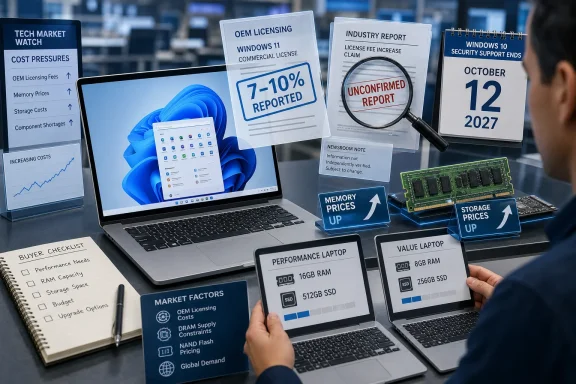 The Windows license claim has not been publicly confirmed
The reported increase applies to OEM licenses: the Windows copies preinstalled on a new Dell, HP, Lenovo, ASUS, Acer, or Surface PC. It does not change Microsoft’s published U.S. retail pricing for standalone Windows 11 licenses, which remains $99 for Windows 11 Home and $199 for Windows 11 Pro, according to Windows Central’s review of the report.
The supply-chain reporting says Microsoft’s OEM fees vary by processor class and that the latest rise averaged 7% to 10%, after prior annual adjustments normally stayed in the single digits. It also says ASUS and Acer expected roughly 5% PC-price increases in Taiwan during the third quarter. That last point is explicitly regional: Taiwanese retail pricing, local channel inventory, exchange rates, and product mixes do not automatically map to U.S. laptop pricing.
There is also no public evidence showing which Windows editions, processor tiers, OEM contract volumes, or geographies are affected. Microsoft has not published the starting date, list prices, or whether the reported adjustments are universal rather than negotiated changes for selected manufacturers. That missing detail matters. Windows OEM licensing is not a single global sticker price, so a percentage cited by one executive cannot establish what a particular $499 notebook—or a workstation sold through a U.S. enterprise reseller—will cost.
The practical conclusion is straightforward: do not buy a new PC this week solely to beat a rumored Windows fee increase. Watch actual configurations and street prices. An OEM faced with higher costs can raise retail prices, accept a lower margin, trim memory or storage, use a lower-tier processor, reduce promotions, or do several of those things at once. The lower-end market is where those tradeoffs become visible first.
Memory costs are the bigger force behind 2026 PC pricing
IDC’s June outlook is much clearer than the Windows-license report. The research firm forecasts global PC shipments will fall 11.3% in 2026, with average selling prices rising 17% to 18.3%, depending on the IDC forecast release cited. IDC attributes the pressure to a persistent memory shortage that it does not expect to meaningfully ease before the end of 2027.
The mechanism is unglamorous but painful. DRAM and NAND are baseline parts of every modern laptop: a manufacturer cannot meaningfully build a consumer Windows system without memory and solid-state storage. When those components become expensive or difficult to source, OEMs either raise prices or protect entry-level price points by reducing specifications.
That makes a reported 7% to 10% increase in the Windows license fee comparatively small in the final bill of materials. It can still matter to an OEM selling low-margin PCs at aggressive price points, especially if every other component is also rising. But it does not translate to a 7% to 10% increase in the laptop’s retail price. TechRadar reached the same conclusion from the Taiwanese reporting: the licensing change is likely to be overshadowed by the broader hardware cost surge.
Microsoft’s own financial disclosures show the company recognizes the component problem. In its fiscal third-quarter call in April, Microsoft said Windows OEM revenue had been supported by partners building inventory before memory costs rose further. It forecast Windows OEM revenue would decline in the high teens in the following quarter, citing a difficult comparison after Windows 10’s end of support, inventory normalization, and a weaker PC market as memory costs increased.
Microsoft’s fiscal fourth-quarter results, released July 29, later showed Windows OEM revenue down 5% year over year and Windows OEM and Devices revenue down 7%. That does not prove that Windows license pricing has changed. It does show that the post-Windows 10 replacement cycle is losing momentum just as the hardware market becomes less affordable.
The $500-to-$800 Windows notebook is under the most pressure
IDC says the affordable MacBook Neo is adding unusual pressure to the notebook market. Apple launched the 13-inch MacBook Neo in March at $599, with a $499 education price; Apple subsequently raised the regular starting price to $699 and the education price to $599. Even after that increase, it has shifted comparisons in the segment where Windows OEMs have traditionally competed on price and variety.
IDC’s Jitesh Ubrani said the Neo was putting “real pressure” on PC vendors and expected responses involving new silicon, a more efficient Windows, and aggressive promotions. The analyst firm expects price pressure from components to remain the dominant trend, but the Neo may keep some low-cost notebooks alive through competitive discounting.
For Windows buyers, that will likely mean a less tidy market rather than a uniform price hike. Some models will rise in price. Others will retain a familiar price tag but arrive with 8GB of memory, less storage, lower-end displays, or more compromised build quality than prior generations. A sale price alone will reveal less than it did when 16GB RAM and 512GB storage were easier for vendors to include.
The reported OEM fee change, if it is confirmed, therefore matters chiefly as another reason manufacturers may be less willing to absorb component inflation. It does not make a new Windows laptop categorically bad value, and it does not mean Apple is immune—Apple raised Mac prices amid the same memory constraints. It does mean buyers should compare the exact memory, storage, display, ports, warranty, and upgradeability on offer rather than assuming two $699 laptops occupy the same class.
Windows 10 now has a defined, temporary reprieve
Windows 10’s ordinary support ended on October 14, 2025. But Microsoft’s current consumer support page says enrolled Windows 10 PCs can receive Extended Security Updates through October 12, 2027. BleepingComputer and Ars Technica independently reported that Microsoft quietly extended consumer ESU coverage by a year beyond the original October 2026 cutoff.
That extension changes the purchasing calculation for a working Windows 10 machine. It gives home users another year of security updates before replacing otherwise functional hardware, precisely as new-PC prices are rising. It does not restore Windows 10 to full support. ESU is a security bridge, not a return of feature updates, routine technical support, or a guarantee that every third-party application will continue supporting the operating system.
Microsoft says Windows 10 version 22H2 is the relevant path for consumer upgrades and that a compatible PC can still upgrade to Windows 11 at no charge. Users who cannot or do not want to upgrade should check Windows Update for ESU enrollment and confirm that their device is receiving the extended patches. The date to record is October 12, 2027, not a vague “another year”: after that date, a consumer PC on standard Windows 10 will again face a security-support deadline.
Organizations should not assume consumer ESU terms apply to their fleets. Commercial Windows 10 ESU arrangements, licensing channels, and support timelines differ. IT teams should separately confirm their edition, servicing channel, ESU purchase status, and application support obligations rather than treating the consumer extension as a universal policy.
Microsoft’s Windows 11 performance work is becoming a price issue
Microsoft has spent 2026 promising to improve Windows fundamentals, and the timing is revealing. In March, Windows chief Pavan Davuluri said the company was working on lower baseline memory use, faster responsiveness, less latency in core interfaces, File Explorer improvements, and better OS, driver, and application reliability. Microsoft specifically described moving more core experiences toward WinUI 3 and reducing platform overhead.
Those changes are welcome on any PC, but their commercial value is greatest on an 8GB entry-level machine. When memory is cheap, an OEM can compensate for a heavy operating system by fitting more RAM. When memory is scarce, Windows needs to leave more of the installed capacity available for browsers, Office applications, Teams, security software, and the user’s actual workload.
Microsoft’s recent Surface guidance also now frames 8GB as suitable for everyday browsing, streaming, schoolwork, and productivity use, a notable change after years in which 16GB became the preferred baseline for newer Windows hardware and AI PC messaging. The company has not lowered Windows 11’s official hardware minimum from 4GB, but the marketplace has long operated at a more realistic threshold: 8GB is survivable, while 16GB is more comfortable for multitasking and future use.
The near-term result is that Windows 11 needs to earn an upgrade through better behavior on constrained hardware, not through the expiration of Windows 10 support alone. Microsoft has bought itself some time by extending consumer ESU to October 12, 2027. PC makers now have to decide whether rising costs show up as higher prices or weaker specifications—and buyers should judge each new Windows 11 system by which compromise the vendor chose.