
That distinction is important for Windows users because the headline is broad while the operating system is now split across materially different servicing tracks. Microsoft’s own release information lists Windows 11 26H1, 25H2, 24H2, and 23H2 as distinct versions with different build numbers, support deadlines, and deployment paths. A general verdict that Windows 11 “keeps improving” tells an individual user very little unless it identifies the edition, version, build, hardware, and features actually tested.
The PCMag Australia and PCMag UK entries supplied here do not provide those details. They name Windows 11 as the product but do not say whether the review was revised for Windows 11 25H2, the 26H1 release aimed at newer hardware, or an earlier version. They also do not identify the build that underpins the assessment, which leaves readers unable to connect the review’s conclusions to the Windows installation in front of them.
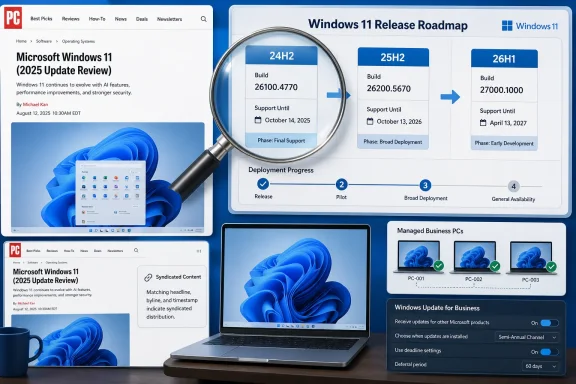 Two PCMag editions, one apparent review record
The matching publication time is unusually exact: both editions show the same timestamp down to the second. The Australian and UK pages also use URL paths that label them as migrated Windows 10 content, despite the displayed Windows 11 headline. That does not establish an error by itself—publishers often preserve old content identifiers when they move platforms—but it does establish that the August 11 timestamp is not enough to date the underlying evaluation.
PCMag Australia and PCMag UK may be separate regional editions, but the material supplied for both is identical. Treating the pair as two independent reviews would double-count the same editorial event. No separate test notes, differing regional price analysis, version-specific verdicts, or distinct publication dates are present in the submitted records.
This is a small but consequential publishing detail. Software reviews age differently from laptop or peripheral reviews because the named product can continue changing after the review has been written. A Windows 11 review published, migrated, or re-indexed today may still rest on observations from an earlier feature release unless the outlet states otherwise.
For Windows enthusiasts, that means the useful question is not whether a review says Windows 11 has improved. It is whether the review was re-tested against the build Microsoft is currently servicing for the device class in question.
Windows 11 is no longer a single practical target
Microsoft currently identifies Windows 11 version 26H1 as a General Availability Channel release with build 28000.2525 in its July 2026 servicing record. But Microsoft also says 26H1 is intended for new devices arriving in early 2026 and is not offered as an in-place update from Windows 11 24H2 or 25H2 on existing hardware.
That makes 26H1 a poor reference point for most organizations and home users evaluating whether to update a current PC. An installed 24H2 or 25H2 system does not simply receive 26H1 through the normal feature-update route. A review that treats “Windows 11” as one continuously updated product can therefore blur a deployment boundary Microsoft itself draws sharply.
For the far larger group already running Windows 11, version 25H2 remains the relevant current branch. Microsoft describes 25H2 as a feature update that includes the fixes and features delivered through prior Windows 11 24H2 cumulative updates; on eligible 24H2 machines, the move to 25H2 uses an enablement package. In practical terms, that makes the transition relatively lightweight compared with a traditional full feature-update reinstall, but it does not make every new Windows capability universal or automatically enabled.
Version 24H2 is also still supported, though its remaining runway is shorter. Microsoft lists October 13, 2026, as the end-of-servicing date for Home, Pro, Pro Education, and Pro for Workstations on 24H2. Enterprise, Education, and IoT Enterprise editions receive support until October 12, 2027. Windows 11 25H2 extends those dates to October 12, 2027, for consumer and Pro editions, and October 10, 2028, for Enterprise and Education.
Those dates make version specificity operationally important. A favorable generic review is no substitute for checking
winver, deployment rings, feature-update policies, and the edition actually licensed in an environment.
The headline skips the version, build, and support questions
PCMag’s headline calls Windows 11 the world’s most popular desktop OS. Independent reporting from Notebookcheck noted that Windows 11 overtook Windows 10 in worldwide desktop usage during 2025, citing StatCounter data. The broad market claim is plausible, but it has little bearing on whether a particular Windows 11 version is right for a managed fleet or an unsupported older PC.
Popularity does not resolve Windows 11’s central practical constraints:
- A device must meet Microsoft’s supported hardware requirements to receive Windows 11 through the normal supported path, including the platform security baseline that excluded many otherwise capable Windows 10-era systems.
- Windows 11 feature releases have edition-specific servicing periods, with Home and Pro receiving 24 months and Enterprise and Education receiving 36 months.
- Windows 11 26H1 is a distinct branch for newer devices rather than a general in-place successor to 24H2 and 25H2 installations.
- A review without a tested build number cannot tell readers whether its observations reflect changes that are already installed, staged through controlled feature rollout, or unavailable on their branch.
TechRadar’s Windows 11 review, for comparison, explicitly says it was updated on October 13, 2025, in response to Windows 10 entering end of life. That does not validate PCMag’s assessment, but it illustrates the information a living software review needs: a visible revision date and an explanation of why the verdict was revisited.
The two PCMag entries offer neither in the submitted material. Readers should therefore regard the August 11, 2026 timestamp as a publication-system signal, not as confirmation that Windows 11 was newly reviewed on the current builds.
For IT teams, the review is not a deployment signal
A general consumer review may still be useful for a first impression of the interface, productivity features, gaming support, or Microsoft’s evolving AI integration. It does not answer the questions that determine whether an IT department can deploy a release safely.
Administrators need to know whether a given assessment covers Windows 11 Home, Pro, Enterprise, Education, or LTSC; whether it was performed on x64 or Arm hardware; whether the device is managed with Microsoft Intune, Configuration Manager, Windows Server Update Services, or another tool; and whether its claims depend on a feature rollout that can be deferred or disabled. None of that is visible in the two PCMag feed entries.
The current support calendar adds urgency. Organizations still standardizing on 24H2 have roughly two months before Home and Pro reach end of servicing on October 13, 2026. That does not mean every machine must be rushed onto a different branch immediately, but it does mean a generic positive review should not become the basis for deciding whether to stay on 24H2, move to 25H2, or purchase new 26H1-capable hardware.
Microsoft’s documentation makes the immediate planning path clearer than the syndicated headline does: validate the hardware estate, identify the installed version and edition, confirm the servicing deadline, and test the next supported branch in a controlled ring. For most existing Windows 11 PCs, that points toward 25H2—not an assumption that 26H1 will arrive as the next routine in-place upgrade.
The useful takeaway is narrower than the headline
PCMag Australia and PCMag UK have surfaced the same positive Windows 11 review entry simultaneously, but the submitted records do not establish a new evaluation of Windows 11’s current releases. The duplicated regional publication is editorially one item, and the lack of a named tested version prevents readers from mapping its conclusion to the Windows builds Microsoft is servicing in August 2026.
For a personal PC, check the installed version before using the review as upgrade guidance. For a managed environment, treat Windows 11 25H2, 24H2, and 26H1 as separate planning cases with separate support and deployment implications. The next actionable date is October 13, 2026, when Windows 11 24H2 reaches end of servicing for Home and Pro editions.