
Windows NT 4.0 reached release to manufacturing on July 31, 1996—30 years ago today—bringing the Windows 95 shell to Microsoft’s business-focused workstation and server platform. The change put the Start menu, taskbar, Explorer interface and Task Manager atop the NT kernel, a combination that helped establish the basic shape of Windows used in offices for decades.
Microsoft’s launch announcement described NT 4.0 as marrying Windows 95’s ease of use with Windows NT reliability and security. Both Windows NT Workstation 4.0 and Windows NT Server 4.0 entered manufacturing that day, with broad availability following in the ensuing weeks. Build 1381 is the RTM release enthusiasts still recognize.
Before NT 4.0, Windows NT 3.x used the Program Manager-era interface familiar from Windows 3.1. NT 4.0 made the administrative experience immediately more recognizable to anyone arriving from Windows 95: Explorer became the shell, the Start button became the primary launch point, and the taskbar became a standard part of the desktop.
That was more than cosmetic. Microsoft was trying to make NT approachable as a file, print, application and network server while retaining the protected, pre-emptive 32-bit architecture that separated NT from the consumer Windows 95 and Windows 98 line.
Tom’s Hardware’s anniversary reporting rightly places NT 4.0 at a crucial point in that transition. It did not yet merge the consumer and business Windows families, but it gave them a common user experience years before Windows XP finally moved mainstream consumer PCs onto the NT foundation.
NT 4.0 also brought technologies with long afterlives in the Windows ecosystem, including CryptoAPI, DCOM and TAPI 2.0. Its architecture supported x86 alongside DEC Alpha, MIPS and PowerPC hardware—a portability ambition that now seems extraordinary for a Windows release.
It was the final major Windows release to support all three of those non-x86 architectures. Windows 2000 ultimately consolidated the product line around x86, ending a notable period when Windows NT competed across multiple workstation and server processor platforms.
Microsoft later extended the NT 4.0 family with Windows NT 4.0 Terminal Server Edition in 1998, an important precursor to the Remote Desktop Services model used today. The platform’s support life ended in 2004, but its influence persisted: Windows 2000 expanded the directory and management foundation with Active Directory, while Windows XP completed the consumer shift away from DOS-based Windows.
Thirty years on, NT 4.0 matters less as a practical operating system than as the moment Microsoft put its future Windows interface on the kernel that would eventually power nearly every mainstream Windows desktop and server.
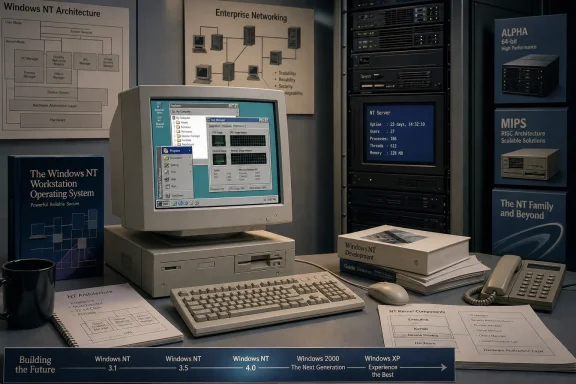 The familiar desktop moved into the data center
Before NT 4.0, Windows NT 3.x used the Program Manager-era interface familiar from Windows 3.1. NT 4.0 made the administrative experience immediately more recognizable to anyone arriving from Windows 95: Explorer became the shell, the Start button became the primary launch point, and the taskbar became a standard part of the desktop.That was more than cosmetic. Microsoft was trying to make NT approachable as a file, print, application and network server while retaining the protected, pre-emptive 32-bit architecture that separated NT from the consumer Windows 95 and Windows 98 line.
Tom’s Hardware’s anniversary reporting rightly places NT 4.0 at a crucial point in that transition. It did not yet merge the consumer and business Windows families, but it gave them a common user experience years before Windows XP finally moved mainstream consumer PCs onto the NT foundation.
Pentium-era requirements, enterprise-era ambitions
The operating system arrived during the Pentium and Pentium Pro era, when a 33 MHz 486-class processor, 16 MB of memory and roughly 110 MB of disk space could satisfy baseline workstation requirements; real server deployments needed substantially more. A 32 MB configuration and a few hundred megabytes of storage were far from extravagant for serious NT Server use, but look tiny beside a modern Windows Server installation.NT 4.0 also brought technologies with long afterlives in the Windows ecosystem, including CryptoAPI, DCOM and TAPI 2.0. Its architecture supported x86 alongside DEC Alpha, MIPS and PowerPC hardware—a portability ambition that now seems extraordinary for a Windows release.
It was the final major Windows release to support all three of those non-x86 architectures. Windows 2000 ultimately consolidated the product line around x86, ending a notable period when Windows NT competed across multiple workstation and server processor platforms.
Cairo’s shadow, not Cairo itself
One historical correction is worth making: Cairo was not simply the shipping codename for Windows NT 4.0. It was Microsoft’s much broader, ultimately unrealized next-generation computing project, whose ideas and development work overlapped with NT’s evolution. NT 4.0 inherited parts of that era’s ambition, most visibly the Windows 95-style shell, but it was not the fully realized Cairo vision.Microsoft later extended the NT 4.0 family with Windows NT 4.0 Terminal Server Edition in 1998, an important precursor to the Remote Desktop Services model used today. The platform’s support life ended in 2004, but its influence persisted: Windows 2000 expanded the directory and management foundation with Active Directory, while Windows XP completed the consumer shift away from DOS-based Windows.
Thirty years on, NT 4.0 matters less as a practical operating system than as the moment Microsoft put its future Windows interface on the kernel that would eventually power nearly every mainstream Windows desktop and server.
References
- Primary source: Tom's Hardware
Published: 2026-07-31T09:00:00+00:00
Windows NT 4.0 brought the Win95 UI to servers 30 years ago today — milestone unifying modern Windows OS hit RTM in the Pentium era | Tom's Hardware
It was also the last NT release to support Alpha, MIPS, or PowerPC CPU architectures.www.tomshardware.com