
The distinction is more than editorial housekeeping. Windows OEM royalties are a confidential input cost paid by manufacturers and their manufacturing partners; a 7% to 10% change in that one line item cannot be read as a 7% to 10% increase in the price of a laptop. In Taiwan, it arrives after memory, SSD, and CPU costs have already pushed system prices sharply higher. For buyers in the United States, there is no evidence yet of a published, universal Windows price increase or a fixed 5% increase across retail PCs.
Economic Daily News reported on August 10 that unnamed PC-brand executives said Microsoft’s Windows OEM license fees rose by an average of 7% to 10% from July. The publication says the increase varies by the CPU tier in the device, with higher-specification machines carrying higher Windows licensing charges. HotHardware’s report accurately conveyed the claimed 7%–10% range, but it blurred the source’s separate discussion of ASUS and Acer’s expected price moves.
Microsoft has not published an OEM price list, a country-by-country schedule, or a statement confirming the reported 7%–10% adjustment. At publication time, no independently reported Microsoft document established whether the reported change applies globally, to particular OEM agreements, or only to particular Windows editions and device categories. The price increase is credible reporting from Taiwan’s PC supply chain, but its worldwide scope remains unconfirmed.
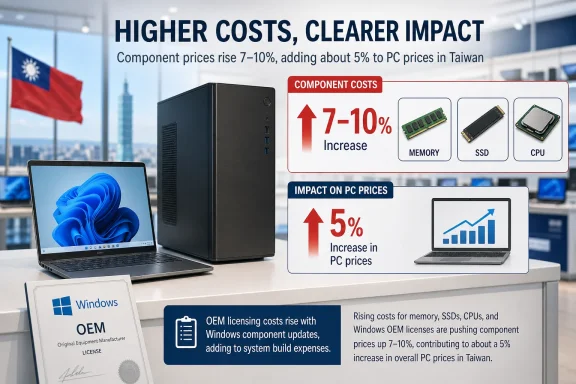 The 5% figure belongs to PC prices, not Windows royalties
The original Economic Daily News account says Taiwan’s two largest PC brands, ASUS and Acer, expect their PC products to rise by about 5% or by a single-digit percentage in the current quarter. Those statements come after a much larger run-up in hardware costs, especially memory.
ASUS Systems Business Group General Manager Liao Yi-hsiang had already said that some ASUS products in Taiwan were priced nearly 30% higher by May 2026 than they were in the fourth quarter of 2025. ASUS expected further single-digit price adjustments in the third quarter. Acer has similarly warned that the third quarter would be the peak period for PC price increases as component costs feed through its supply chain.
Those are end-product price estimates. They include the whole bill of materials: DRAM, NAND flash, SSDs, processors, displays, batteries, freight, currency exposure, channel margins, and now Windows. They are not a transparent pass-through of Microsoft’s royalty.
That correction changes the practical reading of the report. A buyer cannot look at a $1,000 laptop and conclude that Microsoft’s change added $50 or $100. OEM Windows licensing is only one cost layer, and the amount a vendor recovers depends on model positioning, contracts, inventory already bought at prior prices, and the price sensitivity of the market segment.
It also means that higher-end systems may see a larger absolute Windows cost increase without necessarily receiving the biggest percentage retail increase. The source says OEM Windows pricing is tiered by CPU class, but it does not disclose the underlying license prices. Without those figures, claims about Microsoft taking a specific extra “cut” of a premium PC sale go beyond the available record.
Microsoft’s public July price increase is a different program
The timing has encouraged a second source of confusion. Microsoft did announce public commercial licensing and packaging changes effective July 1, 2026, including price adjustments to Windows Enterprise E3 and E5, Microsoft 365 suites, Office 365, Entra, Intune-related offerings, and other commercial products.
Those published changes are not the same product channel as the Windows license embedded in a new consumer or business PC. Windows Enterprise subscriptions and per-device commercial licenses serve organizational customers. An OEM Windows license is the preinstalled license delivered with a new machine and ordinarily associated with that device.
Microsoft’s public commercial pricing FAQ names affected subscription and per-device commercial SKUs, explains renewal timing, and sets an effective date. It does not announce the reported Windows OEM adjustment, publish OEM rates, or identify CPU-tier licensing bands. Treating Microsoft’s public July commercial increase as proof of the Taiwan OEM report would therefore be wrong.
The parallel timing is still relevant. Microsoft is raising prices in public commercial programs at the same time the Taiwan report says OEM Windows costs have risen. For corporate procurement teams, that can create pressure on both sides of a refresh cycle: higher acquisition costs for new PCs and higher recurring costs for certain Windows and Microsoft 365 licensing plans. But the programs should be budgeted separately.
Memory remains the price driver buyers will actually feel
The Windows royalty report has landed in a market already defined by a prolonged component-cost squeeze. Counterpoint Research estimated that global PC shipments fell 4% year over year in the second quarter of 2026 to about 65 million units, ending a growth streak that began in the first quarter of 2025. The research firm pointed to elevated memory and broader component costs suppressing demand, even as Windows migration cycles and AI PC interest supported parts of the commercial market.
Omdia independently put worldwide second-quarter PC shipments at 65.7 million units, down 3.6% year over year, and said selling prices would continue to reflect earlier component inflation through the second half of 2026. Gartner has likewise warned that rising memory costs will pressure worldwide PC shipment volumes and force vendors to choose between preserving margins and chasing increasingly price-sensitive buyers.
That broader record supports the Taiwan report’s central point: Windows is becoming more expensive at the same time as the rest of the PC is becoming more expensive. It does not support framing the Microsoft increase as the primary explanation for today’s laptop and desktop sticker shock.
Memory pricing carries much more weight in a system’s bill of materials, particularly in machines with 32GB, 64GB, or larger memory configurations. A 7%–10% rise in a Windows OEM license can still matter to an OEM operating on slim margins — especially in entry-level configurations — but it is one additional upward pressure rather than the force remaking PC pricing.
What Windows buyers and IT teams should do with this report
For U.S. consumers, this is a warning sign rather than a reason to expect an identical 5% price jump at every retailer. PC makers often price differently by region, and current inventory can delay or mask an input-cost change. Watch comparable configurations rather than list prices alone: memory capacity, SSD size, processor tier, warranty, and promotional bundles can make a “discounted” new model a worse deal than an older configuration.
For IT departments, the immediate task is to separate device procurement from subscription licensing. Refresh quotes should identify whether a vendor’s increase reflects hardware availability, currency and logistics, memory allocation, or software preinstallation. Microsoft 365 and Windows Enterprise renewals should be reviewed against Microsoft’s separately published July 2026 commercial price changes rather than folded into a PC hardware budget without detail.
The real consequence of the Taiwan report is not that a Windows license suddenly costs consumers 10% more. It is that the PC industry has lost another place to absorb cost pressure just as component inflation has already curtailed demand. If Microsoft’s reported OEM adjustment spreads beyond Taiwan, OEMs will have less room to discount Windows devices — particularly low-margin models — even after memory markets begin to settle.