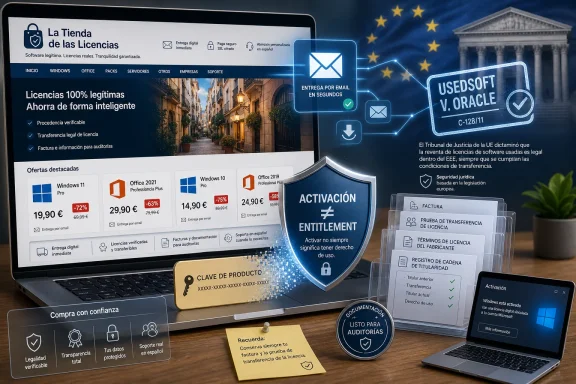
La Tienda de las Licencias, a Spain-based reseller operated by MYA WIFI S.L.U., is promoting low-cost Windows, Office, Microsoft 365, Windows Server, SQL Server, and security-software licenses through a July 2026 press campaign that frames its business around Europe’s second-hand software resale rules. The pitch is simple enough to set off every Windows user’s scam radar: genuine Microsoft activation for a fraction of the usual sticker price. The reality is more interesting, because the legal theory behind the model is real, but the practical risk shifts from “is resale ever legal?” to “can this reseller prove the chain of title when it matters?” As with so much in modern software, the cheapest checkout button is not the whole story.
The underlying press release, distributed through openPR and related syndication services, presents La Tienda de las Licencias as a quiet Spanish shop that has turned a 2012 European court ruling into an instant-delivery license business. The company’s own site describes immediate email delivery, invoices, long-running operations since 2017, and a catalog heavy with Microsoft products. The claim worth unpacking is not that cheap keys exist — the internet is drowning in them — but that this particular corner of the market sits inside a recognized European legal doctrine rather than the usual gray-market fog.
The legal hinge is the Court of Justice of the European Union’s July 3, 2012 judgment in UsedSoft v. Oracle, case C-128/11. In plain English, the court held that a copyright holder’s distribution right can be exhausted after the first sale of a software copy in the European Union, including downloaded software, when the buyer received a perpetual right to use it for a fee. That decision cracked open a secondary market for used software licenses that vendors had every commercial reason to dislike.
That is the part cheap-license sellers love to quote, and they are not wrong to quote it. The ruling is not a rumor, not a forum myth, and not a magical incantation from a reseller’s FAQ page. It is a landmark EU software decision, and it remains the reason second-hand software specialists can plausibly sell Windows, Office, and server licenses without sounding like they are merely laundering keys from a Telegram channel.
But “legal resale exists” is not the same as “every cheap license is legally clean.” The CJEU’s logic depends on conditions: the original sale must have exhausted the vendor’s distribution right, the original acquirer must stop using the copy, and the reseller must be able to substantiate what it is transferring. That last point is where the business stops being a clever consumer hack and becomes an evidence problem.
For an individual rebuilding a PC, that distinction may feel academic. For a business facing a licensing audit, it is the difference between a bargain and a procurement headache. A license that activates today is not automatically a license that satisfies an auditor tomorrow.
The business is not presenting itself as an official Microsoft distributor. That matters. The press release says the company is an independent reseller and notes that, aside from certain security-vendor relationships such as Panda Security, it should not be mistaken for an authorized Microsoft channel. In a market where “official-ish” badges and invented partner language are common, that restraint is more useful than another gold seal.
The site’s current catalog also shows why scrutiny is necessary. Alongside familiar Microsoft products, the extracted homepage includes “Windows 12” categories and out-of-stock Windows 12 product listings. As of July 7, 2026, Microsoft has not made Windows 12 a shipping mainstream client release in the way Windows 10 and Windows 11 are. A placeholder category is not proof of fraud, but it is a reminder that storefront cataloging can run ahead of product reality.
There is also a tension in the numbers. The syndicated release says the company has delivered more than 70,000 orders across more than 30 countries, while the store’s own homepage copy references more than 60,000 licenses sold since 2017. Those figures may be using different counting methods or may reflect updated marketing copy moving at different speeds. They are not wildly inconsistent, but they are exactly the sort of detail an IT buyer should treat as marketing until supported by documentation.
That distinction is familiar to anyone who has administered Microsoft estates. Microsoft licensing is a contractual ecosystem as much as a technical one, full of OEM rights, retail rights, volume agreements, subscription entitlements, CALs, downgrade rights, reassignment limits, and regional complications. The CJEU decision gives resellers a legal theory for transferring certain perpetual software rights in the EU, but it does not flatten every license type into a generic commodity.
The safest way to think about a low-cost Windows or Office key is this: activation is necessary, but it is not sufficient. If the purchase is for a home lab, a spare PC, or a non-critical personal machine, many buyers will be satisfied with a working key, an invoice, and support if activation fails. If the purchase is for a company, school, municipality, MSP customer, or regulated environment, the buyer needs a paper trail.
That paper trail should show what was sold, who sold it, invoice details, license type, transfer basis, and — for used software — evidence that the original owner’s use rights were extinguished or transferred properly. Vendors in the secondary software market often talk about audit guarantees, notary statements, or chain-of-title documentation. The value of those promises depends on what they actually provide when a real audit or dispute arrives.
That condition is not cosmetic. If a company buys a license, resells it, and continues using the software, the second buyer has not magically multiplied the license. The whole model depends on a one-in, one-out transfer of rights. In a clean transaction, the original buyer exits and the new buyer steps in. In a sloppy one, everyone downstream inherits uncertainty.
The market has also evolved since 2012. Microsoft has pushed hard toward subscriptions, cloud identity, and license management through Microsoft 365, Azure, and enterprise portals. That migration makes older perpetual licenses more valuable to some buyers and less central to Microsoft’s commercial strategy. It also means second-hand license resellers live in a narrowing lane: perpetual rights, older product generations, volume-license leftovers, and one-time purchases remain the natural terrain, while cloud subscriptions are structurally harder to treat as used goods.
This is why the presence of Microsoft 365 in discount catalogs deserves a different kind of reading than the presence of Office 2021 or Office 2024 perpetual editions. A 12-month Microsoft 365 subscription is not the same legal object as a perpetual Office license. It can still be legitimately resold or discounted through authorized or lawful channels, depending on supply and terms, but it should not be casually bundled into the same mental category as a used perpetual key.
From a security perspective, a reputable reseller of genuine keys is vastly preferable to downloading an executable that promises to “activate everything” and asks for administrator privileges. The latter is not a bargain; it is an invitation to credential theft, persistence, browser hijacking, and whatever else the payload author decided to monetize. If a low-cost legal resale market diverts users away from that behavior, it has a genuine public-interest upside.
The same applies to small businesses. A neighborhood shop, repair technician, freelancer, or small office may not have the budget or licensing expertise of an enterprise procurement team. If a Spanish reseller can provide a legitimate invoice, responsive support, and keys that activate without resorting to cracks, that is materially better than the under-the-table alternatives that often fill the gap.
The catch is that small buyers are also the easiest to impress with the wrong evidence. A polished website, an email key, and a review badge do not answer every licensing question. They answer the first question: “Will I receive something that works?” The second question — “Will this stand up if challenged?” — requires more.
That does not mean IT should reject every secondary-market license. It means IT should treat it like any other procurement channel with compliance requirements. The reseller should be vetted, purchase records should be retained, license types should be documented, and deployment should match the rights actually acquired. The lower the price and the more enterprise-critical the workload, the more documentation should be demanded.
Server products raise the stakes. Windows Server, SQL Server, RDS CALs, and related access licenses are not casual desktop purchases. They sit at the center of virtualization rights, core licensing, user/device access, external connectors, and audit exposure. A consumer can shrug off a failed Office activation. A company running production SQL Server on poorly documented discount licenses can find itself in a far more expensive conversation.
The best use case for a reseller like La Tienda de las Licencias may be controlled, narrow, and documented: lab machines, refurb PCs, one-off perpetual Office deployments, small office upgrades, or replacement keys where the organization understands the product’s licensing model. The worst use case is impulsive bulk buying because the unit price looks irresistible.
That disclaimer matters because it shifts the burden back to the reader. The press release can say “genuine licenses.” It can say “legal.” It can cite UsedSoft. It can quote review scores and order counts. But the decisive facts for a buyer are transactional: what license is being sold, what rights transfer, what proof is included, what happens if activation fails, and what happens if Microsoft or another vendor challenges the entitlement.
La Tienda de las Licencias’ own website makes some positive signals visible. It lists company positioning, immediate digital delivery, support channels, invoice language, payment options, and legal framing around EU law. It also links to a legal section and review pages. Those are better signs than an anonymous marketplace seller with no address, no tax invoice, and no support beyond a chat handle.
Still, buyers should not confuse transparency with authorization. The store’s independence from Microsoft is not a scandal; it is the entire business model. But independence means Microsoft is not standing behind the transaction. The reseller is.
Microsoft’s answer has increasingly been subscriptions. Microsoft 365 turns Office from a one-time decision into a recurring relationship, adds cloud storage and services, and gives Microsoft a cleaner revenue stream. That model works for many households and businesses, but it also leaves a constituency that wants exactly what older Microsoft licensing used to promise: buy the software once, install it, and get on with life.
The used-license market feeds that constituency. It is the aftermarket for a world Microsoft is trying to leave behind. Perpetual licenses, volume-license surplus, and decommissioned software assets become valuable precisely because the vendor prefers new revenue to flow through subscriptions and managed accounts.
That does not make the secondary market anti-Microsoft. It makes it economically inconvenient. The same company that benefits from broad Windows ubiquity also benefits from controlling channels, terms, and recurring revenue. Used software resellers sit in the seam between those incentives.
Ask whether the license is OEM, retail, volume, subscription, or another category. Ask what documentation accompanies the purchase beyond the product key. Ask whether the reseller provides an invoice with clear product identification. Ask what happens if the key activates now but is blocked later. Ask whether the license can be transferred, reinstalled, or reassigned. Ask whether the product is appropriate for the country and entity buying it.
Those questions are not signs of paranoia. They are signs of treating software as an asset rather than a magic string. The cheaper the license, the more important it is to know what you are actually buying.
For many users, the answer may still be yes. A Spanish reseller operating under EU resale principles can be a rational middle ground between paying full retail and gambling on piracy. But the right conclusion is not “too good to be true” or “perfectly safe for everything.” The right conclusion is more adult: cheap can be legitimate, but legitimacy has paperwork.
The underlying press release, distributed through openPR and related syndication services, presents La Tienda de las Licencias as a quiet Spanish shop that has turned a 2012 European court ruling into an instant-delivery license business. The company’s own site describes immediate email delivery, invoices, long-running operations since 2017, and a catalog heavy with Microsoft products. The claim worth unpacking is not that cheap keys exist — the internet is drowning in them — but that this particular corner of the market sits inside a recognized European legal doctrine rather than the usual gray-market fog.
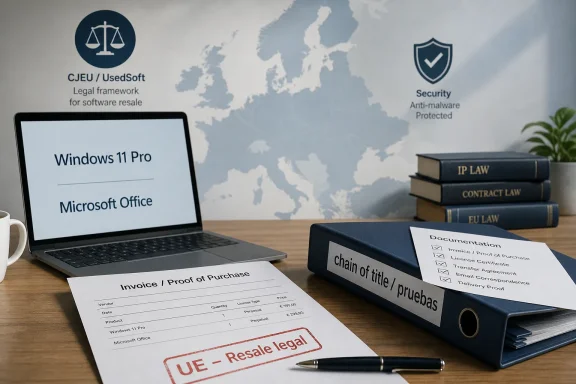 Europe Made Software Resale Boringly Legal, Which Is Why This Business Exists
The legal hinge is the Court of Justice of the European Union’s July 3, 2012 judgment in UsedSoft v. Oracle, case C-128/11. In plain English, the court held that a copyright holder’s distribution right can be exhausted after the first sale of a software copy in the European Union, including downloaded software, when the buyer received a perpetual right to use it for a fee. That decision cracked open a secondary market for used software licenses that vendors had every commercial reason to dislike.That is the part cheap-license sellers love to quote, and they are not wrong to quote it. The ruling is not a rumor, not a forum myth, and not a magical incantation from a reseller’s FAQ page. It is a landmark EU software decision, and it remains the reason second-hand software specialists can plausibly sell Windows, Office, and server licenses without sounding like they are merely laundering keys from a Telegram channel.
But “legal resale exists” is not the same as “every cheap license is legally clean.” The CJEU’s logic depends on conditions: the original sale must have exhausted the vendor’s distribution right, the original acquirer must stop using the copy, and the reseller must be able to substantiate what it is transferring. That last point is where the business stops being a clever consumer hack and becomes an evidence problem.
For an individual rebuilding a PC, that distinction may feel academic. For a business facing a licensing audit, it is the difference between a bargain and a procurement headache. A license that activates today is not automatically a license that satisfies an auditor tomorrow.
The Spanish Store Is Selling Certainty, Not Just Keys
La Tienda de las Licencias’ marketing understands the anxiety perfectly. Its homepage and press copy lean hard on words like “original,” “legal,” “invoice,” “guarantee,” and “immediate delivery.” The store lists Windows 11 Pro, Windows 10 Pro, Office 2024, Office 2021, Microsoft 365, Windows Server 2025 and 2022, SQL Server, CALs, Remote Desktop Services licenses, antivirus suites, and productivity software. It also advertises local-currency payment support for Latin American markets and independent reviews through eKomi.The business is not presenting itself as an official Microsoft distributor. That matters. The press release says the company is an independent reseller and notes that, aside from certain security-vendor relationships such as Panda Security, it should not be mistaken for an authorized Microsoft channel. In a market where “official-ish” badges and invented partner language are common, that restraint is more useful than another gold seal.
The site’s current catalog also shows why scrutiny is necessary. Alongside familiar Microsoft products, the extracted homepage includes “Windows 12” categories and out-of-stock Windows 12 product listings. As of July 7, 2026, Microsoft has not made Windows 12 a shipping mainstream client release in the way Windows 10 and Windows 11 are. A placeholder category is not proof of fraud, but it is a reminder that storefront cataloging can run ahead of product reality.
There is also a tension in the numbers. The syndicated release says the company has delivered more than 70,000 orders across more than 30 countries, while the store’s own homepage copy references more than 60,000 licenses sold since 2017. Those figures may be using different counting methods or may reflect updated marketing copy moving at different speeds. They are not wildly inconsistent, but they are exactly the sort of detail an IT buyer should treat as marketing until supported by documentation.
Microsoft Activation Is Not the Same as Microsoft Blessing
The central trap in cheap-license shopping is that activation feels like judgment. Windows accepts the key, Office lights up, the watermark disappears, and the user concludes that the license must be legitimate. Technically, activation proves that Microsoft’s systems accepted a key under the rules and telemetry available at that moment. It does not, by itself, prove that a downstream purchaser owns every legal right they think they bought.That distinction is familiar to anyone who has administered Microsoft estates. Microsoft licensing is a contractual ecosystem as much as a technical one, full of OEM rights, retail rights, volume agreements, subscription entitlements, CALs, downgrade rights, reassignment limits, and regional complications. The CJEU decision gives resellers a legal theory for transferring certain perpetual software rights in the EU, but it does not flatten every license type into a generic commodity.
The safest way to think about a low-cost Windows or Office key is this: activation is necessary, but it is not sufficient. If the purchase is for a home lab, a spare PC, or a non-critical personal machine, many buyers will be satisfied with a working key, an invoice, and support if activation fails. If the purchase is for a company, school, municipality, MSP customer, or regulated environment, the buyer needs a paper trail.
That paper trail should show what was sold, who sold it, invoice details, license type, transfer basis, and — for used software — evidence that the original owner’s use rights were extinguished or transferred properly. Vendors in the secondary software market often talk about audit guarantees, notary statements, or chain-of-title documentation. The value of those promises depends on what they actually provide when a real audit or dispute arrives.
The Court Ruling Was a Door, Not a Force Field
UsedSoft v. Oracle is often summarized as “used software licenses are legal in Europe,” which is mostly useful and partly dangerous. The ruling did not create a universal right to resell all digital goods in every configuration. It concerned computer programs under EU software law and rested on the principle that the rightsholder’s distribution right can be exhausted after a first sale. It also required that the original acquirer make its copy unusable at the time of resale.That condition is not cosmetic. If a company buys a license, resells it, and continues using the software, the second buyer has not magically multiplied the license. The whole model depends on a one-in, one-out transfer of rights. In a clean transaction, the original buyer exits and the new buyer steps in. In a sloppy one, everyone downstream inherits uncertainty.
The market has also evolved since 2012. Microsoft has pushed hard toward subscriptions, cloud identity, and license management through Microsoft 365, Azure, and enterprise portals. That migration makes older perpetual licenses more valuable to some buyers and less central to Microsoft’s commercial strategy. It also means second-hand license resellers live in a narrowing lane: perpetual rights, older product generations, volume-license leftovers, and one-time purchases remain the natural terrain, while cloud subscriptions are structurally harder to treat as used goods.
This is why the presence of Microsoft 365 in discount catalogs deserves a different kind of reading than the presence of Office 2021 or Office 2024 perpetual editions. A 12-month Microsoft 365 subscription is not the same legal object as a perpetual Office license. It can still be legitimately resold or discounted through authorized or lawful channels, depending on supply and terms, but it should not be casually bundled into the same mental category as a used perpetual key.
For Home Users, the Real Alternative Is Usually Worse
The consumer case for shops like La Tienda de las Licencias is straightforward: the alternative is often piracy, malware, or overpaying. Windows users have been trained for decades to see activation as an annoying toll booth rather than a meaningful software entitlement. That resentment produces a market for “activators,” cracked ISO files, suspect KMS tools, and random marketplace keys.From a security perspective, a reputable reseller of genuine keys is vastly preferable to downloading an executable that promises to “activate everything” and asks for administrator privileges. The latter is not a bargain; it is an invitation to credential theft, persistence, browser hijacking, and whatever else the payload author decided to monetize. If a low-cost legal resale market diverts users away from that behavior, it has a genuine public-interest upside.
The same applies to small businesses. A neighborhood shop, repair technician, freelancer, or small office may not have the budget or licensing expertise of an enterprise procurement team. If a Spanish reseller can provide a legitimate invoice, responsive support, and keys that activate without resorting to cracks, that is materially better than the under-the-table alternatives that often fill the gap.
The catch is that small buyers are also the easiest to impress with the wrong evidence. A polished website, an email key, and a review badge do not answer every licensing question. They answer the first question: “Will I receive something that works?” The second question — “Will this stand up if challenged?” — requires more.
For IT Pros, Cheap Licenses Are a Procurement Workflow
The WindowsForum audience will already know the pattern. A business unit buys “cheap Office” on a card, forwards a key to IT, and expects the admin to make the licensing mess disappear. The key activates, so the business thinks the job is done. Six months later, the MSP or internal admin is reconciling assets and trying to explain why a purchase record from a reseller is not the same as a volume licensing portal entitlement.That does not mean IT should reject every secondary-market license. It means IT should treat it like any other procurement channel with compliance requirements. The reseller should be vetted, purchase records should be retained, license types should be documented, and deployment should match the rights actually acquired. The lower the price and the more enterprise-critical the workload, the more documentation should be demanded.
Server products raise the stakes. Windows Server, SQL Server, RDS CALs, and related access licenses are not casual desktop purchases. They sit at the center of virtualization rights, core licensing, user/device access, external connectors, and audit exposure. A consumer can shrug off a failed Office activation. A company running production SQL Server on poorly documented discount licenses can find itself in a far more expensive conversation.
The best use case for a reseller like La Tienda de las Licencias may be controlled, narrow, and documented: lab machines, refurb PCs, one-off perpetual Office deployments, small office upgrades, or replacement keys where the organization understands the product’s licensing model. The worst use case is impulsive bulk buying because the unit price looks irresistible.
The Press Release Tells a Good Story, But It Is Still a Press Release
The syndicated article is written like a consumer-friendly explainer, with jokes about sketchy activators and a clean narrative about a Spanish shop using European law to save people money. That story is not false on its face, but it is promotional. It comes from a distribution network that also carries a legal disclaimer saying the content is provided by an independent third party and that the publisher does not warrant accuracy, legality, completeness, or reliability.That disclaimer matters because it shifts the burden back to the reader. The press release can say “genuine licenses.” It can say “legal.” It can cite UsedSoft. It can quote review scores and order counts. But the decisive facts for a buyer are transactional: what license is being sold, what rights transfer, what proof is included, what happens if activation fails, and what happens if Microsoft or another vendor challenges the entitlement.
La Tienda de las Licencias’ own website makes some positive signals visible. It lists company positioning, immediate digital delivery, support channels, invoice language, payment options, and legal framing around EU law. It also links to a legal section and review pages. Those are better signs than an anonymous marketplace seller with no address, no tax invoice, and no support beyond a chat handle.
Still, buyers should not confuse transparency with authorization. The store’s independence from Microsoft is not a scandal; it is the entire business model. But independence means Microsoft is not standing behind the transaction. The reseller is.
The Secondary Market Is a Symptom of Microsoft’s Own Pricing Problem
The reason these shops keep finding customers is not mysterious. Microsoft’s retail pricing for Windows and Office often feels detached from the reality of PC ownership. A user can buy a used business desktop for less than the official price of a Windows Pro license. A small shop can assemble a capable workstation and then discover that operating system and productivity software pricing changes the economics of the build.Microsoft’s answer has increasingly been subscriptions. Microsoft 365 turns Office from a one-time decision into a recurring relationship, adds cloud storage and services, and gives Microsoft a cleaner revenue stream. That model works for many households and businesses, but it also leaves a constituency that wants exactly what older Microsoft licensing used to promise: buy the software once, install it, and get on with life.
The used-license market feeds that constituency. It is the aftermarket for a world Microsoft is trying to leave behind. Perpetual licenses, volume-license surplus, and decommissioned software assets become valuable precisely because the vendor prefers new revenue to flow through subscriptions and managed accounts.
That does not make the secondary market anti-Microsoft. It makes it economically inconvenient. The same company that benefits from broad Windows ubiquity also benefits from controlling channels, terms, and recurring revenue. Used software resellers sit in the seam between those incentives.
The Best Buyers Will Ask Boring Questions
The practical advice here is intentionally unglamorous. If you are buying a cheap Windows 11 Pro key for a home PC, you probably care most about delivery, activation, refund policy, and whether you are avoiding malware. If you are buying Office, Windows Server, SQL Server, or CALs for a business, you need a procurement record that would make sense to someone who has never seen the website.Ask whether the license is OEM, retail, volume, subscription, or another category. Ask what documentation accompanies the purchase beyond the product key. Ask whether the reseller provides an invoice with clear product identification. Ask what happens if the key activates now but is blocked later. Ask whether the license can be transferred, reinstalled, or reassigned. Ask whether the product is appropriate for the country and entity buying it.
Those questions are not signs of paranoia. They are signs of treating software as an asset rather than a magic string. The cheaper the license, the more important it is to know what you are actually buying.
For many users, the answer may still be yes. A Spanish reseller operating under EU resale principles can be a rational middle ground between paying full retail and gambling on piracy. But the right conclusion is not “too good to be true” or “perfectly safe for everything.” The right conclusion is more adult: cheap can be legitimate, but legitimacy has paperwork.
The Checkout Button Is Only Half the License
The concrete lesson from La Tienda de las Licencias is that Europe’s used-software market is neither a scam by definition nor a free-for-all. It is a legitimate legal niche with real consumer value and real compliance edges. Buyers should treat it as a secondary market, not as an official Microsoft clearance rack.- A Windows or Office key that activates successfully is useful evidence, but it is not the same thing as complete proof of license compliance.
- The 2012 UsedSoft v. Oracle ruling supports the resale of certain used software licenses in the European Union, but only under conditions that matter in audits and disputes.
- La Tienda de las Licencias presents itself as an independent reseller rather than an official Microsoft distributor, which is an important distinction for buyers.
- Home users mainly need to avoid malware, fake activators, and no-support key sellers, while businesses need invoices, license-type clarity, and transfer documentation.
- Server, SQL Server, RDS, and CAL purchases deserve much more scrutiny than a one-off desktop Windows activation.
- Any catalog claim that appears to run ahead of Microsoft’s actual product lineup, such as Windows 12 listings, should be treated as a prompt to ask more questions rather than as proof of availability.
References
- Primary source: openpr.com
Published: 2026-07-07T09:10:08.193670
The Quiet Spanish Shop That Legally Sells Windows and Office
Press release - Getnews - The Quiet Spanish Shop That Legally Sells Windows and Office for Pocket Change - published on openPR.comwww.openpr.com