
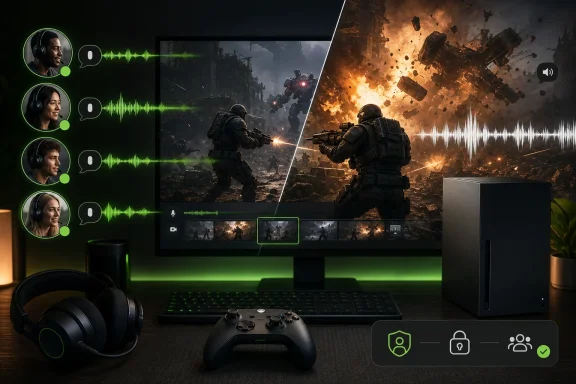
Xbox has begun testing a long-missing capture feature on its consoles: recorded game clips can now include party chat or in-game chat audio. The practical gain is obvious for anyone who has tried to preserve a multiplayer highlight without routing a headset through a capture card, PC, or streaming setup. But the early test also exposes the limits of Xbox’s first implementation: the feature is opt-in, confined to the Xbox Insider Alpha Skip-Ahead ring, and—based on an early hands-on recording—does not yet offer the audio controls needed to make voice reliably audible over a game’s sound mix.
Microsoft announced the feature on Xbox Wire on August 5, saying Alpha Skip-Ahead Insiders can elect to include chat in game captures. Windows Central followed with a real-world clip from Warhammer 40,000: Space Marine 2 on August 6. Its recording confirms that chat can make it into an ordinary console clip; it also shows why availability should not be confused with polish.
The first correction for prospective testers is a small but important one. The hands-on report describes the feature as available in the Alpha ring, but Xbox Wire and Windows Central’s earlier announcement both identify Alpha Skip-Ahead, the more restricted preview flight. A normal Xbox Insider enrollment, or even access to a different preview ring, does not guarantee the setting will appear.
Until now, Xbox’s built-in Game DVR workflow primarily preserved game audio. Players who wanted their own commentary and their friends’ reactions in the same file generally had to stream through software such as OBS, use a capture card, or build an audio-routing arrangement around their console and headset. That was needlessly complicated for what is a routine feature on competing console platforms and on many PC capture tools.
Microsoft’s new test changes the capture path rather than merely adding a share option. In a party, each player decides whether their own voice can be included in recordings. Outside a party, the player making the clip can also choose to include game-chat audio. The distinction matters: Xbox is framing this as a consent-controlled capture feature, not a blanket recording switch that silently scoops up every conversation heard through the console.
That privacy design is the substantive part of the update. Microsoft’s Game Development Kit documentation has historically instructed developers to label chat audio so the system excludes it from Game DVR clips. The reason is straightforward: a game may be visually public while voice communications involve multiple people with different expectations about whether they are being recorded. The new implementation creates a platform-level opt-in route for chat capture rather than removing that separation indiscriminately.
Windows Central reports that the new settings live under Preferences, then Clip settings, then Voice in captures and live streams. Its hands-on also says players can govern whether their voice is eligible for capture in public game-chat settings, a useful safeguard for proximity chat and open-lobby games where the people speaking may not be friends or party members. Xbox Wire’s announcement is clearer on party consent than it is on the exact behavior of open game chat, so Insiders should treat the public-chat controls as something to test rather than assume they will work identically in every title.
The result should be far more usable for ordinary clips: a boss kill, a co-op failure, or a competitive finish can preserve the context that game audio alone loses. It does not turn the Xbox into a multitrack production suite. It makes the console’s existing “record what just happened” command suitable for the kind of social gaming moment that users actually want to share.
One recording is not enough to establish a platform-wide defect. The issue could be specific to the Alpha Skip-Ahead build, the game, the headset configuration, output settings, or the test environment. Still, it is the only published hands-on evidence available so far, and it illustrates an immediate shortcoming in the announced feature: Microsoft has not disclosed controls for voice-versus-game volume, separate audio tracks, normalization, microphone gain, or per-application mixing.
For players, that omission is more than a missing preference toggle. A clip with clear game audio but inaudible voices is technically complete and socially useless. The common workaround—lowering game volume before playing—means compromising the live experience to improve a recording that may never be worth keeping.
Microsoft’s own accessibility guidance encourages games to offer separate controls for music, effects, dialogue, and voice chat. The console-level feature would benefit from applying the same principle to captures. A slider for chat gain, a separate microphone control, and optional separate tracks would give users a chance to repair a clip after the moment occurs instead of trying to predict the balance in advance.
Windows Central’s observed capture hitch deserves the same restrained treatment. A fraction of a second may be invisible in a slow-paced game and noticeable in a shooter or timing-sensitive action title. The test is exactly where this kind of overhead should be discovered, but Microsoft has not acknowledged the pause as a known issue or published performance targets for voice-enabled captures. There is no basis yet to call it a broad regression—only a reason for Insiders to report it with the affected game and capture settings.
That silence matters because the technical boundaries may be more complicated than the announcement makes them appear. Party chat is controlled by Xbox, but in-game voice is handled by individual games and their audio implementations. Older titles, backward-compatible titles, games with unusual voice routing, headset-only output configurations, and cross-network chat services could all expose edge cases. Xbox has not said whether Discord voice conversations are captured, for example, and no published report has independently confirmed it.
The feature should also not be confused with Xbox’s 2023 reactive voice-reporting tool. That earlier safety feature let players preserve a short segment of inappropriate in-game voice activity for moderation purposes; those evidence clips were not ordinary shareable Game DVR captures. The new test is built for personal capture and sharing, subject to participant consent, rather than enforcement.
There is also no announcement of a desktop equivalent. Windows 11’s Xbox Game Bar has long offered its own recording and microphone settings, but Xbox Wire’s August 5 post specifically describes new console updates. PC players should not assume their Game Bar workflow has gained the same party and game-chat capture controls.
For all Xbox players, wishlists can now hold up to 1,000 games. Those changes share a theme with voice capture: Xbox is gradually moving controls that previously required workarounds, guesswork, or external tools into the console interface.
The chat-capture test is the most consequential of the group because it changes what an Xbox clip represents. Game DVR stops being a record of pixels and soundtrack alone and becomes a record of the multiplayer moment around them. But Microsoft still needs to answer the parts that determine whether people will leave the option on: how the mix can be controlled, which chat services work, whether capture overhead is measurable across games, and when the feature leaves Alpha Skip-Ahead.
For now, the correct expectation is modest but meaningful. Alpha Skip-Ahead testers can record opted-in voices in their game clips. Everyone else should wait for Microsoft to publish a wider rollout—and for the audio controls that turn captured chat from barely audible proof of concept into a clip worth sharing.
The first correction for prospective testers is a small but important one. The hands-on report describes the feature as available in the Alpha ring, but Xbox Wire and Windows Central’s earlier announcement both identify Alpha Skip-Ahead, the more restricted preview flight. A normal Xbox Insider enrollment, or even access to a different preview ring, does not guarantee the setting will appear.
 Chat audio finally joins the console capture pipeline
Until now, Xbox’s built-in Game DVR workflow primarily preserved game audio. Players who wanted their own commentary and their friends’ reactions in the same file generally had to stream through software such as OBS, use a capture card, or build an audio-routing arrangement around their console and headset. That was needlessly complicated for what is a routine feature on competing console platforms and on many PC capture tools.Microsoft’s new test changes the capture path rather than merely adding a share option. In a party, each player decides whether their own voice can be included in recordings. Outside a party, the player making the clip can also choose to include game-chat audio. The distinction matters: Xbox is framing this as a consent-controlled capture feature, not a blanket recording switch that silently scoops up every conversation heard through the console.
That privacy design is the substantive part of the update. Microsoft’s Game Development Kit documentation has historically instructed developers to label chat audio so the system excludes it from Game DVR clips. The reason is straightforward: a game may be visually public while voice communications involve multiple people with different expectations about whether they are being recorded. The new implementation creates a platform-level opt-in route for chat capture rather than removing that separation indiscriminately.
Windows Central reports that the new settings live under Preferences, then Clip settings, then Voice in captures and live streams. Its hands-on also says players can govern whether their voice is eligible for capture in public game-chat settings, a useful safeguard for proximity chat and open-lobby games where the people speaking may not be friends or party members. Xbox Wire’s announcement is clearer on party consent than it is on the exact behavior of open game chat, so Insiders should treat the public-chat controls as something to test rather than assume they will work identically in every title.
The result should be far more usable for ordinary clips: a boss kill, a co-op failure, or a competitive finish can preserve the context that game audio alone loses. It does not turn the Xbox into a multitrack production suite. It makes the console’s existing “record what just happened” command suitable for the kind of social gaming moment that users actually want to share.
The first sample points to an audio-mixing problem
The early Space Marine 2 example published by Windows Central provides the reporting Microsoft’s announcement does not. The player’s voice is present, but low enough against the game soundtrack and effects that it is difficult to hear. Windows Central also observed a brief pause—estimated at about two-tenths of a second—when triggering a capture with voice enabled.One recording is not enough to establish a platform-wide defect. The issue could be specific to the Alpha Skip-Ahead build, the game, the headset configuration, output settings, or the test environment. Still, it is the only published hands-on evidence available so far, and it illustrates an immediate shortcoming in the announced feature: Microsoft has not disclosed controls for voice-versus-game volume, separate audio tracks, normalization, microphone gain, or per-application mixing.
For players, that omission is more than a missing preference toggle. A clip with clear game audio but inaudible voices is technically complete and socially useless. The common workaround—lowering game volume before playing—means compromising the live experience to improve a recording that may never be worth keeping.
Microsoft’s own accessibility guidance encourages games to offer separate controls for music, effects, dialogue, and voice chat. The console-level feature would benefit from applying the same principle to captures. A slider for chat gain, a separate microphone control, and optional separate tracks would give users a chance to repair a clip after the moment occurs instead of trying to predict the balance in advance.
Windows Central’s observed capture hitch deserves the same restrained treatment. A fraction of a second may be invisible in a slow-paced game and noticeable in a shooter or timing-sensitive action title. The test is exactly where this kind of overhead should be discovered, but Microsoft has not acknowledged the pause as a known issue or published performance targets for voice-enabled captures. There is no basis yet to call it a broad regression—only a reason for Insiders to report it with the affected game and capture settings.
What Microsoft has announced—and what it has left unsaid
Xbox Wire describes the feature as beginning in Alpha Skip-Ahead and says other features in the August 5 package will move through Insider channels and broader release over time. It does not provide a general-availability date for voice-enabled captures, a list of supported console models, a capture-length limitation specific to chat audio, or a title-by-title compatibility list.That silence matters because the technical boundaries may be more complicated than the announcement makes them appear. Party chat is controlled by Xbox, but in-game voice is handled by individual games and their audio implementations. Older titles, backward-compatible titles, games with unusual voice routing, headset-only output configurations, and cross-network chat services could all expose edge cases. Xbox has not said whether Discord voice conversations are captured, for example, and no published report has independently confirmed it.
The feature should also not be confused with Xbox’s 2023 reactive voice-reporting tool. That earlier safety feature let players preserve a short segment of inappropriate in-game voice activity for moderation purposes; those evidence clips were not ordinary shareable Game DVR captures. The new test is built for personal capture and sharing, subject to participant consent, rather than enforcement.
There is also no announcement of a desktop equivalent. Windows 11’s Xbox Game Bar has long offered its own recording and microphone settings, but Xbox Wire’s August 5 post specifically describes new console updates. PC players should not assume their Game Bar workflow has gained the same party and game-chat capture controls.
The wider update puts the capture test in a player-control push
Voice clip recording arrived alongside three less flashy Xbox changes. Alpha Skip-Ahead Insiders can now sort achievement history by game name, completion percentage, Gamerscore earned, and unlocked-achievement count, in ascending or descending order. Microsoft is also expanding cloud-save restoration, starting with Forza Horizon 6, so supported games can restore an earlier synced save from the console through Manage game & add-ons and Saved data.For all Xbox players, wishlists can now hold up to 1,000 games. Those changes share a theme with voice capture: Xbox is gradually moving controls that previously required workarounds, guesswork, or external tools into the console interface.
The chat-capture test is the most consequential of the group because it changes what an Xbox clip represents. Game DVR stops being a record of pixels and soundtrack alone and becomes a record of the multiplayer moment around them. But Microsoft still needs to answer the parts that determine whether people will leave the option on: how the mix can be controlled, which chat services work, whether capture overhead is measurable across games, and when the feature leaves Alpha Skip-Ahead.
For now, the correct expectation is modest but meaningful. Alpha Skip-Ahead testers can record opted-in voices in their game clips. Everyone else should wait for Microsoft to publish a wider rollout—and for the audio controls that turn captured chat from barely audible proof of concept into a clip worth sharing.
References
- Primary source: Windows Central
Published: August 6, 2026 at 3:08 PM UTC
Loading…
www.windowscentral.com - Related coverage: windowscentral.com
Loading…
www.windowscentral.com - Related coverage: news.xbox.com
Loading…
news.xbox.com - Related coverage: learn.microsoft.com
Loading…
learn.microsoft.com - Related coverage: support.microsoft.com
Loading…
support.microsoft.com - Related coverage: news.xbox.com
Loading…
news.xbox.com - Related coverage: xbox.com
Loading…
www.xbox.com - Related coverage: learn.microsoft.com
Loading…
learn.microsoft.com - Related coverage: techradar.com
Loading…
www.techradar.com - Related coverage: answers.microsoft.com
Loading…
answers.microsoft.com - Related coverage: seaofthieves.com
Loading…
www.seaofthieves.com