
The rollout was first reported by Press Start and independently verified by PC Gamer, which obtained Microsoft’s notice to customers. Microsoft’s own support documentation now lists Australia alongside Brazil and Singapore as countries where users can proactively complete verification. The deadline matters: Australia’s eSafety Commissioner says app-distribution services must have appropriate age checks in place for people downloading R18+ apps by September 9, 2026.
This is therefore not a sudden Xbox-specific content crackdown, nor a new rule affecting every game in a player’s library. It is Microsoft implementing an Australian compliance requirement on its stores, several weeks before the regulator’s staged deadline. For administrators, parents, and players who use a single Microsoft account across Windows and Xbox, the practical consequence is broader than a console prompt: verification changes the status of the Microsoft account itself.
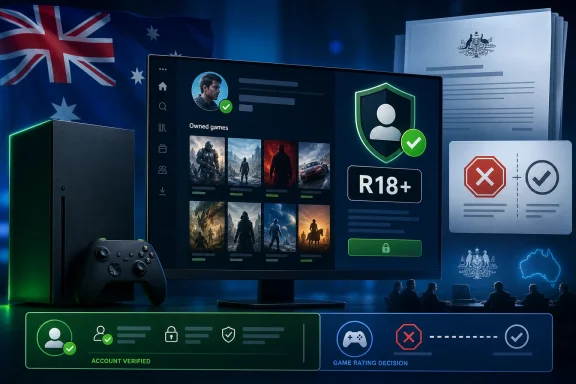 Microsoft’s gate applies to new access, not existing purchases
Microsoft’s customer email says adult accounts in Australia must verify their age to access apps and games rated 18+ on the Microsoft Store and Xbox Store. Crucially, it also says apps and games already owned will not be affected. That distinction means a player should not lose access to a digitally purchased R18+ title simply for declining verification, at least under the policy Microsoft has announced.
The phrase “access” still leaves an important operational gap. Microsoft has not publicly explained whether unverified accounts will be prevented only from new purchases and downloads, or whether access to subscription catalogue titles, free R18+ apps, DLC and cloud-streamed games will be handled differently. It also has not specified what happens when an already-owned game is removed and later needs to be re-downloaded, or when a player switches consoles and restores their library.
Those details are not academic. Xbox ownership is already account-based, and Windows Store licensing follows the same Microsoft identity. A policy that exempts existing purchases but blocks a fresh entitlement, re-download, or Game Pass installation can produce different results for two players using the same title in different ways.
Microsoft’s public help page says a successful check applies to both the Microsoft account and Xbox account. In other words, users will not need to prove their age separately on a Windows 11 PC and an Xbox Series X|S, but they also cannot treat this as a console-only setting. It is an identity status attached to the account.
The company lists three broad methods in its official documentation: selfie-based age estimation, a government ID upload, or an approved digital identity service. PC Gamer reports that the Australian flow also offers email-based verification and a credit-card option, with VerifyMy handling email verification and Yoti handling the selfie, card and ID routes. Microsoft’s general help page does not name its Australian providers or spell out the retention, deletion and appeal process for each method.
That omission is worth watching. A face-estimation result, an ID scan and a card verification do not present the same privacy, recovery or false-rejection risks. Microsoft tells users to choose from available options, but it has not published a country-specific explanation of which data each partner receives, how long it is retained, or what a legitimate adult should do if every offered method fails.
Australia’s September deadline explains the timing
The underlying requirement comes from Australia’s Age-Restricted Material Codes, administered by the eSafety Commissioner under the Online Safety Act framework. The codes began taking effect for app distribution platforms on March 9, 2026, with some obligations introduced in stages. The relevant age-check obligation for logged-in users seeking R18+ apps is due before September 9.
Microsoft’s late-August timing is therefore a compliance schedule, not evidence that the company has independently decided to make age verification a prerequisite for all mature Xbox gaming worldwide. Xbox introduced a different version of the system in the United Kingdom in 2025, initially for adult accounts and focused on preserving access to social features such as voice, text communication and invitations. Australia’s implementation is aimed at storefront access to adult-rated content.
The difference matters for users comparing headlines from the two countries. In the UK, Microsoft’s public policy described a pathway in which unverified adult accounts could continue to play games but faced limits on social features. In Australia, the stated consequence is much more transactional: an adult account may be unable to purchase or access an R18+ listing from the Microsoft or Xbox Store unless it completes age verification.
Microsoft is moving first among the major game storefronts, according to PC Gamer, which reported that Steam and PlayStation had not yet introduced an equivalent Australian R18+ verification flow. That may change before the September deadline. The legal obligation is directed at the service category, not uniquely at Xbox, and the eSafety Commissioner’s deadline leaves little room for major platforms to ignore it.
For Windows users, this also clarifies why the notice names both stores. The Microsoft Store is not being treated as a separate PC marketplace for this purpose. R18+ apps and games acquired through the Windows storefront are within the same account-wide age-assurance program.
The Halloween refusal is a different system — and the public record is incomplete
The simultaneous claim that Australia has “gone back to banning games” rests on a separate event involving Halloween: The Game, IllFonic’s upcoming multiplayer horror title. The developer said the Australian Classification Board denied the game a rating because of a controlled substance, rather than its violence, and said that meant physical and digital sales would not proceed in Australia and New Zealand.
But the available official record does not yet substantiate all of that claim. Australia’s classification database currently lists Halloween: Pre-Order Content, classified R18+ on July 2, 2026 through the IARC Global Rating Tool. Its consumer advice explicitly includes “High Impact Violence” and “High Impact Drug Use.” The public listing is for pre-order content, not necessarily the final game, but it demonstrates that an R18+ classification was already attached to related Halloween material.
At the time of publication, the database did not provide a corresponding public Refused Classification entry for the full game that could be independently compared with IllFonic’s statement. The developer’s announcement is evidence that it was told the release could not be sold as planned; it is not a substitute for the Classification Board’s decision, certificate, stated reasons, or any appeal record. Neither the Board nor IllFonic has publicly supplied those documents.
That gap matters because “denied a rating” can be imprecise shorthand. Australia’s formal term is Refused Classification, or RC. An RC game cannot be sold, hired, advertised or legally imported into Australia. A publisher can seek review of a classification decision, alter the title and resubmit it, or make a commercial decision not to offer a regional version. Those routes have produced very different outcomes for past games.
The alleged drug mechanic fits an old rule, not a new prohibition
If Halloween: The Game was refused classification because a controlled substance provides an in-game benefit, the outcome would track Australia’s long-standing games guidelines almost exactly. The current 2023 guidelines, in force since September 2024, say a game will be refused classification if it includes illicit or proscribed drug use connected to incentives or rewards, or detailed and realistic interactive drug use.
The rule applies even at R18+. Australia allows adult-rated games to contain drug use, including high-impact drug use in context, but it draws a bright line when the game rewards the player for taking an illicit or proscribed substance. That reward can be a new skill, an attribute boost, easier progression, points, equipment or another mechanical advantage.
The Classification Board’s earlier decisions show how strictly it interprets that test. In 2018, the Board initially refused We Happy Few because taking the fictional drug Joy could make progress easier by reducing hostile reactions from non-player characters. The Board said the ability to reduce gameplay difficulty constituted an incentive or reward. Its 2019 DayZ statement similarly said cannabis use tied to an advantage required an RC rating, while drug use without such a reward could have fit within R18+.
Reports and social-media discussion surrounding Halloween have alleged that cannabis use in the game helps players detect Michael Myers. That specific mechanic has not been confirmed in a Classification Board decision, so it should not be treated as established fact. If it is accurate, however, it would explain why a game featuring violence severe enough for R18+ could still fall outside the classification system: the prohibition concerns the interactive reward structure, not a general ban on depicting drugs or violence.
Calling this a return to game bans also overstates the policy change. The relevant restriction was in the previous guidelines and remains in the 2023 rules. Australia has not announced a new ban standard in response to Halloween; the question is whether the Board applied an existing standard to the final game, and the public paperwork needed to answer that is still missing.
Two forms of control, with different consequences
The Xbox verification requirement and the Halloween dispute point in the same direction for adult players — more friction before accessing particular content — but they operate at entirely different layers.
Microsoft’s measure is an account-level age assurance system designed to ensure a store can identify an adult buyer before supplying an R18+ listing. It leaves the classification itself intact and, by Microsoft’s account, preserves already-owned content. The Classification Board’s RC process determines whether a title can be lawfully sold in the first place. An age check cannot unlock a game that has been refused classification.
Australian Xbox users should therefore separate immediate action from speculation. Anyone expecting to buy R18+ games from the Microsoft or Xbox Store after late August should review Microsoft’s verification choices before the September 9 regulatory deadline. Owners of existing R18+ games do not need to rush to verify merely to keep playing them under Microsoft’s stated policy.
For Halloween: The Game, the next meaningful development is not another age-verification notice. It is a published Classification Board record, a review application, or a revised Australian build from IllFonic. Until one of those appears, the clearest verified fact is that Microsoft is preparing a store gate for adult content — while the evidence for a final Australian ban of the full Halloween game remains incomplete.