
Microsoft announced on Xbox Wire on August 26 that Xbox Insiders can begin testing the feature on August 31. Insert a supported disc into an Xbox One or Xbox Series X, launch the game, and the account can receive a digital entitlement. That can unlock Xbox Play Anywhere and Xbox Cloud Gaming where supported, while Microsoft says the disc itself continues to work as before.
Windows Central framed the announcement against Sony’s stated January 2028 end date for physical-disc production for newly released PlayStation games. The immediate contrast is real: Sony has set a deadline, while Xbox has launched a program that gives eligible physical purchases a path into a digital library. But the Xbox announcement carefully promises library portability, not continued disc hardware.
That distinction is the whole story.
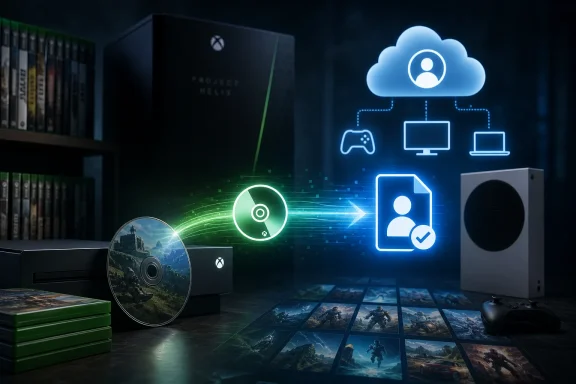 Microsoft’s announcement says “thousands,” not 1,000
One detail in the reporting deserves correction. In comments attributed by Windows Central to Xbox CEO Asha Sharma, the rollout was described as covering 1,000 disc-based titles. Microsoft’s formal announcement uses different language: it says most Xbox One and Xbox Series X disc-based games support the feature and that the company is “starting with thousands of titles.”
That is more expansive than a fixed 1,000-game opening list, but it is also less precise. Microsoft has not published a public compatibility database, named the exceptions, or explained whether support is determined by publisher participation, the specific disc release, licensing rights, regional editions, discontinued games, or technical requirements embedded in newer discs.
For a feature being sold partly as preservation, that missing list matters. A player deciding whether to retain a physical copy of a delisted title needs to know whether that title can receive a digital entitlement before assuming the disc has gained an escape route from aging hardware.
Tom’s Hardware independently confirmed the same core mechanics reported by Xbox Wire: compatible Xbox One and Series X discs can be used to claim an entitlement, and the feature begins with Xbox Insiders on August 31 rather than arriving immediately for every Xbox owner. The publication also noted that not every title will be supported at launch.
Microsoft’s use of “most” is encouraging, but it is not the same as a commitment to every disc a customer owns.
A digital entitlement is access, not preservation by itself
The program solves a practical problem that has become more visible as Xbox expands across Windows PCs, handhelds, cloud streaming, and consoles without disc drives. A supported Play Anywhere game bought on disc can potentially become available on a Windows PC without the player needing to buy the digital version again. On a Series S or a future digital-only device, that changes a boxed purchase from something tied to one physical machine into something usable across the account’s supported devices.
For ordinary use, that is a substantial improvement. It means the person who bought a disc can retain convenience after moving to hardware that has no place to insert one.
But it also changes what the customer is relying on. The disc remains a durable object that can be loaned, resold, or installed on compatible hardware. The new entitlement is bound to Microsoft’s account and delivery systems. Cloud access depends on a title being cloud-enabled and available in the player’s region; Play Anywhere depends on the particular game participating in that program. Neither benefit applies universally just because a game disc is supported.
Microsoft’s own wording acknowledges this boundary with “where supported.” The company has not promised that every disc-to-digital title will work through Cloud Gaming, appear on Windows through Play Anywhere, or remain downloadable indefinitely. Nor has it said what happens for games whose digital store listings have been removed, whose music or other licensed content has expired, or whose publisher no longer operates.
That does not make the feature hollow. It makes it a license-portability program, not a complete preservation program. Preservation requires access to the game, the hardware or compatible software needed to run it, and a workable way to install it after storefronts, servers, or account systems change. Microsoft has improved one of those pieces.
Project Helix remains silent on the drive
Microsoft has been unusually public about some elements of its next-generation system, code-named Project Helix. At the Game Developers Conference in March, Xbox said Helix is designed to play Xbox console and PC games, is being developed with AMD, and will receive alpha hardware in developers’ hands during 2027. Xbox has also made backward compatibility a central part of the pitch.
What Microsoft has not disclosed in any of those official Helix announcements is whether the machine includes an optical drive, supports an optional drive, accepts current Xbox discs, or has any physical-media strategy for newly released games.
The omission is conspicuous because the disc-to-digital rollout itself requires a disc-capable Xbox One or Series X to claim the entitlement. A Series S owner with a shelf of Xbox discs cannot simply attach a generic USB Blu-ray drive to turn that collection into digital licenses; Microsoft’s instructions specify Xbox One or Xbox Series X hardware. PC owners are in the same position. An external drive may read an optical disc, but it is not part of the announced redemption path.
That makes the program useful today while leaving an awkward transition problem for the next hardware cycle. If Helix ships without a disc drive, owners of physical games will need to claim eligible entitlements before retiring their existing disc-capable console. If a disc is unsupported, the original hardware remains the route to playing it.
The company may ultimately offer a removable drive, a separate reader, a broader import tool, or a disc-equipped Helix model. There is no evidence for any of those plans in Microsoft’s public materials as of August 27. It would be premature to call Helix all-digital; it would be equally wrong to interpret the disc-to-digital announcement as a promise that Xbox discs will have a place in the next console.
Sony’s 2028 deadline sharpens Xbox’s advantage—for now
Sony’s July 1 PlayStation Blog announcement said physical disc production for all new games released on PlayStation consoles would be discontinued beginning in January 2028. Sony said games already released, or released before that date, in disc form would not be affected by the transition.
That gives Xbox an opening to claim a more consumer-friendly position without making a permanent hardware commitment. The disc-to-digital initiative tells owners of recent Xbox physical games that their purchases can follow them into Xbox’s wider account-based platform. Sony’s announcement, by contrast, tells buyers of future PlayStation games that new releases will be digital-only after the deadline.
Still, Microsoft should not confuse a superior transition mechanism with a full answer to ownership concerns. Digital licenses can be convenient and cross-device, but they are not interchangeable with a disc on a shelf. The ability to lend a game, sell it, use it offline, or preserve a playable copy outside a platform holder’s account infrastructure comes from the physical format and the hardware that reads it.
Windows Central’s report adds one more unresolved issue. Sharma reportedly told BBC technology reporter Laura Cress that Xbox must think about “efficiency and affordability alongside performance” for the next generation. That is a reasonable concern as console component costs rise, but it also describes the commercial pressure that can push optical drives out of mainstream hardware configurations. A drive adds parts, assembly complexity, physical space, and cost to a device whose software strategy is increasingly built around downloads and cloud access.
Microsoft has not said that such cost pressure is why it has avoided discussing Helix’s disc plans. The explanation in Windows Central’s report about optical-drive supply chains came from the outlet’s unnamed hardware sources and has not been independently documented by Microsoft or another primary manufacturer. It should be treated as reporting, not established company policy.
What Xbox owners should do before changing hardware
Owners of eligible Xbox One and Series X discs should treat the Insider rollout as a library-management task rather than proof that every physical game is now future-proof.
- Keep a disc-capable Xbox One or Xbox Series X available until Microsoft publishes clear compatibility information and the entitlement has been successfully claimed for the games that matter to you.
- Verify whether a claimed title actually supports Xbox Play Anywhere or Xbox Cloud Gaming before assuming it will appear on a Windows PC, handheld, or cloud device.
- Do not discard, trade, or sell a disc solely because a digital entitlement appears in the account. Microsoft has said the physical disc will continue functioning, while its public announcement does not yet spell out every ownership-transfer and resale scenario.
- Watch for Microsoft’s promised expansion list, especially for titles that are delisted, backward-compatible, region-specific, or dependent on publisher licenses.
The immediate payoff is straightforward: supported physical Xbox games are becoming easier to use on a digital-first Xbox platform. The unresolved consequence is equally straightforward: the only currently announced method still begins with a console that has a disc drive. Until Microsoft states what Project Helix will read, Xbox’s new bridge to digital remains a bridge built from the current generation’s hardware.