
Windows Central’s account of an Xbox Series S being parked for the summer captures a real problem for UK players: a game console becomes one more heat source in a house already struggling to shed the day’s heat. But the piece overstates the console’s role. A Series X can add meaningful warmth to a closed room during a heatwave, while the Series S is a substantially smaller load; neither is the underlying reason a home becomes intolerable at night.
The larger story is that British homes, workplaces and schools are being asked to handle temperatures they were not designed around. The UK government’s Warm Homes Plan says summer 2025 was the country’s hottest on record, following the first UK temperatures above 40°C in 2022, and acknowledges that buildings are at significant risk of overheating. The Climate Change Committee has gone further, warning that a warmer UK will require active cooling in a growing share of homes.
For Xbox owners, that turns a familiar annoyance—hot exhaust at the back of a console—into a practical question: does changing hardware, switching to a handheld, or using cloud streaming actually make a room cooler?
The answer is yes, but the scale is important. The Series X is a room heater in thermodynamic terms; the Series S is a much smaller one. Neither diagnosis makes the console defective.
Windows Central says the Xbox Series X draws roughly 160 to 200 watts under demanding workloads, and that range is well supported by early independent testing. Tom’s Hardware measured 169.2W in Forza Horizon 4 and peaks around 192W in Gears 5 on launch-era Series X hardware.
Microsoft now publishes its own platform-power baselines for developers, based on more than 100 Xbox test scenarios. Those figures put average Series X active gameplay at approximately 154W. They also reveal the detail missing from the summer-gaming complaint: average active Series S gameplay is listed at about 74W, or less than half the Series X result.
That is not a minor distinction when the complaint is heat rather than graphics performance. A Series X running for three hours at Microsoft’s 154W gameplay baseline uses about 0.46 kWh of electricity. A Series S at 74W uses about 0.22 kWh over the same period. The Series X therefore puts roughly an additional 0.24 kWh of energy into the room across that session.
Almost all of that energy does become heat in the home. The console is not making heat out of nowhere; it is turning electrical energy into computation, light, sound, fan movement and, eventually, heat. The bright exhaust plume is simply the cooling system moving that heat from the hardware into room air quickly enough to protect the components.
Yet the Series S cannot credibly be described as having the same practical room-heating effect as the Series X. Its heat output is closer to a modest always-on appliance than a 150W-plus console. It may feel hot at the vent because its cooling system concentrates a smaller amount of heat into a narrow stream, but the total energy is what changes the room temperature.
Windows Central’s “about half as powerful” framing is therefore beside the point. In a heatwave, its lower power use is the material advantage. A player who already owns a Series S has made a more consequential heat-saving choice than the article implies, especially if the alternative is a high-end console, gaming PC, television and several people occupying the same small room.
Still, a 154W Series X is not remotely comparable to a portable air conditioner’s electrical demand or cooling capacity. National Energy Action estimates a typical portable AC unit consumes roughly 1,000W to 1,500W. The critical difference is that an air conditioner transfers heat outdoors through its hose; a console merely redistributes heat indoors.
The Energy Saving Trust’s heat guidance points toward the interventions that matter more than moving from a Series X to a handheld: keep direct sun out with blinds or curtains, close windows while outdoor air is hotter than indoors, and use cross-ventilation when outdoor temperatures fall. The UK government similarly advises opening windows at night, where it is safe to do so, to move cooler air through the building.
This is the uncomfortable practical reality for heat-struck players: reducing a console’s load can improve an already bad room, but it does not solve the problem if solar gain, warm masonry, inadequate shading and poor nighttime ventilation have turned the building itself into a thermal store. Turning off a Series X removes a small electric radiator. It does not remove the heat already trapped in the walls, roof and furnishings.
That also means buying Microsoft’s revised 2024 Series X models is not a sensible heatwave strategy on its own. Independent teardown reporting found the newer all-digital and 2TB Series X variants use a smaller 6nm processor and can use around 10W less power in some cases. That reduction is real, but it is modest: it saves about 0.03 kWh over a three-hour session. It is a welcome efficiency improvement, not air conditioning.
There is a trade-off that deserves more attention than it receives in the Windows Central piece. Much of the heat avoided by choosing a handheld is not merely the console’s heat: it is also the display’s heat and the reduction in rendering work made possible by a smaller screen, lower frame rate, lower resolution or reduced graphics settings.
For players using an Xbox Series X or Series S, the most immediate low-cost option is often not abandoning the console but using the settings already available. Choosing a 30 fps quality mode can reduce load in some games, although it is not guaranteed; modern titles often use extra graphical headroom aggressively. A 60 fps performance mode, ray tracing setting, uncapped menu frame rate or a power-hungry display can all change the total heat delivered to the room.
Microsoft’s developer data makes one point clear: the Xbox is not drawing a fixed amount of power merely because it is switched on. Its Series X figures range from roughly 105W while loading to 154W in active gameplay, while the Series S moves from about 60W to 74W. The game, scene, frame-rate mode and display configuration matter.
Players who want an answer for their own setup should use a plug-in power meter rather than rely on vent temperature or marketing specifications. It will capture the combined draw from the console and, if connected to the same strip, the television, speakers and accessories that may be doing more to warm the room than expected.
Microsoft has publicly promoted its newer AI data-center design as using closed-loop, direct-to-chip liquid cooling with zero water evaporation during operation. In a June post, the company said its average water-use effectiveness had fallen from 2.3 litres per kWh in its early data centers to 0.27 litres per kWh in 2025, and that 90% of its owned fleet uses low- or zero-water cooling systems.
Those claims are meaningful specifically on water consumption, but they do not establish that cloud streaming is lower-carbon than local gameplay in every case. Closed-loop cooling removes evaporative water loss; it does not eliminate the electricity required for servers, storage, networking and mechanical cooling. Microsoft has not published a consumer-facing, per-hour energy or emissions figure for an Xbox Cloud Gaming session that would let players compare cloud rendering with a Series X in their own home.
The environmental case is also different from the immediate comfort case. Streaming a game can make a bedroom cooler because it removes a local 70W-to-150W-plus rendering load. That is a direct, personal benefit. Whether it reduces total energy use depends on server utilization, the data center’s power source, the game, video encoding, network delivery and what local hardware it replaces. Players should not confuse “my room is cooler” with “less energy was used overall.”
That is why the most useful summer-gaming upgrade may be boring building work rather than a newer console: external shading, better window treatments, secure nighttime ventilation, insulation installed with overheating risk in mind, or a reversible heat pump that can provide both heating and cooling. Those measures address the whole room, rather than transferring a few dozen watts from one device category to another.
For now, the practical hierarchy is straightforward. Keep sun out before it enters, ventilate when outdoor conditions allow, measure the complete entertainment setup instead of blaming the hottest vent, and use lower-power hardware or settings when comfort is the priority. A Series X can make a bad heatwave room worse. It is not the reason Britain’s homes are increasingly failing at summer.
For Xbox owners, that turns a familiar annoyance—hot exhaust at the back of a console—into a practical question: does changing hardware, switching to a handheld, or using cloud streaming actually make a room cooler?
The answer is yes, but the scale is important. The Series X is a room heater in thermodynamic terms; the Series S is a much smaller one. Neither diagnosis makes the console defective.
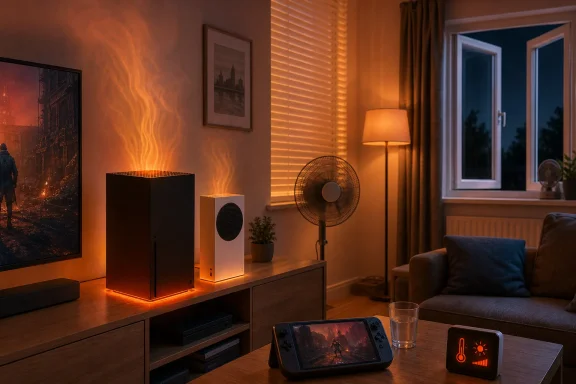 Microsoft’s own figures undercut the Series S comparison
Windows Central says the Xbox Series X draws roughly 160 to 200 watts under demanding workloads, and that range is well supported by early independent testing. Tom’s Hardware measured 169.2W in Forza Horizon 4 and peaks around 192W in Gears 5 on launch-era Series X hardware.Microsoft now publishes its own platform-power baselines for developers, based on more than 100 Xbox test scenarios. Those figures put average Series X active gameplay at approximately 154W. They also reveal the detail missing from the summer-gaming complaint: average active Series S gameplay is listed at about 74W, or less than half the Series X result.
That is not a minor distinction when the complaint is heat rather than graphics performance. A Series X running for three hours at Microsoft’s 154W gameplay baseline uses about 0.46 kWh of electricity. A Series S at 74W uses about 0.22 kWh over the same period. The Series X therefore puts roughly an additional 0.24 kWh of energy into the room across that session.
Almost all of that energy does become heat in the home. The console is not making heat out of nowhere; it is turning electrical energy into computation, light, sound, fan movement and, eventually, heat. The bright exhaust plume is simply the cooling system moving that heat from the hardware into room air quickly enough to protect the components.
Yet the Series S cannot credibly be described as having the same practical room-heating effect as the Series X. Its heat output is closer to a modest always-on appliance than a 150W-plus console. It may feel hot at the vent because its cooling system concentrates a smaller amount of heat into a narrow stream, but the total energy is what changes the room temperature.
Windows Central’s “about half as powerful” framing is therefore beside the point. In a heatwave, its lower power use is the material advantage. A player who already owns a Series S has made a more consequential heat-saving choice than the article implies, especially if the alternative is a high-end console, gaming PC, television and several people occupying the same small room.
A console adds heat, but it does not explain an overheated house
The author’s experience is believable: several people playing Palworld around consoles and displays will make a room less comfortable. Human bodies are heat sources, TVs consume power, routers and chargers are continuously on, and a console pushes warm air into the living space. In a sun-facing, poorly ventilated room that has absorbed heat through the day, every extra watt makes relief harder.Still, a 154W Series X is not remotely comparable to a portable air conditioner’s electrical demand or cooling capacity. National Energy Action estimates a typical portable AC unit consumes roughly 1,000W to 1,500W. The critical difference is that an air conditioner transfers heat outdoors through its hose; a console merely redistributes heat indoors.
The Energy Saving Trust’s heat guidance points toward the interventions that matter more than moving from a Series X to a handheld: keep direct sun out with blinds or curtains, close windows while outdoor air is hotter than indoors, and use cross-ventilation when outdoor temperatures fall. The UK government similarly advises opening windows at night, where it is safe to do so, to move cooler air through the building.
This is the uncomfortable practical reality for heat-struck players: reducing a console’s load can improve an already bad room, but it does not solve the problem if solar gain, warm masonry, inadequate shading and poor nighttime ventilation have turned the building itself into a thermal store. Turning off a Series X removes a small electric radiator. It does not remove the heat already trapped in the walls, roof and furnishings.
That also means buying Microsoft’s revised 2024 Series X models is not a sensible heatwave strategy on its own. Independent teardown reporting found the newer all-digital and 2TB Series X variants use a smaller 6nm processor and can use around 10W less power in some cases. That reduction is real, but it is modest: it saves about 0.03 kWh over a three-hour session. It is a welcome efficiency improvement, not air conditioning.
Handheld gaming changes the calculation, not the climate
The ROG Ally X is a plausible escape hatch precisely because handhelds can be configured around lower power targets. Reducing a handheld’s thermal design power, or TDP, cuts battery draw and heat output, while the device’s small screen removes the need to run a large television. In a close, stuffy bedroom, replacing a console-and-TV arrangement with a handheld can be noticeable.There is a trade-off that deserves more attention than it receives in the Windows Central piece. Much of the heat avoided by choosing a handheld is not merely the console’s heat: it is also the display’s heat and the reduction in rendering work made possible by a smaller screen, lower frame rate, lower resolution or reduced graphics settings.
For players using an Xbox Series X or Series S, the most immediate low-cost option is often not abandoning the console but using the settings already available. Choosing a 30 fps quality mode can reduce load in some games, although it is not guaranteed; modern titles often use extra graphical headroom aggressively. A 60 fps performance mode, ray tracing setting, uncapped menu frame rate or a power-hungry display can all change the total heat delivered to the room.
Microsoft’s developer data makes one point clear: the Xbox is not drawing a fixed amount of power merely because it is switched on. Its Series X figures range from roughly 105W while loading to 154W in active gameplay, while the Series S moves from about 60W to 74W. The game, scene, frame-rate mode and display configuration matter.
Players who want an answer for their own setup should use a plug-in power meter rather than rely on vent temperature or marketing specifications. It will capture the combined draw from the console and, if connected to the same strip, the television, speakers and accessories that may be doing more to warm the room than expected.
Cloud gaming shifts the heat, but it is not a free environmental pass
Windows Central is right to reject the idea that cloud gaming eliminates the heat and environmental cost of rendering demanding games. It moves most of the computational load from a player’s room to Microsoft’s infrastructure, while leaving the display, networking gear and local device active at home.Microsoft has publicly promoted its newer AI data-center design as using closed-loop, direct-to-chip liquid cooling with zero water evaporation during operation. In a June post, the company said its average water-use effectiveness had fallen from 2.3 litres per kWh in its early data centers to 0.27 litres per kWh in 2025, and that 90% of its owned fleet uses low- or zero-water cooling systems.
Those claims are meaningful specifically on water consumption, but they do not establish that cloud streaming is lower-carbon than local gameplay in every case. Closed-loop cooling removes evaporative water loss; it does not eliminate the electricity required for servers, storage, networking and mechanical cooling. Microsoft has not published a consumer-facing, per-hour energy or emissions figure for an Xbox Cloud Gaming session that would let players compare cloud rendering with a Series X in their own home.
The environmental case is also different from the immediate comfort case. Streaming a game can make a bedroom cooler because it removes a local 70W-to-150W-plus rendering load. That is a direct, personal benefit. Whether it reduces total energy use depends on server utilization, the data center’s power source, the game, video encoding, network delivery and what local hardware it replaces. Players should not confuse “my room is cooler” with “less energy was used overall.”
UK cooling policy has become part of the gaming hardware problem
The deeper failure here belongs neither to Microsoft nor to a single Xbox model. It is the mismatch between a housing stock built around retaining winter warmth and summers that are becoming more severe. The Climate Change Committee says that, at 2°C of global warming, around 22% of UK homes could require active cooling to manage overheating. It also says passive measures such as external shading can reduce overheating in up to 80% of dwellings.That is why the most useful summer-gaming upgrade may be boring building work rather than a newer console: external shading, better window treatments, secure nighttime ventilation, insulation installed with overheating risk in mind, or a reversible heat pump that can provide both heating and cooling. Those measures address the whole room, rather than transferring a few dozen watts from one device category to another.
For now, the practical hierarchy is straightforward. Keep sun out before it enters, ventilate when outdoor conditions allow, measure the complete entertainment setup instead of blaming the hottest vent, and use lower-power hardware or settings when comfort is the priority. A Series X can make a bad heatwave room worse. It is not the reason Britain’s homes are increasingly failing at summer.
References
- Primary source: Windows Central
Published: 2026-08-02T13:06:10+00:00
Climate change is forcing my Xbox console into summer hibernation | Windows Central
Rising temperatures in the UK are making gaming unbearable, but what is the answer?www.windowscentral.com - Related coverage: gov.uk
- Related coverage: learn.microsoft.com
Gaming Sustainability Lab Platform Baselines - Microsoft Game Dev | Microsoft Learn
Data insights into the power consumption averages relative to each in-game area for sustainabilitylearn.microsoft.com - Related coverage: techradar.com
9 tips to get more from your fan or air conditioner — air quality experts on how to keep your whole home cool without spiking your energy bill | TechRadar
Top advice from professionals at Dreo, Meaco, and Dimplexwww.techradar.com - Related coverage: energysavingtrust.org.uk
How to keep your home cool in hot weather - Energy Saving Trust
Our energy experts share their top tips on keeping yourself and your home cool during a heatwave without spending a lot.energysavingtrust.org.uk - Related coverage: energy.gov