
TechPowerUp first highlighted the project on August 10, pointing to work by developers associated with the Heroic Games Launcher community. The project’s own GitHub repository confirms the authentication and download milestone, but its documentation is clearer about the present state: the missing piece is the Windows-side Xbox Gaming Runtime behavior that actual games expect when they start.
That makes Xodus a serious technical effort, not a new way for Steam Deck, Linux desktop, or macOS users to install Forza Horizon 6 or the current PC Game Pass catalog today. For now, it is developer-oriented software with no packaged release and a command-line toolchain intended to test login, package retrieval, licensing, extraction, and decryption work.
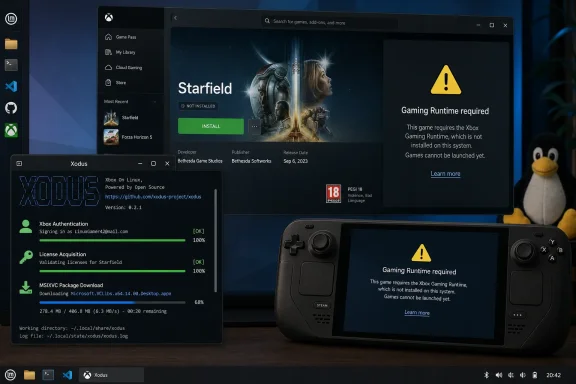 Xodus Is Rebuilding the Part Proton Does Not Cover
Linux gaming has already benefited enormously from Valve’s Proton, the Wine-based compatibility layer used by Steam. Proton translates or implements enough Windows behavior for a large share of ordinary Windows games to run on Linux, and Heroic already uses Wine, Proton, and related tools to manage Epic Games Store, GOG, and Amazon Games libraries.
Xbox PC games are a different category. Microsoft’s own Game Development Kit documentation describes the Gaming Runtime as the set of services behind MSIXVC packaging, installation management, connected saves, commerce, standard game UI, invites, accessibility features, and other Xbox services. A Game Development Kit title can require
xgameruntime.dll, which communicates with separate Gaming Runtime Services installed by Microsoft on Windows.
Xodus is trying to substitute that missing layer. Its organization currently contains a Rust-based core client for authentication, token exchange, downloads, and license acquisition; a clean-room documentation project for
xgameruntime.dll; and a separate open-source implementation of that DLL designed to run under Wine. The group has also forked Valve’s Wine and Proton projects to carry its integration patches.
In practical terms, Xodus is not merely making an installer recognize a Game Pass subscription. It has to reproduce enough of Microsoft’s platform plumbing for a Windows game to believe it is running in a supported Xbox PC environment while Proton handles the usual Windows-to-Linux compatibility work underneath. That includes a potential chain of account login, entitlement verification, encrypted package handling, runtime initialization, cloud-save integration, Xbox network features, and game-specific API calls.
The project’s public code shows why that remains a substantial task. Its current command-line interface can download MSIXVC or XSP game files, obtain license material, extract locally stored packages, log in, and perform several package and license operations. Those capabilities are meaningful progress, but they sit before the moment most players care about: pressing Play and getting a stable game session with saves, achievements, multiplayer, DLC, and updates working.
The Project’s Own Readme Is More Cautious Than the Headlines
The most consequential finding in the primary record is simple: Xodus’s repository does not claim working Game Pass gameplay. It says the project can now log in, download packages, and obtain licenses, then says there is still substantial Wine work required to provide the Xbox services games need.
Its FAQ offers a deliberately vague “soon” when asked when games can be played. That is not a release target, a beta commitment, or a compatibility promise. As of August 10, the GitHub repository shows source code, open issues, pull requests, and build instructions; it does not list a player-ready release.
The project also names its immediate compatibility boundary. It aims primarily at Xbox PC games built with Microsoft’s Game Development Kit and distributed in MSIXVC format. Older Universal Windows Platform releases are outside the central target, and the developers already identify Gears of War 4 as a prominent unsupported title.
That qualification matters more than it may first appear. “PC Game Pass” is a subscription catalog, not one uniform technical platform. A title’s presence in the Xbox app does not guarantee that Xodus will support it, and even a game that fits the intended GDK and MSIXVC model may depend on runtime services Xodus has not implemented yet. The prospect of downloading a game should not be confused with a commitment that the game will boot—or that its online features will survive contact with a reverse-engineered Xbox stack.
Microsoft’s public Xbox PC app page still specifies Windows 10 or Windows 11, version 22H2 or later, as the supported operating systems for its official PC client. Xodus explicitly says it is unaffiliated with and not endorsed by Microsoft. There is no sign of an official Linux or macOS Game Pass download client in Microsoft’s current PC Game Pass materials.
Why the Download Milestone Still Matters
The authentication and licensing work is the part that makes Xodus more than another launcher concept. Game Pass access depends on account and entitlement checks, while Microsoft Store-delivered GDK games use packaging and licensing mechanisms that conventional Linux launchers were never designed to handle.
Xodus says it can acquire licenses and download the relevant packages. Its code also includes work around MSIXVC containers—the format Microsoft uses for modern Xbox and Microsoft Store game distribution. That moves the project beyond the long-standing Linux workaround of Xbox Cloud Gaming, where the game runs in Microsoft’s datacenter and the Linux machine receives a video stream through a browser.
Cloud Gaming remains the practical Game Pass route for Linux users today, provided a title and region support it. Local execution would remove the dependency on low-latency broadband, streaming image quality, data use, and cloud-library availability. It could also allow handheld PCs running SteamOS or another Linux distribution to use their hardware locally rather than treating a Game Pass subscription as a streaming-only service.
But local execution introduces a more demanding support burden. With cloud gaming, Microsoft owns the server environment and can update it centrally. With Xodus, every change in Microsoft’s authentication flow, package format, licensing service, Game Runtime, or a game’s Xbox SDK implementation could create a new compatibility failure. The project’s own warning to use it at one’s own risk is not boilerplate in this context; it reflects a dependency on behaviors Microsoft did not design for Linux.
Steam Deck Support Is a Goal, Not a Feature
For Steam Deck owners, Xodus is compelling because Game Pass remains one of the clearest reasons to keep Windows installed alongside SteamOS. Steam’s Proton compatibility reports do not solve the Xbox app and Gaming Services dependency that accompanies many Microsoft Store and PC Game Pass releases.
The project may eventually be able to fit into familiar Linux workflows. Its stated plans include broader launcher integration, which could bring it into tools such as Heroic, Lutris, Bottles, or even Steam as a non-Steam shortcut. None of that is operational support today.
Heroic’s existing project demonstrates why the association has attracted attention. Heroic is established software with support for Linux, Windows, and macOS, and it already manages non-Steam game libraries while integrating compatibility tools. Its public credits also include software maintained by imLinguin, one of the developers publicly discussing Xodus. That experience lends the project credibility as an engineering effort, but it does not turn Xodus into an official Heroic feature or a supported Game Pass client.
The macOS claim deserves particular restraint as well. Xodus says it aims to support Mac systems, but the visible work is heavily centered on Wine and Proton—technology most directly associated with Linux. Heroic’s existing macOS guidance uses CrossOver and Apple’s Game Porting Toolkit ecosystem rather than Proton. Until Xodus publishes a working macOS path and compatibility results, Linux is the more concrete near-term target.
The First Useful Test Will Be a Game, Not a Login Screen
Xodus has crossed a real technical threshold: it can authenticate, retrieve entitlements, and fetch Xbox PC game packages outside Windows. The next threshold is much harder and much more meaningful—booting a modern GDK title under its custom Gaming Runtime implementation, then proving that saves, updates, offline access, and multiplayer work reliably enough for ordinary players.
For now, Linux and Steam Deck users should treat Xodus as a project to watch rather than software to deploy. It has no consumer release, no published compatibility list, no evidence yet of a Game Pass game running end to end, and no Microsoft backing. The concrete payoff will arrive only when its first supported game launches locally on Linux without requiring Windows, the Xbox app, or a cloud stream.